
Is a Blue Needle Quartz Bracelet Worth It? How to Choose
Is a blue needle quartz bracelet worth it? Use disclosure, colour readability, quartz condition, drilling, bead matching and price to decide whether a strand suits you.
In this field note
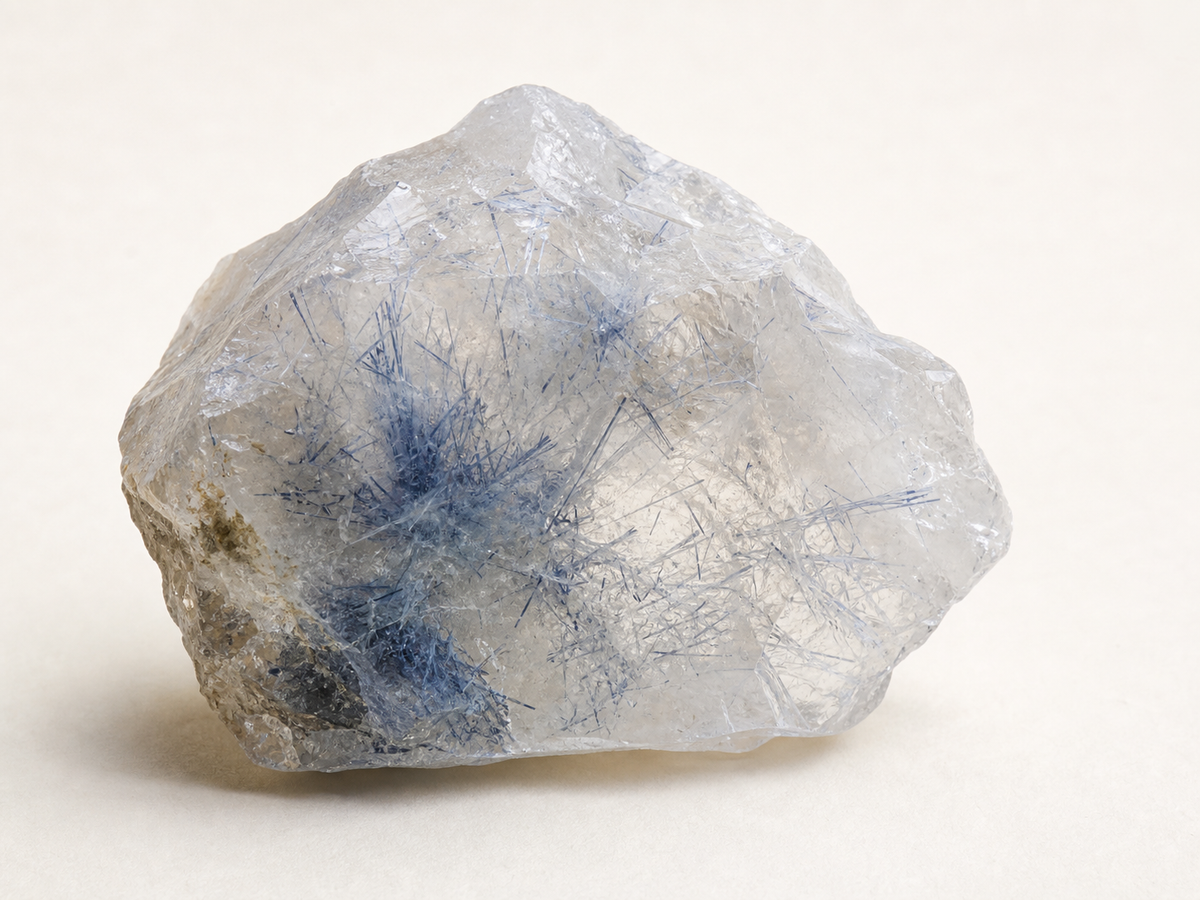
If you have looked at a blue needle quartz bracelet and hesitated at the price, ask four things: what evidence identifies the blue inclusion, was any treatment disclosed, is the quartz and drilling sound, and does the lot justify the price? This page owns that decision. For identification evidence and mineralogy, see the blue needle quartz guide.
Best for / not for
- Worth it if you like the specimen’s restrained blue, receive clear material and treatment disclosure, and accept quartz-level care for daily wear.
- Maybe not if you want a bold, saturated "electric" blue every time — natural blue needle is subtler and varies bead to bead.
- Check first: colour in surface-reaching cracks is a dye warning, but colour through the body is not proof of natural dumortierite; ask what evidence supports the label.
BE. does not currently stock blue needle quartz. The strand below is blue smoky quartz, a different stone coloured by scattering rather than by dumortierite fibres — the two are compared in the blue smoky quartz guide.
The four checks, in order
Each check answers a different question, and the order matters: an unidentified inclusion makes every later check moot.
| Check | What you are asking | What a good answer looks like | What does not count |
|---|---|---|---|
| 1. Inclusion identity | What evidence identifies the blue as dumortierite? | A stated test method, or an honest "identified by appearance only". | The trade name. "Blue needle quartz" is a label, not a result. |
| 2. Treatment status | Has dye, coating or filling been disclosed? | A written statement covering the specific lot. | Silence. No disclosure is not the same as no treatment. |
| 3. Host condition | Is the quartz and the drilling sound? | Clean drill holes, no chipping at the bead ends, no fracture reaching the surface under a loupe. | A photograph taken at a flattering angle. |
| 4. Price basis | What is the price actually paying for? | Matching, colour readability, cut and documented provenance. | Price itself. A higher number proves nothing about identity or rarity. |
Why it costs more than ordinary quartz
Price is lot- and seller-specific. Inclusion evidence, treatment disclosure, host condition, colour readability, bead matching, cut, provenance and supply can all contribute. A high price is not proof of dumortierite, natural colour or geological rarity.
What the money is actually buying
Two strands can carry the same trade name and differ by a factor of several in price. The difference is often not the mineral but the work that went into selecting and finishing it.
Matching. A strand where every bead carries a similar density of blue fibre has been picked from a much larger parcel. That selection cost is real, and it is one of the main things a higher price can legitimately be paying for.
Colour you can read. Blue needle quartz is not an intense stone. A strand where the blue reads clearly in ordinary daylight, rather than only under a shop spotlight, is the harder thing to find.
Finish. Drill holes without chipping, an even polish, and beads that sit flat against the wrist. These are workshop costs, not material costs, and they are what you feel every day you wear it.
Documentation. A seller who states what was tested and what was only observed is carrying a cost that a seller who states nothing avoids. That cost is worth paying for.
When to walk away
Three situations where the answer is no, regardless of price.
- The seller will not say how the inclusion was identified. An honest "by appearance" is a workable answer. No answer is not.
- Colour pools in surface-reaching cracks. That pattern is the classic dye indicator. It does not prove dye on its own, but it moves the burden of proof onto the seller.
- The price is justified by rarity alone. Rarity claims about included quartz are rarely supported by anything checkable. If rarity is the whole argument, there is no argument.
How to choose one
Three checks, no equipment needed.
- Disclosure first. Check for treatment and material evidence. Colour pooled in surface-reaching cracks is a warning sign, not the only possible treatment clue.
- Blue you can actually see. In daylight against white, the blue should read without effort.
- A host you can see into. The best strands show both blue needles and clear quartz in the same bead, which gives the stone its depth.
Who it's for
Blue needle quartz suits someone who prefers a quiet, uncommon blue over a loud one and values natural-looking variation. The exposed quartz surface is approximately Mohs 7, but drilling, fractures and finish still determine how confidently a bracelet can be worn.
How BE. grades it
BE. does not currently stock blue needle quartz. If a future lot is assessed, Crystal 4T™ would separate Transparency, Tone, Texture and Treasure, while a Stone Origin Record would state only the inclusion, treatment and origin evidence actually supported for that lot.
Four steps before you buy
- Ask what identified the blue. Send one message: "How was the inclusion identified?"
- Ask what treatment was disclosed for this lot. Not for the material in general — for the strand you are being sold.
- Look at the beads in daylight, against white. Check that the blue reads without effort and that the drill holes are clean.
- Decide what the price is buying. If the answer is matching, readability, finish and documentation, the price can be fair. If the answer is rarity, ask the first question again.
If you would rather start with a stone BE. does document end to end, THE VOID holds the blue smoky quartz strand above, and the Crystal 4T™ grading page explains what a Stone Origin Record records, and what Crystal 4T™ is and is not.
Frequently asked questions
Q1.Is a blue needle quartz bracelet worth it?
It can be, when you like the restrained blue, receive responsible material and treatment disclosure, the quartz and drilling are sound, and the price fits your priorities. The trade name alone does not prove dumortierite or rarity.
Q2.Is the blue natural or dyed?
Colour concentrated in surface-reaching cracks is a dye warning. Colour through the body is only a screening observation; treatment and inclusion identity may require gemmological evidence.
Q3.How do I choose a good one?
Start with disclosure, then inspect colour readability, host condition, drilling, polish and bead matching. Do not use price or colour alone as proof of identity or rarity.
Q4.Can I wear it every day?
Yes, with ordinary quartz-level care. The exposed surface is approximately Mohs 7, but fractures and drilling still matter. Avoid hard knocks and clean with warm soapy water.
Q5.Why is it more expensive than other quartz?
Price can reflect evidence, colour readability, host condition, bead matching, cut, provenance, supply and seller policy. Price is not proof of dumortierite, natural colour or rarity.
References
Field Notes.
One stone at a time: its geology, and how to read quality. The Stone Buying Checklist comes with your first email.
By subscribing you agree to receive emails from BE. Unsubscribe anytime.
Sent. Check your inbox.