
Amethyst vs Garnet: Two Dark Stones, Different Stories
Amethyst and garnet both make deep-toned bracelets, but one is quartz and one a silicate group. Colour, hardness, care and price compared.
In this field note
This is a decision guide, not a ranking — neither is “better”. It compares the two on the dimensions that actually affect a daily-wear bracelet.
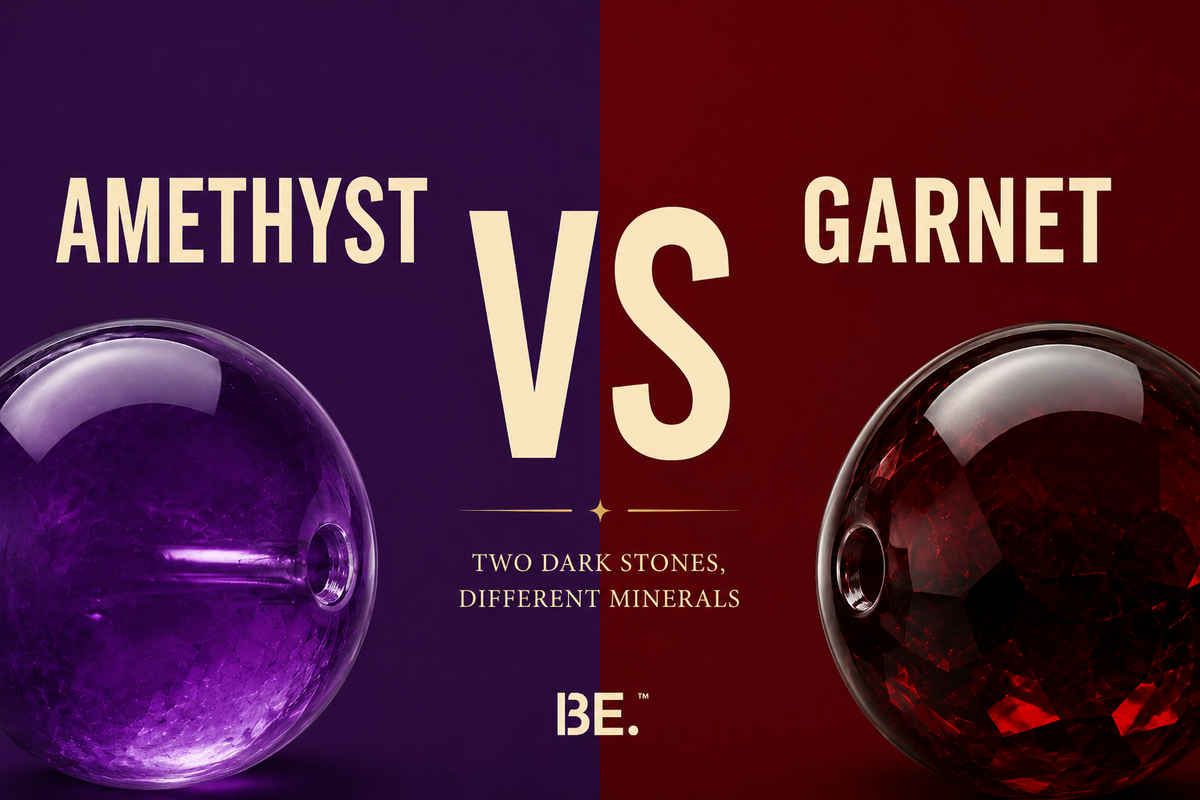
Same darkness, different physics
Amethyst’s violet is a colour centre associated with iron and irradiation in quartz. Garnet’s red is intrinsic chemistry: iron and other relevant components in the garnet crystal structure affect which wavelengths are absorbed. Magnesium is part of pyrope's composition, but is not itself the source of its red colour. Some amethyst can fade under prolonged intense light; common jewellery garnets are not known for that same response in ordinary wear.
Why can a red garnet look almost black indoors? Watch BE.'s 6:48 film on garnet colour, transmitted light and the mineral family. The guide also explains the limits of judging a bead by eye.
Side by side
| Dimension | Amethyst | Garnet |
|---|---|---|
| Mineral | Quartz (SiO2) | Silicate group; red jewellery includes almandine–pyrope compositions |
| Colour | Violet — lilac to deep purple | Red — bright to deep, often glowing |
| Colour mechanism | Iron colour centre + natural radiation | Intrinsic metal chemistry |
| Hardness (Mohs) | 7 | 6.5–7.5 |
| Fades in sun? | Can fade slowly under prolonged sun | Not known for amethyst-style fading in ordinary wear |
| Tone / mood | Cool, calm | Warm, intense |
| Price logic | Colour, clarity and cut matter; origin alone does not set quality | Compare colour, clarity, size and finish; the name alone is not a grade |
| Care note | Keep out of strong sun | Store apart; chips along fractures |
How to choose
- By tone. Want a cool, quiet violet? Amethyst. Want a warm red that glows? Garnet.
- By sun exposure. If the bracelet lives outdoors in strong sun, garnet is the safer colour bet — amethyst can fade slowly.
- By skin and wardrobe. Violet reads cool against most skin tones; red garnet reads warm and rich. Try both against your wrist.
- By durability. Both are daily-wear durable; both prefer to be stored away from harder stones.
- By layering. Amethyst pairs cool with clear quartz and moonstone; garnet pairs warm with hematoid and smoky quartz.
Reading each stone
Amethyst: hold to daylight, check saturation and evenness, watch for near-colourless windows. Deep and even is the premium. Garnet: compare the colour in ordinary light and with light passing through the bead. Near-black appearance can depend on thickness and lighting. A purple-red flash does not establish rhodolite or a higher grade.
Care, compared
Amethyst: keep out of prolonged direct sun; warm soapy water is safe. Garnet: colour-stable in light, but store apart from harder stones and avoid knocks that can chip along fractures. Both are Mohs ~7 and durable for everyday wear.
How BE. grades both
Both are graded on the Crystal 4T standard — Transparency, Tone, Texture and Treasure — and each strand carries a Stone Origin Record recording the species or variety and the colour mechanism (colour centre for amethyst, metal chemistry for garnet), so the difference is documented rather than implied.
Frequently asked questions
Q1.Is amethyst or garnet better?
Neither — different colours and materials. Amethyst is a cool violet quartz; garnet is a warm red silicate. Choose on tone, sun exposure and look.
Q2.Which is harder / more durable?
Amethyst is Mohs 7; garnet spans roughly 6.5–7.5 by species. Hardness measures scratch resistance, not resistance to chipping, bead-edge damage or construction failure.
Q3.Which fades?
Some amethyst can fade under prolonged intense light. Common jewellery garnets are not known for the same amethyst-style colour-centre response in ordinary wear, but every stone should still be protected from high heat and harsh treatment.
Q4.Which is more expensive?
Both span wide price ranges. Compare the actual stones: colour, clarity, size, finish and supporting documentation matter more than a simple species ranking.
Q5.Can I wear them together?
Yes — cool violet and warm red layer well. Store apart from harder stones.
Q6.Are they the same family?
No. Amethyst is quartz; garnet is a separate silicate group.
References
Field Notes.
One stone at a time: its geology, and how to read quality. The Stone Buying Checklist comes with your first email.
By subscribing you agree to receive emails from BE. Unsubscribe anytime.
Sent. Check your inbox.