
Smoky Quartz: How Natural Radiation Creates the Brown
The complete science of smoky quartz colour — aluminium substitution, gamma radiation colour centres, natural vs artificial irradiation, and how to read a strand.
In this field note
Smoky quartz is a material identity before it is a colour or symbolic story. It remains quartz, SiO2, with Mohs hardness 7; the brown-grey field comes from lattice defects. There is no coating, and no second mineral. Mohs hardness describes scratch resistance, not toughness or the strength of fractures, drilled bead edges, stringing or clasps. Where cultural or retail language calls smoky quartz ‘grounding’, BE. treats that as interpretation. It is not a measured mineral property, and it is not evidence of a medical, detoxifying, radiation-shielding or electromagnetic effect.
This guide separates what the material supports from what still needs specimen-level evidence. It covers identity, colour centres, terminology, treatment limits, care, strand observation and the neighbouring Journal owners that answer narrower questions.
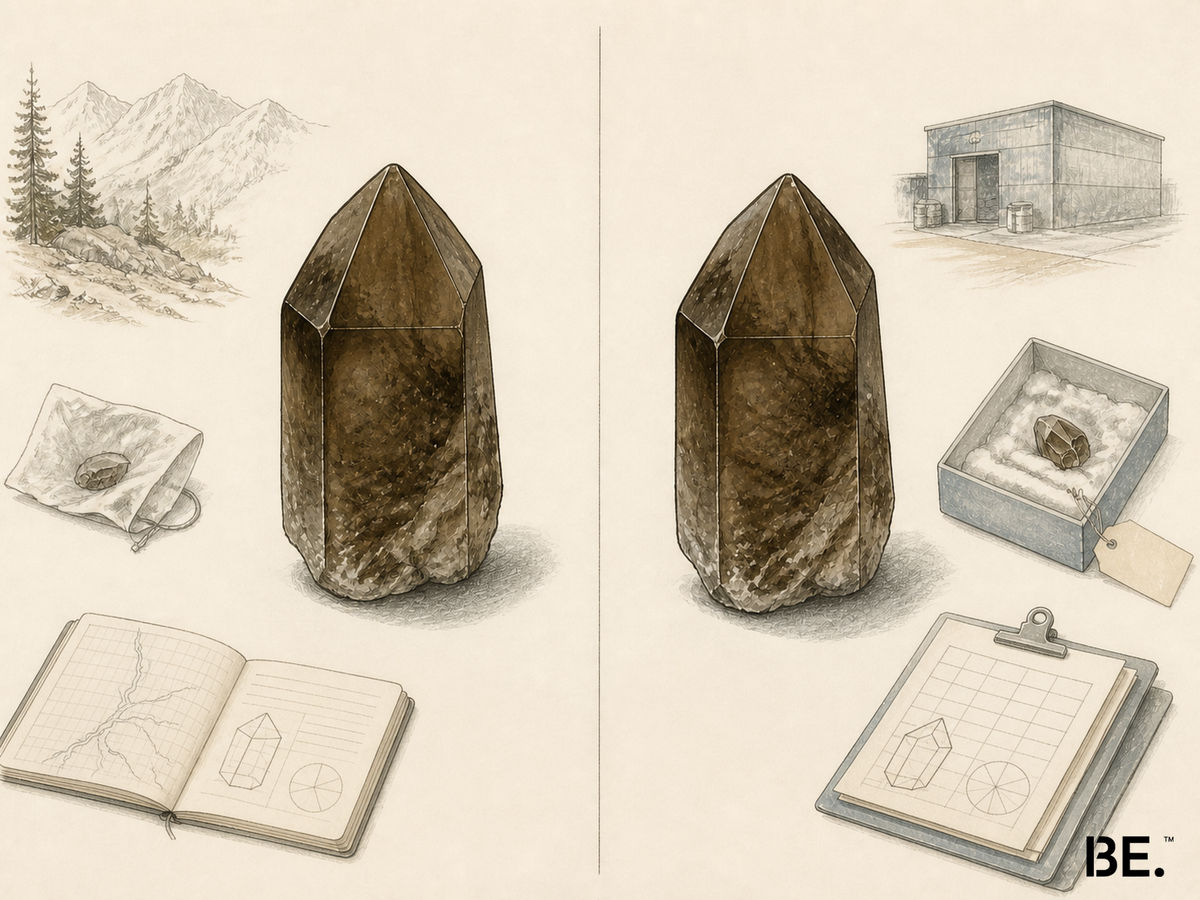
What creates the brown colour
The mechanism involves three components acting in sequence:
Step 1: Aluminium-related defects. Quartz can contain aluminium-related defects at some silicon sites. Aluminium alone is insufficient to create the visible smoky colour.
Step 2: Irradiation. Irradiation can change the electronic state around those defects and create smoky colour centres. Natural and laboratory irradiation can produce the same colour-centre type.
Step 3: Visible absorption. The resulting defect population changes how the crystal absorbs and transmits visible light. A visible shade cannot be converted into one dose, age or aluminium concentration.
Why the colour depth varies
| Layer | Supported statement | Boundary |
|---|---|---|
| Mineral | Quartz; silicon dioxide, SiO2. | Brown does not create a new species. |
| Colour | Irradiation acting on aluminium-related lattice defects is the accepted general mechanism. | Aluminium alone is insufficient; the visible shade is not a dose meter. |
| Morion | The very dark to black end of smoky quartz terminology; specimens called Morion may appear opaque in ordinary viewing. | Not a separate species or a standardised transmitted-light threshold; any thin-edge translucency is an observation. It does not prove which kind of irradiation produced the colour. |
| Cairngorm | Historical and locality-linked Scottish smoky-brown quartz name. | Not a generic synonym or origin claim without provenance. |
Where naturally smoky quartz forms
| Origin language | Supported description | Evidence boundary |
|---|---|---|
| Cairngorm, Scotland | Historical locality-linked smoky-brown quartz name. | Use only with provenance; not a generic synonym. |
| Brazil | Commercially important source of quartz across a wide visual range. | Colour and bead-market presence do not establish a deposit. |
| Alpine localities | Collector quartz may show smoky colour and growth features. | Appearance does not assign locality or treatment history. |
| Madagascar and other sources | Material can vary in tone, clarity and internal features. | Require lot records before making a specific origin claim. |
Reading a smoky quartz strand
- Record tone under controlled light. Compare beads on the same neutral background. Warm or cool brown is not an origin test.
- Read transparency separately. A deep tone can remain transparent; opacity may also reflect inclusions, fractures or cutting.
- Describe zoning without diagnosing treatment. Zoning is an observation. Natural and laboratory histories can overlap visually.
- Inspect polish and fractures. Surface finish and structural integrity affect wearability independently of colour.
- Ask for the treatment and provenance record. Appearance cannot replace supplier disclosure or laboratory evidence.
For a direct structural comparison between crystalline quartz and volcanic glass, see smoky quartz and obsidian.
Natural and laboratory irradiation: evidence boundary
- Appearance. Record tone, uniformity, zoning and clarity as observations. None of them is a treatment verdict.
- Disclosure. Natural and laboratory irradiation can create the same smoky colour-centre type; use supplier or laboratory evidence for treatment history.
- Heat. Heating can anneal smoky colour centres, but response varies by defect system and specimen; do not use home heating as a diagnostic.
- Price and origin. Neither price nor an assumed locality converts appearance into proof of untreated natural colour.
Caring for smoky quartz
Quartz is Mohs 7, but jewellery durability also depends on fractures, drill holes, stringing and setting. Heat can anneal smoky colour centres, and light stability can vary. Avoid home heating, steam on fractured material and prolonged direct display sunlight. For the broader comparison, use the stone-by-stone sunlight guide.
How BE. grades smoky quartz
BE. can record transparency, tone, texture, cutting and the documents supplied for a lot. Those are separate evidence layers. A Stone Origin Record should repeat verified lot information, not convert colour into an unearned origin or treatment conclusion.
Smoky quartz strands are listed in the BE. collection, and every strand ships with a Stone Origin Record that states its lot, its four Crystal 4T™ readings and what those readings do not claim.
Frequently asked questions
Q1. What is smoky quartz?
Smoky quartz is quartz, SiO2, whose brown to near-black appearance is associated with irradiation acting on aluminium-related defects in the crystal lattice. It remains quartz. There is no separate species here.
Q2. What creates the brown colour in smoky quartz?
Aluminium-related lattice defects provide sites that can become colour centres after irradiation. Aluminium alone is insufficient, and visible colour depth cannot be converted into one dose, age or aluminium concentration.
Q3. Is smoky quartz radioactive?
A colour centre records past irradiation; it is not radioactive decay. Colour alone does not certify the radiation level of every specimen or its inclusions, so specimen-specific safety claims need specimen-specific evidence.
Q4. Can appearance tell natural irradiation from laboratory irradiation?
No. Natural and laboratory irradiation can produce the same type of smoky colour centre. Tone, uniformity, zoning, clarity and price are observations. None of them settles treatment history.
Q5. Can smoky quartz fade in sunlight?
Light stability varies among irradiation-related colours and specimens. Avoid prolonged direct display sunlight when preservation matters, and use the dedicated sunlight guide for the broader stone-by-stone boundary.
Q6. What is Morion?
Morion is the very dark to black end of smoky quartz terminology. It is a descriptive variety name. The species is still quartz.
Q7. What is Cairngorm quartz?
Cairngorm quartz is a historical and locality-linked name associated with smoky-brown Scottish quartz from the Cairngorm area. It should not be used as a generic synonym or origin claim without provenance.
Q8. Is smoky topaz the same material?
No. Smoky topaz is a misleading retail name often used for smoky quartz. Topaz is a different mineral with different chemistry and structure.
References
- GIA: Smoky and irradiation-related colours in quartz
- Gems & Gemology: Irradiated smoky quartz and treatment limits
- Materials Research: Optical absorption of irradiated and heat-treated quartz
- Mineralogical Magazine: Irradiation-related colours in quartz
- Mindat: Morion
- Gem-A: Historical use of Morion terminology
- National Museums Scotland: Cairngorm quartz
- GIA: Light stability and gemstone treatment review
Field Notes.
One stone at a time: its geology, and how to read quality. The Stone Buying Checklist comes with your first email.
By subscribing you agree to receive emails from BE. Unsubscribe anytime.
Sent. Check your inbox.