
Natural vs Irradiated Smoky Quartz: What Colour Can and Cannot Prove
Natural and controlled irradiation can create the same smoky colour-centre system in quartz. Learn what appearance records, what laboratory reports can establish, and which buyer questions preserve the evidence boundary.
In this field note
Smoky quartz is quartz whose grey-brown to nearly black appearance is linked to irradiation acting on aluminium-related defects in the crystal. The broad geology belongs in our Smoky Quartz colour and formation guide. Here the question is narrower: can that colour tell us whether the irradiation was natural or controlled?
The short answer is no. Colour is evidence of an optical state. It is not a complete record of the route, timing or dose that produced it. That distinction matters because many buying guides turn plausible-looking tendencies into verdicts the material cannot support.
How smoky colour forms
Quartz is silicon dioxide, but real crystals contain structural defects and minor impurities. In smoky quartz, some aluminium can substitute for silicon. Aluminium alone is not sufficient to make the crystal smoky. Irradiation can change the electronic state around those aluminium-related defects, creating colour centres that absorb part of the incoming light. The transmitted light is then shifted towards grey, brown or very dark smoke.
Natural background irradiation
In a geological setting, low concentrations of naturally radioactive elements in surrounding rocks can expose quartz to ionising radiation over long periods. If the crystal contains a suitable defect system, smoky colour can develop. The result may be pale, strongly zoned, evenly brown or nearly black; the outcome also depends on the crystal's chemistry and defect population.
Controlled irradiation
Colourless or pale quartz can also be irradiated under controlled conditions. Gamma irradiation is one documented route; irradiation may be combined with heating to modify the resulting colour. The important point is not that natural and controlled histories are identical in every detail. It is that both can act on the same kind of aluminium-related smoky colour-centre system. The final brown can therefore overlap.
Heating can alter or remove colour-centre absorption, but its effect depends on the defect system and treatment protocol. It is not a safe home diagnostic. Heating a specimen risks changing the material without producing a reliable account of its earlier history.
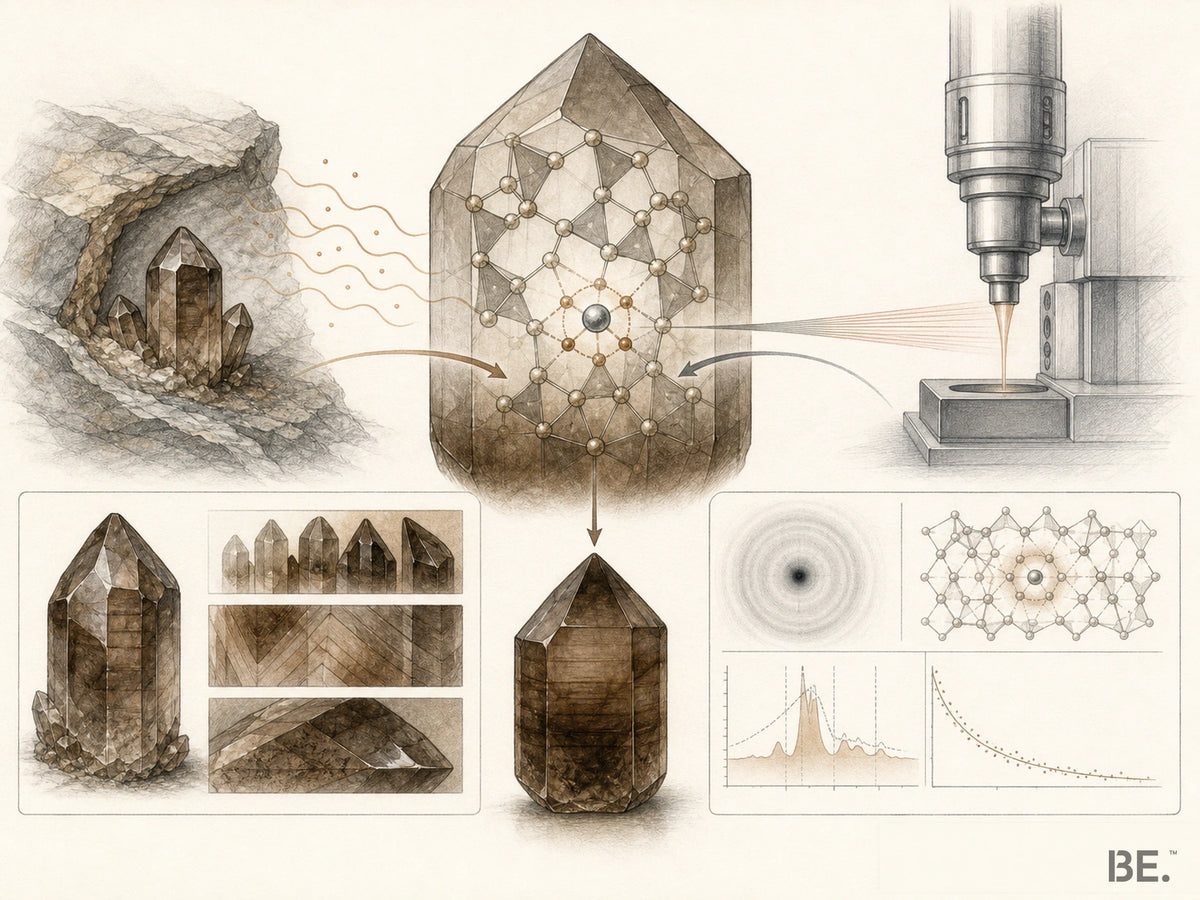
What colour can and cannot prove
Visual examination is still useful. It gives a precise description of the stone in front of you. The mistake is allowing description to become an unsupported history.
| Observation | What it can support | What it cannot prove |
|---|---|---|
| Depth of colour | A repeatable description such as pale smoke, brown-grey or near-black. | Natural irradiation, artificial irradiation, dose or treatment date. |
| Uniform colour | How evenly the colour is distributed in the visible specimen. | That the colour was produced in a treatment facility. |
| Zoning or phantoms | Growth-related or defect-related spatial variation worth documenting. | That all colour is naturally produced, or that no later treatment occurred. |
| Transparency and inclusions | Material character, internal features and whether further identification work may be useful. | The origin of the smoky colour centre. |
| Price or seller story | Commercial context that can be checked against documents. | A mineralogical or treatment-history conclusion. |
One implication follows: “dark means treated” is not a valid rule. Neither is its mirror image, “zoned and warm brown means natural”. A visual tendency can help frame questions; it cannot close the case.
What a laboratory can test
Identity is not treatment history
A laboratory can first establish that a material is quartz and document its physical and optical properties. Microscopy can record inclusions, fractures, growth features and colour distribution. Spectroscopic or chemical methods may then characterise absorption, trace constituents or defect-related signals. These are narrower questions than “natural or irradiated?”
Research on irradiated and heat-treated quartz has used methods including EPR, UV-VIS and infrared spectroscopy to study the defect systems responsible for colour. Those experiments show what the instruments can measure under defined conditions. They do not create a universal pass/fail test for every finished smoky quartz.
Ask what the report actually says
A laboratory report should be read for its exact scope. It may identify natural quartz, record detectable treatments, or describe that a treatment origin is not determinable. “Natural quartz” concerns the material's origin; it does not automatically mean “natural colour, with no later irradiation”. If treatment history is central to the purchase, that question needs its own line of evidence.
Instrument names are not conclusions. A seller saying “spectroscopy tested” is less useful than a report stating the sample identity, the methods used, the result, the limits of that result and the laboratory that issued it.
Irradiation and safety are a separate question
Past irradiation versus present radioactivity
A colour centre records an electronic change created by irradiation. It is not itself radioactive decay. Conversely, a radiological survey measures radiation associated with the specimen at the time of measurement; it does not tell you whether the smoky colour formed naturally or through controlled irradiation.
The irradiation route matters
The US Nuclear Regulatory Commission distinguishes among gamma irradiation, accelerator treatment and reactor treatment. Its public guidance states that gamma irradiation does not activate gemstones, while reactor or accelerator routes can activate trace constituents. Batches that contain activation products are held and surveyed before initial distribution under the applicable controls. The IAEA likewise describes measurement, traceability and release procedures for irradiated gemstones.
This is not permission to declare an undocumented stone safe or unsafe from colour. Safety evidence belongs to the treatment route, supply chain and regulatory release process. A brown appearance does not supply those records.
Disclosure is not one global rule
CIBJO's Gemstone Blue Book treats artificial irradiation as a treatment requiring specific information and permits the wording “artificially irradiated”. It is an international industry standard, not national legislation. In the United States, FTC business guidance focuses treatment disclosure on effects such as permanence, special care and significant value. Other markets can apply different legal requirements. Our Crystal Treatment Disclosure Chart keeps the cross-stone terminology in one place.
What to ask before buying
- Is the claim about material origin or colour origin? “Natural quartz” and “naturally coloured smoky quartz” are not the same statement.
- What treatment history has the supplier disclosed in writing? Ask specifically about irradiation and heating, not only whether the stone is “real”.
- What supports an untreated-colour claim? A mine name, colour pattern or verbal assurance is not a substitute for traceable records.
- If there is a laboratory report, what does it actually conclude? Check the sample identity, method, result and limitations rather than relying on the existence of a report.
- Will the treatment disclosure appear on the invoice or product record? Written wording is easier to retain than a conversation at the point of sale.
- What happens if later evidence conflicts with the description? A clear return or resolution policy is part of a verifiable purchase.
The honest answer is sometimes “not determined”. That is more useful than a confident visual diagnosis. It separates what the stone shows from what the evidence can support.
Frequently asked questions
Q1.Can dark colour prove artificial irradiation?
No. Very dark smoky quartz can form through natural irradiation when the defect system and exposure are suitable. Darkness describes appearance, not treatment history.
Q2.Can a laboratory always separate natural and artificial irradiation?
No universal test is established for every smoky quartz specimen. A laboratory can identify quartz and may characterise inclusions, absorption or defect-related signals, but the report must state whether the treatment origin is determinable in that case.
Q3.Is irradiated smoky quartz radioactive?
Not necessarily. Gamma irradiation does not activate gemstones, while reactor or accelerator routes can activate trace constituents. Applicable controls require activated batches to be held and surveyed before release; colour alone cannot verify that process.
Q4.Does “natural smoky quartz” mean untreated colour?
Not by wording alone. “Natural” may describe the quartz rather than the origin of its colour. Ask separately whether irradiation or heating was disclosed and what evidence supports any natural-colour claim.
Q5.Does uniform colour prove treatment?
No. Uniformity can be recorded as an observation, but natural and controlled histories can overlap in appearance. It is not a treatment certificate.
Q6.What should a buyer request?
Request written treatment disclosure, the exact scope of any laboratory report, traceable supplier or batch records where available, and a clear policy for resolving a description that later proves inaccurate.
References
- Gemological Institute of America: An Update on Color in Gems, Part 2
- Gemological Institute of America: colour centres in natural and laboratory-irradiated smoky quartz
- Gemological Institute of America: Gemstone Enhancement and its Detection in the 1980s
- Materials Research: The optical absorption of gamma irradiated and heat-treated natural quartz
- Gemological Institute of America: How GIA analyzes coloured stones
- US Nuclear Regulatory Commission: Backgrounder on Irradiated Gemstones
- International Atomic Energy Agency: Radiation Safety for Consumer Products
- CIBJO: Gemstone Blue Book
- US Federal Trade Commission: In the Loupe: Advertising Diamonds, Gemstones and Pearls
- Smoky Quartz vs Obsidian: Crystal or Volcanic Glass?
Field Notes.
One stone at a time: its geology, and how to read quality. The Stone Buying Checklist comes with your first email.
By subscribing you agree to receive emails from BE. Unsubscribe anytime.
Sent. Check your inbox.