
Smoky Quartz vs Obsidian: Crystal or Volcanic Glass?
Smoky quartz is crystalline SiO₂; obsidian is natural volcanic glass. Compare structure, appearance, hardness, fracture and bracelet wear.
In this field note
The two materials are often grouped because a polished bead removes much of the geological context. A dark smoky quartz bead can look almost black from the front. A black obsidian bead can transmit brownish light at a thin edge. A high polish gives both a clean reflection. These overlaps are genuine, so a single photograph is a weak place to make a mineral claim.
This comparison stays between two materials. The colour-centre mechanism belongs to Smoky Quartz: How Natural Radiation Creates the Brown; obsidian varieties and formation belong to the Obsidian Guide. The broader four-way black-bead screening path remains in the Black Bead ID hub.
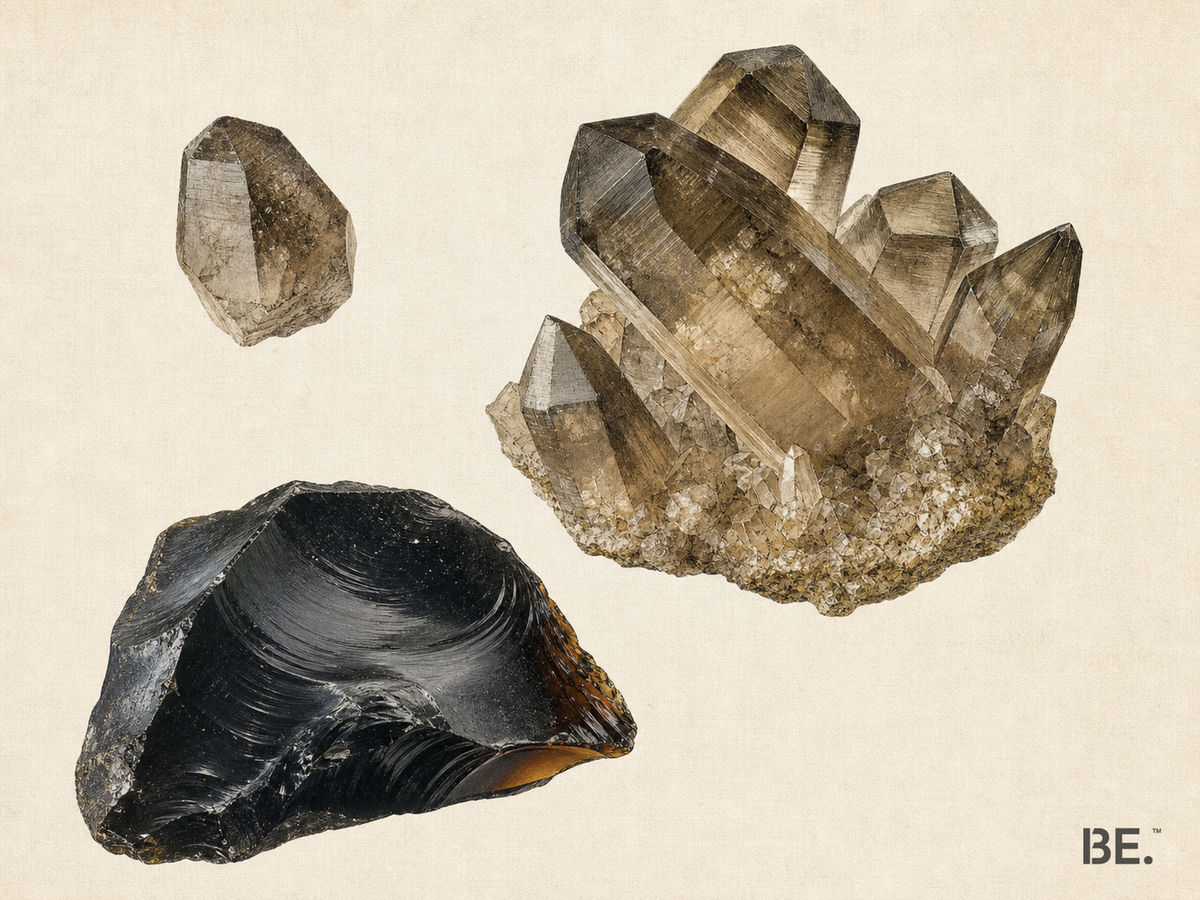
Why is one a crystal and the other a glass?
Smoky quartz has long-range atomic order; obsidian does not. Quartz is crystalline silicon dioxide. Its atoms repeat in an organised lattice, even when the outside has been rounded into a bead. Smoky colour develops when trace aluminium-related defects in quartz interact with natural or artificial irradiation, creating centres that absorb part of the visible spectrum.
Obsidian begins as volcanic melt, commonly rich in silica. Rapid cooling prevents the components from arranging into large, repeating mineral crystals. The solid is therefore described as natural volcanic glass. It may contain microlites, bubbles or flow structures, but the bulk glassy matrix is not a quartz crystal. “Made by a volcano” and “crystal” are not interchangeable categories.
The shared role of silica can be confusing. Quartz has the formula SiO₂. Obsidian is not a single mineral with one formula; it is a glassy rock whose chemistry varies. A high silica content does not make obsidian quartz any more than a similar colour makes the two materials identical.
How do smoky quartz and obsidian compare?
| Point | Smoky quartz | Obsidian |
|---|---|---|
| Material class | Crystalline mineral | Natural volcanic glass |
| Main identity | Quartz, SiO₂ | Silica-rich glassy rock with variable chemistry |
| Formation | Quartz crystallisation followed by colour-centre development | Volcanic melt cooled rapidly |
| Internal structure | Ordered crystal lattice | Amorphous glassy matrix |
| Mohs hardness | About 7 | Usually about 5–5.5 |
| Typical light response | Brown, grey or nearly black body colour; often transparent to translucent | Commonly opaque black; thin edges or some varieties may transmit light |
| Breakage | Can chip or fracture; no cleavage | Conchoidal fracture can form very sharp edges |
| Bracelet care | Avoid hard impacts and abrasion against harder materials | Give extra protection from impacts and inspect chips promptly |
Hardness is the clearest numerical difference, but it does not tell the whole wear story. Mohs 7 means quartz resists many everyday scratches better than obsidian. It does not mean a drilled quartz bead cannot crack. Obsidian’s lower hardness and glass-like conchoidal fracture make edge chips especially relevant. A chip at a drill hole can abrade the connecting material or leave a sharp surface.
What can the eye screen in dark polished beads?
Light transmission, internal texture, flow pattern and sheen can guide screening, but none is universal. Hold a clean bead over white paper in diffuse daylight, then move a small light behind a thin edge. Smoky quartz often reveals brown-to-grey depth through the body. Obsidian often presents a more continuous black glass field. Yet thickness, polish, inclusions and variety can reverse the expected impression.
Rotate the bead. Some obsidian shows curved flow lines, silvery or golden sheen, or clustered inclusions. Gold sheen comes from aligned microscopic features that reflect light directionally; it is not metallic gold. Smoky quartz may show veils, healed fractures, mineral inclusions or subtle colour zoning. A completely clean view is possible in either material and does not prove a laboratory category.
Why is fracture not a home identification test?
Fresh obsidian commonly breaks with a conchoidal, shell-like surface, a property used in stone-tool making. Finished jewellery should never be broken to expose it. Quartz can also show conchoidal fracture, so the general shape is not exclusive. The useful consumer lesson is care: a damaged obsidian bead can become sharp and should be removed from wear, not studied by further impact.
What does bead polishing hide?
Round cutting erases crystal faces, natural fracture surfaces and much of a rock’s original texture. Dye, coating, glass and composite materials can also enter the dark-bead market. A seller’s exact material claim, close photographs and a return path therefore carry more weight than a checklist built for rough specimens.
How do smoky quartz and obsidian wear in a bracelet?
Smoky quartz is more scratch-resistant, while obsidian needs more protection from abrasion and impact. Daily bracelet wear creates repeated contact with desk edges, metal watch cases, door frames and other beads. Fine wear may gradually dull obsidian. A direct impact may produce a chip. Smoky quartz is more resistant to surface scratching but can still break at a fracture or stressed drill hole.
Cleaning can remain simple. Use a soft damp cloth and mild soapy water when the construction permits, then dry thoroughly. Avoid ultrasonic or steam cleaning when fractures, uncertain treatments or mixed components are present. The stone is only one part of the object; clasp, wire, coating and adjacent materials set their own limits.
Inspect dark beads under side light. Look for new chips, rough drill edges and a change in the smooth transition between beads. Stop wearing a bracelet that catches fabric or skin. The Crystal Hardness Chart separates scratch resistance from toughness and construction risk.
Which dark material should you choose?
Choose smoky quartz for translucent brown-grey depth; choose obsidian for a continuous volcanic-glass field or directional sheen. This is a material and visual decision, not a hierarchy. Smoky quartz rewards changing light: a bead that reads almost black indoors may open to warm brown at a window. Obsidian can give a sharper black plane, sometimes interrupted by gold sheen or flow texture.
Ask what is actually being sold. For smoky quartz, check whether irradiation or another treatment is disclosed and whether the colour is stable under ordinary use. For obsidian, ask for the variety claim and inspect for coating, chips and misleading metallic language. “Natural” should describe the material; it should not be used to imply invulnerability.
- Choose by structure: crystalline quartz depth or volcanic-glass continuity.
- Choose by light: transmitted brown-grey colour or reflected black/sheened surface.
- Choose by wear: quartz tolerates abrasion better; obsidian deserves more impact protection.
- Choose by evidence: exact material name, treatment disclosure, close views and return terms.
- Choose by construction: smooth holes, undamaged beads and a secure bracelet system matter on both sides.
The two current product routes below preserve the comparison, and neither material is presented as the winner. The obsidian handle is the steel-wire Gold Sheen Obsidian Strand, not the similarly named elastic bracelet.
Frequently asked questions
Q1. Is smoky quartz a type of obsidian?
No. Smoky quartz is crystalline silicon dioxide with a brown-to-grey colour linked to colour centres. Obsidian is natural volcanic glass formed when silica-rich melt cools too quickly to build a regular crystal lattice.
Q2. Which is harder, smoky quartz or obsidian?
Smoky quartz is about Mohs 7. Obsidian is usually around Mohs 5 to 5.5. Quartz therefore resists scratching better, while obsidian can develop conchoidal chips and sharp edges when broken.
Q3. Can smoky quartz look black?
Yes. Very dark smoky quartz can appear nearly black in reflected light, especially in thick beads. A thin edge or strong backlight may reveal brown or grey transparency, but that clue alone does not establish identity.
Q4. Can you identify obsidian by transparency alone?
No. Obsidian can be opaque or translucent at thin edges, while smoky quartz can become extremely dark. Transparency helps with screening only when combined with structure, inclusions, seller disclosure and, when needed, testing.
Q5. Which material is better for daily bracelet wear?
Smoky quartz generally offers better scratch resistance. Obsidian is suitable when protected from hard impacts and inspected for chips. The right choice also depends on bead condition, hole quality, bracelet construction and the look preferred.
References
- [1] GIA: Ametrine and smoky quartz (smoky quartz colour-centre context)
- [2] USGS: Yellowstone’s tool-making lava flows (obsidian as natural volcanic glass and conchoidal fracture)
- [3] USGS: Obsidian in volcanic settings (volcanic-glass formation context)
Field Notes.
One stone at a time: its geology, and how to read quality. The Stone Buying Checklist comes with your first email.
By subscribing you agree to receive emails from BE. Unsubscribe anytime.
Sent. Check your inbox.