
Obsidian vs Onyx: What Is the Difference?
Obsidian is volcanic glass; jewellery onyx is parallel-banded chalcedony. Compare structure, hardness, black colour, dye disclosure and safe checks.
In this field note
A black round bead is one of the least informative shapes in gem buying. Cutting removes natural faces, hides fracture surfaces and reduces several materials to the same glossy circle. Obsidian, dyed chalcedony, black glass, tourmaline and coated material can meet in a single photograph. The correct first question is not “which black looks deeper?” but “what material category is being claimed?”
This guide uses onyx in the jewellery sense: a variety of chalcedony with straight, parallel bands. Decorative stone sellers also use “onyx” for banded calcite or aragonite, a different and much softer material. The wider four-material screening route sits in Black Bead ID; the geological depth of obsidian remains in the Obsidian Guide.
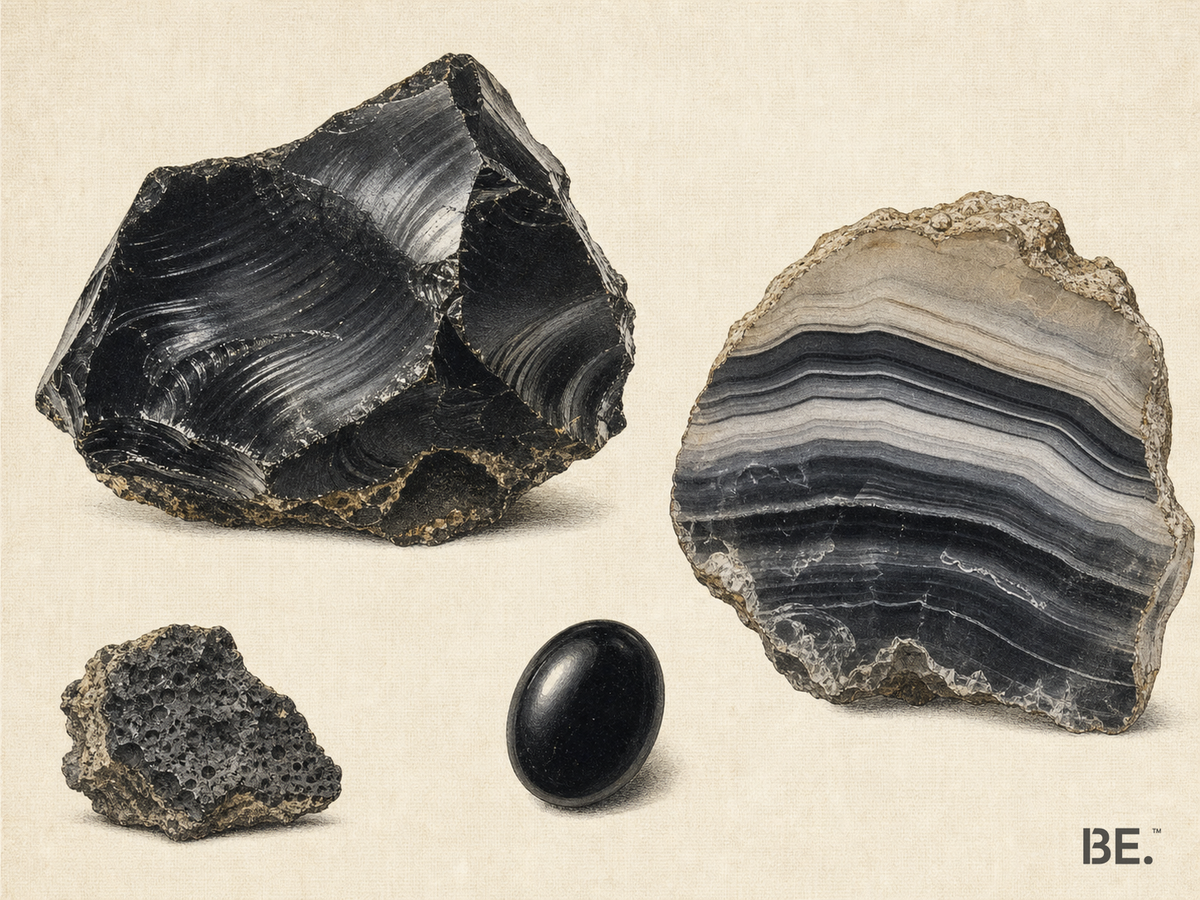
What does “black onyx” mean in jewellery?
Jewellery onyx is parallel-banded chalcedony, and its black colour is often produced or improved by dyeing. Chalcedony is microcrystalline to cryptocrystalline silica. Onyx is distinguished from curved-band agate by relatively straight, parallel banding. A bead cut from a dark layer can look nearly uniform; a black dye can make that uniformity much stronger.
Dyeing chalcedony black has a long commercial history. Treatment leaves the chalcedony identity intact, changes the meaning of the colour, and must be disclosed. “Natural onyx” can be used ambiguously: it may refer to natural chalcedony material while the colour treatment goes unstated. A clear invoice separates material identity from treatment.
The decorative-stone trade adds a second ambiguity. Banded calcite, sometimes called Mexican onyx or onyx marble, is not chalcedony onyx. It is softer, reacts differently to acids and requires different care. A bracelet listing should not leave the buyer to choose between those meanings.
How do obsidian and onyx compare?
| Point | Obsidian | Jewellery onyx |
|---|---|---|
| Material class | Natural volcanic glass | Parallel-banded chalcedony |
| Internal structure | Amorphous glassy matrix | Interlocking microscopic quartz crystals |
| Formation | Rapid cooling of volcanic melt | Silica deposition and chalcedony growth |
| Mohs hardness | Usually about 5–5.5 | About 6.5–7 |
| Common visual clue | Glassy field, flow pattern, sheen or thin-edge translucency | Straight parallel layers; black appearance may be uniform after cutting and dyeing |
| Breakage | Conchoidal fracture can create sharp edges | Can fracture or chip; generally more scratch-resistant |
| Frequent disclosure issue | Variety or sheen overstated; glass confused with obsidian | Black dye omitted; calcite trade material confused with chalcedony |
| Bracelet choice | Volcanic-glass black or directional sheen | Chalcedony structure and higher scratch resistance |
The scorecard identifies the dimensions that matter; it does not offer one decisive household test. Obsidian and chalcedony differ in refractive index, specific gravity and microscopic structure, but dependable measurement requires suitable equipment and known reference conditions. A buyer should not infer a result from an uncalibrated phone application or a single reflection.
What visual clues help on polished black beads?
Parallel banding supports onyx; flow texture or directional sheen supports obsidian, but absence of either proves nothing. Use diffuse daylight first. Rotate the bead, then inspect a thin edge with a small light behind it. Onyx may reveal a brownish, grey or layered field. Obsidian may reveal flow lines, tiny inclusions, bubbles or a glassy internal continuity. Thick, saturated beads can conceal all of these.
Look at drill holes. Dye sometimes concentrates in surface-reaching cracks or at porous areas, though well-dyed chalcedony can remain visually uniform. Coatings may show abrasion at edges. Obsidian chips can expose sharp, curved fracture surfaces. None of those observations authorises a stronger identity claim than the evidence supports.
Can a perfectly black bead be natural onyx?
It can be cut from very dark chalcedony, but uniform black is not proof of untreated natural colour. The commercial prevalence of dyed black onyx makes disclosure the rational starting point. The listing should read “chalcedony onyx, dyed black” when that is the known treatment. A euphemism such as “colour enhanced” gives less useful care and value information.
Does a glassy polish prove obsidian?
No. Manufactured glass is also glassy, and chalcedony can take a bright polish. Obsidian identity comes from natural volcanic origin, not from gloss alone. Bubbles can occur in manufactured glass and sometimes in natural volcanic glass; their presence or absence is therefore not a universal separator.
How can you verify a black bead without damaging it?
Combine written disclosure, close observation and proportionate professional testing. Start with the listing and invoice. They should say obsidian or chalcedony onyx, state dye or other treatment when known, and avoid presenting decorative calcite as quartz onyx. Save those claims before purchase because a vague product name is hard to challenge later.
- Read the noun: “volcanic glass obsidian” and “chalcedony onyx” are clearer than “black stone”.
- Read the treatment line: dyed black chalcedony should not be sold as untreated colour.
- Use two light directions: diffuse front light for surface and backlight for thin-edge transmission.
- Inspect condition: chips, rough holes, coating wear and surface-reaching cracks affect wear even when identity is correct.
- Keep tests non-destructive: no scratching, flame, acid, solvents or deliberate breaking.
- Escalate by value: request a recognised gem laboratory report when the identity claim carries a meaningful premium.
The Crystal Treatment Chart explains why treatment and material identity must be recorded separately. A dyed onyx bead is not obsidian; a natural-colour obsidian bead is not proof of a particular sheen variety. Each claim stands on its own evidence.
Which black material should you choose?
Choose obsidian for volcanic-glass character; choose onyx for chalcedony banding and higher scratch resistance. Obsidian can produce a dense black field, curved flow and directional gold or silver sheen. Onyx can give crisp parallel layering and a quieter, more uniform black, especially after dyeing. The visual preference should be named honestly, and neither material is universally superior.
For frequent wear, onyx’s higher hardness improves scratch resistance. It can still chip, and treated colour sets cleaning limits. Obsidian deserves more protection from desk edges and hard impacts. A small chip can become a sharp edge; the bracelet should be removed until the bead is replaced or the piece is professionally assessed.
Construction remains visible evidence. Check polish continuity, hole placement, spacing and how the strand moves. A secure, smoothly finished obsidian bracelet is a better object than a poorly drilled onyx bracelet with an undisclosed dye treatment. Material prestige cannot repair weak workmanship.
BE. currently has an approved obsidian route for this comparison and no verified onyx PDP. The card below therefore stays on one side. For obsidian varieties, Gold Sheen vs Black Obsidian owns the deeper selection question.
Frequently asked questions
Q1. Is black onyx the same as obsidian?
No. Obsidian is natural volcanic glass. Jewellery onyx is chalcedony with straight, parallel banding. Both may be polished black, but their internal structure, formation and hardness are different.
Q2. Is black onyx naturally solid black?
Some dark chalcedony exists, but much uniform black onyx in jewellery is dyed chalcedony. Dyeing is an established treatment and should be disclosed; a perfectly black appearance does not prove either natural colour or onyx identity.
Q3. Which is harder, onyx or obsidian?
Chalcedony onyx is about Mohs 6.5 to 7, while obsidian is usually around Mohs 5 to 5.5. Onyx therefore resists scratching better, though either material can chip or break.
Q4. Can banding prove a stone is onyx?
Straight parallel bands support an onyx interpretation, but appearance alone is not complete proof. Other banded materials and decorative calcite sold under an onyx trade name can cause confusion. The material category should be stated clearly.
Q5. How can I check a black bead without damaging it?
Inspect it in diffuse light and at a thin edge, rotate it for flow or banding, use magnification for surface concentrations and review the seller’s disclosure. Do not scratch, heat or break a finished bead; seek gemmological testing when the claim carries a large premium.
References
- [1] USGS: Volcano Watch: Obsidian, a scarce commodity in Hawaii: obsidian formation and volcanic-glass identity
- [2] GIA: Anniversary gemstones: onyx: parallel-banded chalcedony and dyed black material
- [3] GIA: Gem treatment overview: treatment disclosure context
Field Notes.
One stone at a time: its geology, and how to read quality. The Stone Buying Checklist comes with your first email.
By subscribing you agree to receive emails from BE. Unsubscribe anytime.
Sent. Check your inbox.