
Kyanite vs Sapphire: Similar Blue, Different Mineral
Kyanite and sapphire can share a deep blue, but differ in composition, structure, directional hardness, cleavage, treatment and wear.
In this field note
Blue compresses identity. Once rough material is cut into polished beads, a saturated kyanite and an included sapphire can occupy the same screen colour. Camera white balance, dark backgrounds and edge enhancement reduce the remaining clues. The result is a comparison that must begin with mineral structure, since no particular shade belongs to one gem.
Blue kyanite and blue sapphire can look alike. They differ in how they are identified, how they wear in a bracelet and what a seller should disclose. Why kyanite has two hardness values is explained in Kyanite: The Crystal With Two Hardness Values.
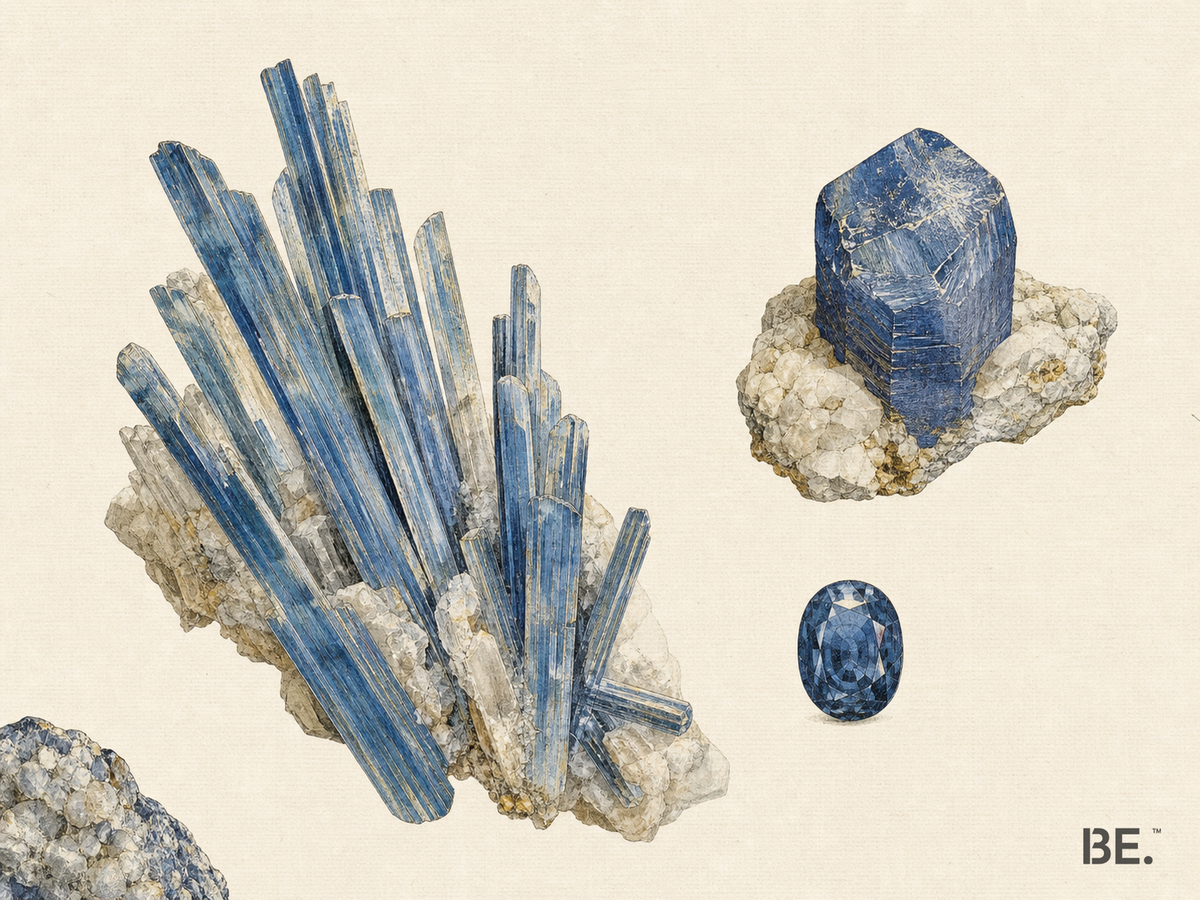
Why does a similar blue not make them the same mineral?
Kyanite is aluminium silicate; sapphire is aluminium oxide. Kyanite has the formula Al₂SiO₅ and a triclinic structure. Sapphire is corundum, Al₂O₃, with a trigonal structure. The two materials may both contain trace elements associated with blue, but a colour cause does not override composition and lattice.
Kyanite commonly grows as bladed crystals and can show linear internal features, zoning and cleavage-related characteristics. Sapphire forms in a different crystal system and has its own inclusion and growth patterns. Cutting into beads hides external crystal shape, so the mineral name must be supported by a documented identification, since a blue swatch settles nothing.
The phrase “sapphire alternative” can be used as a style comparison, but it should not imply equivalent durability or identity. Kyanite offers a blue material experience of its own. Treating it as a failed sapphire removes the very structure that makes it distinctive.
How do kyanite and sapphire compare?
| Point | Kyanite | Sapphire |
|---|---|---|
| Material identity | Aluminium silicate mineral | Corundum; aluminium oxide |
| Formula | Al₂SiO₅ | Al₂O₃ |
| Crystal system | Triclinic | Trigonal |
| Mohs hardness | Directional: about 5.5 one way and about 7 across | 9 |
| Cleavage | Distinct and relevant to impacts | No cleavage; can still chip or fracture |
| Visual overlap | Deep blue, transparent to translucent, often zoned or included | Blue ranges widely; may also be zoned or included |
| Treatment questions | Ask identity and any treatment; blue material may be confused with other gems | Ask natural or laboratory-grown and disclose heat, diffusion, filling or other treatment |
| Wear profile | More careful wear and storage | High scratch resistance; condition and setting still matter |
A table can compare properties, but it cannot certify a bead. Sapphire’s Mohs 9 is a strong differentiator in a controlled test; finished jewellery should not be tested by scratching. Kyanite’s two common values are not a contradiction. They record different resistance along different crystal directions.
Why does kyanite have two hardness values?
Kyanite is anisotropic: its scratch resistance depends strongly on direction. Values near 5.5 are reported parallel to the length of the crystal, and values near 7 across it. Orientation inside a bead is not always obvious, and a curved surface presents many directions during wear. Quoting only the higher figure gives an incomplete care picture.
Hardness is resistance to scratching. Cleavage is the tendency to split along planes related to structure. Toughness is resistance to breaking or chipping. Kyanite’s lower directional hardness and cleavage both matter; sapphire’s high hardness does not make it immune to a sharp knock at a vulnerable edge. The Crystal Hardness Chart keeps those concepts separate.
Bead format reduces some exposure because there are no sharp faceted corners, but drill holes introduce stress concentrations. Inspect kyanite beads for surface-reaching fractures, chipped holes and rough transitions. Avoid stacking them tightly against metal or harder stone bracelets.
What can look similar in kyanite and sapphire?
Blue saturation, zoning, transparency and inclusions can overlap. Kyanite can show a vivid or inky blue with lighter streaks. Sapphire can be pale, dark, unevenly coloured or heavily included. Neither “velvety” nor “royal blue” is a mineral test. Those phrases describe impressions and are used inconsistently in marketing.
Under magnification, a trained examiner may use growth features, inclusion scenes, refractive properties and other measurements to separate materials. A buyer with a phone macro lens can document condition and suspicious surface features, but should not turn an unfamiliar inclusion into a laboratory conclusion.
Why does price not identify sapphire?
A low price can signal that a sapphire claim deserves questions, but synthetic sapphire, treated sapphire, included natural sapphire and small calibrated material occupy different price bands. Kyanite also varies by colour, transparency, cutting and condition. Price is an economic clue, not a composition measurement.
Can a photograph settle the difference?
No. The same bead can move from violet-blue to greenish blue under different light and processing. Scale, thickness and background affect apparent transparency. Product photography should be used to judge the offered object’s matching and visible condition, while identity relies on disclosure and evidence.
Which blue material belongs in your bracelet?
Choose kyanite for layered blue and linear internal character; choose sapphire for corundum identity and much stronger scratch resistance. Kyanite suits a wearer willing to separate the bracelet from harder jewellery, remove it for manual work and inspect it after impacts. Sapphire is more forgiving against abrasion but can still be chipped, treated or misrepresented.
Kyanite can be an excellent bracelet material when the beads are well selected and the wearing context is honest. “Too soft for any bracelet” ignores object design. “As durable as sapphire” ignores the mineral. Both extremes should be replaced by a construction-and-use assessment.
For sapphire, treatment and origin category affect purchase meaning. Heat treatment is common and can be stable; diffusion, filling and composite conditions need clear wording. Laboratory-grown sapphire is corundum but has a different origin category. Those facts should appear before symbolic language or colour adjectives.
What should a blue-stone buying checklist include?
Require an exact material name, origin category, treatment line and return path. A listing that says “sapphire blue stone” has named a colour, not a sapphire. A listing that says “natural sapphire” but omits treatment has left another material fact unresolved. A kyanite listing should not borrow sapphire language in a way that blurs identity.
- Identity: kyanite, natural sapphire, laboratory-grown sapphire or another blue material.
- Treatment: heat, diffusion, filling, coating and other known processes stated separately.
- Condition: close views of fractures, bead surfaces and drill holes.
- Wear context: frequency, stacking, desk contact and impact exposure.
- Evidence: independent laboratory report for a sapphire priced on identity, origin or treatment status.
- Return terms: enough time for independent inspection when the claim is material to the price.
Use the Stone Finder to compare other blue routes, and the Treatment Disclosure Chart to decode treatment language.
Frequently asked questions
Q1. Is kyanite a type of sapphire?
No. Kyanite is aluminium silicate, Al₂SiO₅. Sapphire is corundum, Al₂O₃. Their blue colour can overlap, but they have different crystal structures, hardness behaviour and wear requirements.
Q2. Why does kyanite have two hardness values?
Kyanite’s resistance to scratching changes with crystallographic direction. It is about Mohs 5.5 parallel to the long direction and about 7 across it. A single rounded number hides that anisotropy.
Q3. Can kyanite and sapphire look identical?
They can look very similar in a photograph or polished bead. Colour zoning, inclusions and lustre may help screening, but none gives universal visual proof. Refractive and other gemmological tests may be needed.
Q4. Is kyanite durable enough for a bracelet?
Yes, with care. A protected bead form is more forgiving than an exposed ring stone, but kyanite’s cleavage and directional hardness call for protection from knocks and abrasion. Existing fractures and drill-hole quality matter.
Q5. What disclosure should a sapphire seller provide?
The seller should state sapphire identity, natural or laboratory-grown origin, and known treatments such as heat, diffusion or filling. A significant purchase should have an independent report that matches the stone offered.
References
- [1] GIA: Kyanite as a sapphire substitute (kyanite properties and identification context)
- [2] GIA: A case of mistaken identity (sapphire identification, testing and hardness)
- [3] GIA: Sapphire (corundum identity and buyer context)
Field Notes.
One stone at a time: its geology, and how to read quality. The Stone Buying Checklist comes with your first email.
By subscribing you agree to receive emails from BE. Unsubscribe anytime.
Sent. Check your inbox.