
Citrine vs Golden Rutilated Quartz: Two Yellow Structures
Citrine carries yellow body colour; golden rutilated quartz contains visible rutile needles. Compare structure, quality, treatment and buying value.
In this field note
Two bracelets can occupy the same yellow palette while offering opposite kinds of visual information. Citrine reads first as a colour field. Golden rutilated quartz reads as a host crystal crossed by mineral lines. Calling both “gold crystal” discards the feature that a buyer is actually choosing.
The geological and treatment depth of citrine belongs to the Citrine Guide and Natural vs Heated Citrine. Rutile identity belongs to the Rutilated Quartz Guide; price composition belongs to Golden Rutilated Quartz Price & Quality. This page compares the purchase architectures without duplicating those owners.
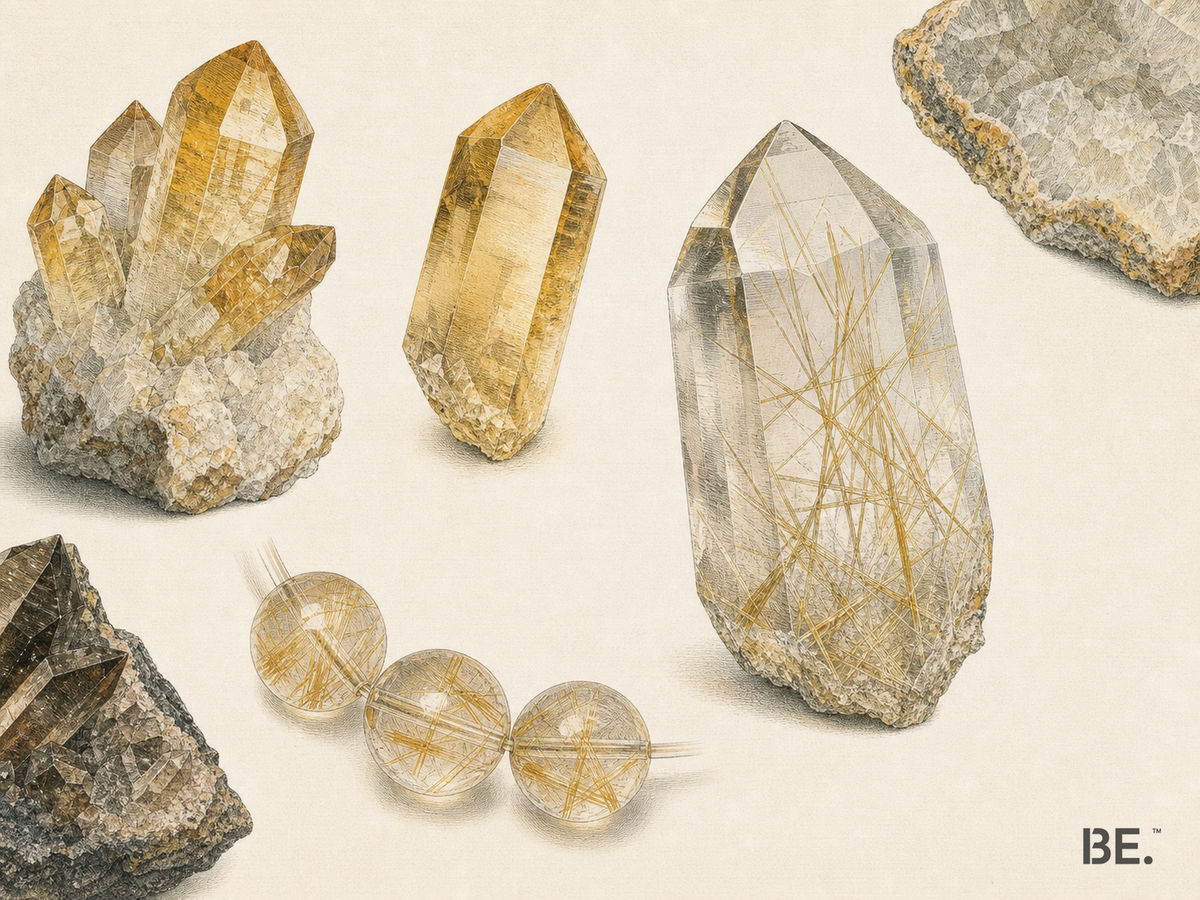
Why are the two yellow structures different?
Citrine’s yellow is body colour; golden rutilated quartz displays separate rutile inclusions. Citrine is macrocrystalline quartz whose yellow, orange or brownish colour is linked to trace elements, defects and geological or treatment history, and the cause varies between specimens. The colour occupies the quartz itself, although zoning and unevenness can occur.
Rutile is titanium dioxide. When slender rutile crystals are enclosed by quartz, they can appear gold, copper, red-brown or dark depending on thickness, orientation and light. The quartz host may be colourless or smoky. The word “golden” describes reflected appearance, not a chemical analysis and not metallic gold.
Both materials inherit quartz’s basic Mohs hardness near 7. Rutilated quartz adds interfaces, inclusions and often fractures that can influence cutting and wear. Citrine can also contain fractures or inclusions. The shared host does not make every bead equally durable or valuable.
How do citrine and golden rutilated quartz compare?
| Point | Citrine | Golden rutilated quartz |
|---|---|---|
| Main visual principle | Yellow-to-orange body colour | Gold-coloured rutile needles inside quartz |
| Host | Quartz | Quartz, which may be clear, pale or smoky |
| Key internal feature | Colour centres; inclusions may occur but do not define citrine | Rutile inclusions define the variety |
| Mohs hardness | About 7 | About 7 for the quartz host |
| Clarity target | Transparency and attractive colour with acceptable natural features | Enough host clarity to read the rutile composition |
| Treatment question | Natural colour, heat history and any irradiation or coating | Host treatment, coating, filling and whether needles are correctly identified |
| Price drivers | Colour, natural/treatment status, clarity, cut, size and matching | Needle contrast and composition, host clarity, condition, size and matching |
| Visual rhythm | More continuous and matchable | More variable; each bead can contain a different line arrangement |
Neither column has one universal top grade. A pale natural citrine may appeal more than a darker heated stone; another buyer may prefer saturated colour with full disclosure. A sparse, precise rutile arrangement can be stronger than a crowded one. Quality language should describe the actual bead set and leave visual density as a matter of taste.
What does quality mean for citrine?
Judge citrine by colour, transparency, evenness, condition, cutting and treatment disclosure. Attractive citrine ranges from pale yellow through golden and orange-brown. Personal preference matters, while patches of unintended dullness, obvious surface damage and weak bead matching remain object-level observations.
Some citrine in commerce is amethyst heated to alter colour. CIBJO allows heated material to use the trade name “Citrine, or Yellow Quartz” when “Heated” is disclosed. Natural material, natural colour, synthetic origin, heat, irradiation and coating remain separate claims; unsupported claims require narrower wording.
Inspect the set, not only the hero bead. Move the bracelet through neutral light and compare hue, saturation, transparency, drill holes and polish. Colour concentrated at a surface coating or fracture deserves questions, but a photograph or one visual feature cannot prove natural colour or reconstruct treatment history. A coloured-stone laboratory report may state natural or synthetic origin and list treatments detected by the laboratory; it should not be promised as proof that every past heating event will always be identified.
What does quality mean for golden rutilated quartz?
Judge golden rutilated quartz as a composition of needles, host and cutting. Rutile should remain legible against the quartz. Parallel sprays, crossing networks and sparse single needles create different rhythms. “More” is not automatically better: dense overlap can hide the host, while too little contrast can make the inclusion disappear in ordinary light.
Host clarity is valuable only insofar as it serves the desired composition. Veils and fractures may add depth, but surface-reaching damage near a drill hole changes wear risk. Look for chipped holes, unstable fractures and polish interruptions. A beautiful internal scene does not excuse a mechanically weak bead.
Needle identity also matters. Not every gold-coloured line in quartz is rutile, and colour language is not mineral analysis. A reliable seller should name rutile when that is the supported identification and avoid “gold threads” language that can be read as literal metal.
Which yellow quartz should you choose?
Choose citrine for continuous warmth; choose golden rutilated quartz for internal line architecture. Citrine can form a quieter sequence because colour carries across the bead surface. Rutilated quartz turns each bead into an individual field, so variation is part of the design.
Comparisons must be like-for-like. A heated citrine and a documented natural-colour citrine do not represent the same claim. A cloudy, fractured rutilated quartz and a clean host with well-composed needles do not represent the same object. Compare size, treatment, condition, cutting and seller evidence before declaring one material “rarer”. For finished-bracelet price, size, fit and construction, the Citrine bracelet buying guide provides a like-for-like checklist.
- For colour continuity: compare citrine hue and matching under neutral light.
- For internal composition: rotate rutilated quartz and read the needle field from several angles.
- For disclosure: separate natural identity, colour treatment and other processes.
- For condition: inspect surface-reaching fractures and drill holes on every side.
- For value: ask what feature creates the premium and what evidence supports it.
- For wear: remember that both use quartz, while individual fractures and construction still control risk.
The two product routes below express the two visual structures directly. They are current exact PDP mappings, not evidence that every citrine or rutile strand has the same treatment history or internal scene.
Frequently asked questions
Q1. Is golden rutilated quartz a type of citrine?
No. Citrine is yellow quartz whose colour belongs to the host crystal. Golden rutilated quartz is quartz containing visible rutile needles. Its host can be colourless, pale or smoky; the golden lines are inclusions, not citrine identity.
Q2. Does golden rutilated quartz contain real gold?
No. The golden needles are normally rutile, which is titanium dioxide. “Golden” describes their appearance. A seller should not use the colour word to imply precious-metal content.
Q3. Which is rarer: citrine or golden rutilated quartz?
There is no universal winner: fine natural citrine is uncommon, while well-composed transparent rutilated quartz is selective. Compare the actual material and disclosure, not a broad rarity slogan.
Q4. Does more rutile always mean higher quality?
No. Dense rutile can be dramatic, but excessive overlap may obscure the host or accompany fractures. Quality depends on needle contrast, composition, host clarity, condition, cutting and personal preference, not needle count alone.
Q5. Which yellow quartz bracelet should I choose?
Choose citrine for a continuous warm body colour and calmer matching. Choose golden rutilated quartz for visible internal lines and greater bead-to-bead variation. Then compare treatment disclosure, fractures, drill holes, size and price.
References
- [1] GIA: Citrine Quality Factors: colour, clarity, cut and commercial quality context
- [2] GIA: Rutile star in quartz: rutile identity and inclusion structure
- [3] GIA: Quartz treatment and identification context: quartz varieties and material background
- [4] CIBJO: Official Gemstone Book 2022, pp. 15–16, 69: treatment disclosure and Heated terminology
- [5] Gem-A: Understanding and Testing for Rare Natural Citrine: colour mechanisms and visual/testing limits
Field Notes.
One stone at a time: its geology, and how to read quality. The Stone Buying Checklist comes with your first email.
By subscribing you agree to receive emails from BE. Unsubscribe anytime.
Sent. Check your inbox.