
Golden Rutilated Quartz: Why Two Strands Can Cost €50 or €2,000
Five mineralogical variables explain why golden rutilated quartz strands vary 10-15x in price. Learn to read needle density, base transparency, and strand uniformity.
In this field note
Hold two 8 mm golden rutilated quartz strands side by side. Same bead count, same circumference, same mineral species. One carries a €50 price tag; the other, €2,000. The difference is invisible to a casual glance — and entirely obvious once you know where to look.
This is not a story about marketing. It is a story about titanium dioxide, optical physics, and the geological lottery that determines whether a quartz crystal traps a sparse scatter of pale fibres or a dense, evenly distributed array of deep-gold needles suspended in ice-clear silica. Understanding these variables does not require a geology degree. It requires about ten minutes and a willingness to look closely.
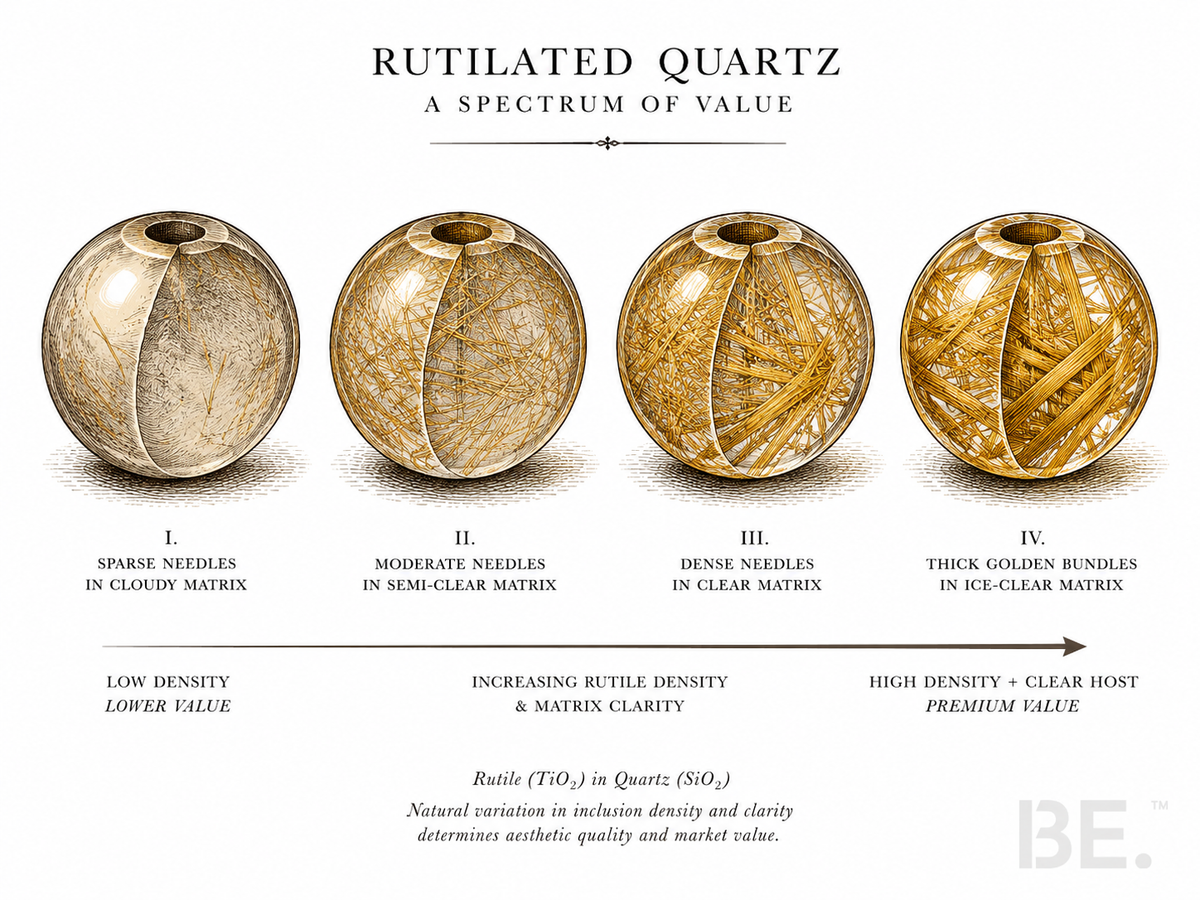
What makes golden rutile ‘golden’
Rutile is a naturally occurring polymorph of titanium dioxide (TiO₂). When rutile crystals nucleate inside a growing quartz host, they form acicular (needle-shaped) inclusions through epitaxial growth — the rutile lattice aligns along specific crystallographic planes of the quartz. This is not a random event; it requires particular conditions of temperature, pressure, and chemical saturation during the quartz’s formation in hydrothermal veins, typically at depths of 5–15 km.
The characteristic golden colour arises primarily from Fe³⁺ (ferric iron) substituting for Ti⁴⁺ within the rutile lattice. Higher iron substitution shifts the colour from pale straw-yellow toward a saturated copper-gold. The degree of substitution varies between individual needles and between deposits — which is why “golden” rutilated quartz ranges from barely tinted to deeply amber. Most gem-grade material with strong gold saturation originates from pegmatitic and hydrothermal deposits in Minas Gerais, Brazil.
The five variables that drive price
Price in golden rutilated quartz is not arbitrary. It follows a grading logic rooted in how light interacts with the inclusion pattern. The table below outlines the five dimensions that separate a €50 strand from an €2,000 one.
| Variable | Low grade (€50 range) | Mid grade | High grade (€2,000 range) |
|---|---|---|---|
| Needle density | Sparse — fewer than 5–8 visible needles per bead, or so dense the bead is opaque | Moderate density with some transparency | Dense yet transparent — abundant needles clearly visible through a clear matrix |
| Needle colour consistency | Mixed tones: some needles pale straw, others brownish, uneven saturation | Predominantly gold with minor variation | Uniform deep gold across all needles within each bead |
| Base transparency | Milky, cloudy, or smoky matrix that obscures the needles | Semi-transparent with slight haze | Ice-clear: the quartz host is colourless and highly transparent, maximising needle visibility |
| Distribution pattern | Needles clustered to one side or concentrated in patches | Reasonably even distribution | Even three-dimensional distribution, or rare radiating/cat’s-eye patterns (collector grade) |
| Strand uniformity | High bead-to-bead variance — some beads dense, others nearly empty | Minor inconsistencies across the strand | Consistent density, colour, and pattern across every bead in the strand |
These variables interact multiplicatively, not additively. A strand with excellent needle density but poor base transparency will still grade low because the needles cannot be seen clearly. Conversely, a strand with moderate density in a perfectly clear matrix often grades higher than an ultra-dense strand in milky quartz. The optical principle is simple: the value lies in what you can see, not merely what is present.
What you won’t see at €50
Low-grade golden rutilated quartz strands share a consistent set of characteristics. Recognising them is the fastest route to understanding the price spectrum.
- Opacity masking density. The most common issue: beads that appear “full of gold” at first glance, but on closer inspection reveal that the quartz matrix is milky or heavily included. The needles are there, but you are looking at them through fog. Without base transparency, the optical depth that defines fine golden rutilated quartz is absent.
- Colour inconsistency within a single bead. Needles range from pale silver-gold to dark brown within the same bead. This indicates variable Fe³⁺ concentration across different growth phases — geologically interesting, but aesthetically incoherent.
- Strand variance exceeding 40–50%. One bead may display a beautiful inclusion pattern while its neighbour is nearly clear or completely opaque. Matching beads across a full strand is one of the most labour-intensive steps in production, and it is the step most commonly skipped in budget material.
- Surface-reaching needles with pitting. In lower-grade strands, rutile needles often reach the bead surface. Because rutile is softer at exposed points and creates stress fractures, this results in small pits or channels on the bead surface — affecting both lustre and long-term durability.
- One-sided distribution. Needles concentrated on one hemisphere of the bead, leaving the other side effectively plain quartz. When strung, this creates a strand that only looks “rutilated” from certain angles.
None of these characteristics make a strand defective in a mineralogical sense. The rutile is real, the quartz is natural. But the optical and aesthetic result — and therefore the grade — differs enormously.
Reading a golden rutile strand
You do not need a loupe or specialist equipment to assess a golden rutilated quartz strand. Five observations, made in sequence, will give you a reliable read on grade.
- 1. Backlight test. Hold the strand up to a single light source (a phone torch works). Examine each bead for base transparency. In high-grade material, light passes cleanly through the quartz matrix and illuminates the rutile needles from behind, creating a glowing depth effect. In low-grade material, the light diffuses or stops at the surface.
- 2. Rotate for lustre. Roll individual beads between your fingers under a directional light. Fine rutile needles should flash — a subtle metallic lustre as the light angle changes. This indicates well-formed, smooth needle surfaces. Dull or matte needles suggest surface degradation or very thin fibre diameter.
- 3. Count density variance. Compare the three densest beads to the three sparsest. In a well-matched strand, the difference should be minimal. If you can immediately spot “the good ones” and “the empty ones” without effort, strand uniformity is low.
- 4. Check needles reaching surface. Run a fingertip slowly around each bead. If you feel tiny channels or pits where needles break the surface, the bead was cut without sufficient margin from the inclusion zone. This is common in material where manufacturers maximise yield from rough.
- 5. Lay flat for colour consistency. Place the strand on a white surface in even, diffused light. Scan the full circumference. Are all beads the same tone of gold? Or do some lean brown, others pale yellow? The eye adapts quickly when beads are viewed individually; laying the full strand flat forces a comparative reading.
Trade names, decoded
Golden rutilated quartz circulates under several names, some accurate, some misleading. Knowing the terminology helps when comparing across sources.
- Venus hair stone (金发晶). The most common trade name in East Asian markets. Refers specifically to golden rutilated quartz with fine, hair-like needle inclusions. Geologically identical to “golden rutilated quartz” — the name is purely commercial.
- Angel hair quartz. Sometimes used for extremely fine, densely packed needles that create a silky, fibrous appearance. A subset of golden rutilated quartz graded by needle fineness.
- Copper rutilated quartz. A misnomer in most cases. True copper inclusions in quartz are extraordinarily rare. What is sold as “copper rutilated” is typically golden rutilated quartz with high Fe³⁺ content producing a reddish-copper tone. Verify by colour: copper metal would appear metallic and opaque, not translucent gold.
- Titanium aura quartz. Not the same mineral. This is clear or milky quartz that has been coated externally with a thin film of titanium (or titanium + other metals) via chemical vapour deposition. The iridescent rainbow surface is artificial. Natural rutilated quartz has needles inside the crystal; coated quartz has a metallic film on the surface. The distinction is immediately visible under magnification.
For deeper context on rutilated quartz varieties and their distinguishing features, see our guides on smoky rutilated quartz and black rutile quartz versus tourmalinated quartz.
Caring for golden rutilated quartz
Golden rutilated quartz is a durable daily-wear stone. Quartz registers 7 on the Mohs hardness scale — harder than steel, glass, and most surfaces encountered in routine wear. The rutile needles themselves (Mohs 6–6.5) are protected within the quartz host and are not exposed to abrasion under normal conditions.
Daily wear: Safe for continuous wear. Remove before activities involving impact (sport, heavy manual work) to avoid fracture along any internal stress planes near dense inclusion zones.
Cleaning: Warm water with mild soap and a soft cloth. Rinse thoroughly and air-dry. This is sufficient for routine maintenance.
Ultrasonic cleaners: Use with caution. While solid quartz tolerates ultrasonic cleaning, heavily included specimens — particularly those with needles approaching the bead surface — may develop micro-fractures along inclusion boundaries under prolonged ultrasonic vibration. If your strand has visible surface-reaching inclusions, avoid ultrasonic and steam cleaning.
Chemical exposure: Quartz is chemically resistant to household cleaners, perfume, and cosmetics. No special precautions are needed beyond standard jewellery care.
How BE. grades golden rutilated quartz
Every strand undergoes assessment across the same five variables outlined above. The Crystal 4T framework — Transparency, Tone, Texture and Treasure — provides the grading structure. Each bead is evaluated individually, and the strand as a whole is assessed for uniformity before approval.
A Stone Origin Record accompanies each piece, documenting the specific grade characteristics of that strand: needle density rating, base transparency classification, and colour tone. This is not a certificate of authenticity alone — it is a record of where within the quality spectrum a particular strand falls and why it was selected at that grade.
The goal is straightforward: when the price of a strand reflects its mineralogical quality, the purchase decision becomes legible. You are not paying for a brand narrative. You are paying for what is — and is not — inside the stone.
Frequently asked questions
Q1 What mineral are the golden needles inside rutilated quartz?
The golden needles are rutile — a naturally occurring crystalline form of titanium dioxide (TiO₂). Rutile forms acicular (needle-shaped) crystals that become trapped within the quartz during its growth in hydrothermal veins. The golden colour results from iron (Fe³⁺) substituting for titanium within the rutile crystal lattice.
Q2 Why can two same-size golden rutilated quartz strands differ 10× in price?
Five mineralogical variables create the price range: needle density (sparse to optimally dense), needle colour consistency (mixed tones versus uniform deep gold), base quartz transparency (milky to ice-clear), distribution pattern within each bead (one-sided to evenly distributed), and bead-to-bead uniformity across the full strand. These factors interact multiplicatively — excellence in all five is rare and commands premium pricing.
Q3 Are more needles always more expensive?
No. There is an optimal density window. Too few needles produces a sparse, underwhelming appearance. But excessive density — where needles are so packed that the bead becomes opaque — actually reduces grade and price. The most valued specimens achieve high needle density while retaining full transparency of the quartz host, allowing light to penetrate and illuminate the inclusions from within.
Q4 Is “Venus hair stone” the same as golden rutilated quartz?
Yes. Venus hair stone (金发晶 in Chinese markets) is a trade name for golden rutilated quartz with fine, hair-like needle inclusions. The mineral composition is identical — quartz with rutile inclusions. The name references the appearance of the fine golden needles resembling strands of hair.
Q5 How can I tell natural rutilated quartz from coated titanium aura quartz?
The distinction is immediately visible. Natural rutilated quartz has needle-shaped inclusions inside the crystal — visible as distinct linear structures within a transparent host. Titanium aura quartz (also called titanium-coated quartz) has a metallic, iridescent rainbow film applied to the outside surface via chemical vapour deposition. Rotate the specimen: natural inclusions stay fixed inside; artificial coating produces surface-level rainbow iridescence that shifts uniformly with viewing angle.
Q6 Should high-quality golden rutilated quartz be transparent?
Yes. Base transparency is one of the strongest indicators of grade. In fine material, the quartz host is colourless and ice-clear, which allows full visual access to the rutile inclusions and permits light to create depth and lustre effects within the bead. A milky or cloudy matrix — regardless of how many needles it contains — significantly reduces both optical impact and assessed grade.
References
- Deer, W. A., Howie, R. A., & Zussman, J. (2013). An Introduction to the Rock-Forming Minerals, 3rd ed. Mineralogical Society of Great Britain and Ireland.
- Henn, U., & Schultz-Güttler, R. (2012). “Inclusions in quartz: fibrous and acicular minerals.” Journal of Gemmology, 33(1–4), 21–28.
- Mindat.org. “Rutile.” Retrieved from https://www.mindat.org/min-3486.html
- GIA (Gemological Institute of America). “Quartz Inclusions: Identification and Classification.” Gems & Gemology Reference Database.
- Minas Gerais Department of Geology. “Pegmatitic and Hydrothermal Quartz Deposits of Minas Gerais.” Geological Survey of Brazil (CPRM) Technical Report.
- Nassau, K. (2001). The Physics and Chemistry of Color: The Fifteen Causes of Color, 2nd ed. Wiley-Interscience.
- Rossman, G. R. (1994). “Colored varieties of the silica minerals.” Reviews in Mineralogy and Geochemistry, 29(1), 433–467.
Field Notes.
One stone at a time: its geology, and how to read quality. The Stone Buying Checklist comes with your first email.
By subscribing you agree to receive emails from BE. Unsubscribe anytime.
Sent. Check your inbox.