
Black Rutile Quartz vs Black Tourmalinated Quartz: Two Black Inclusions, One Critical Difference
How to tell black rutile (TiO₂) needles from black tourmaline (schorl) rods in quartz — visual tests, chemistry differences, and why the market confuses them.
In this field note
Two quartz beads can both show black linear inclusions while containing different minerals. Rutile and schorl have different chemistry and crystal structures, but a polished bead can blur the visual boundary between them.
This is a distinction BE. Crystal Jewellery has to make at the lot level, because the two are priced and described differently.Below, screening clues are kept separate from conclusive identification. For the broader trade term, start with the black rutilated quartz guide.
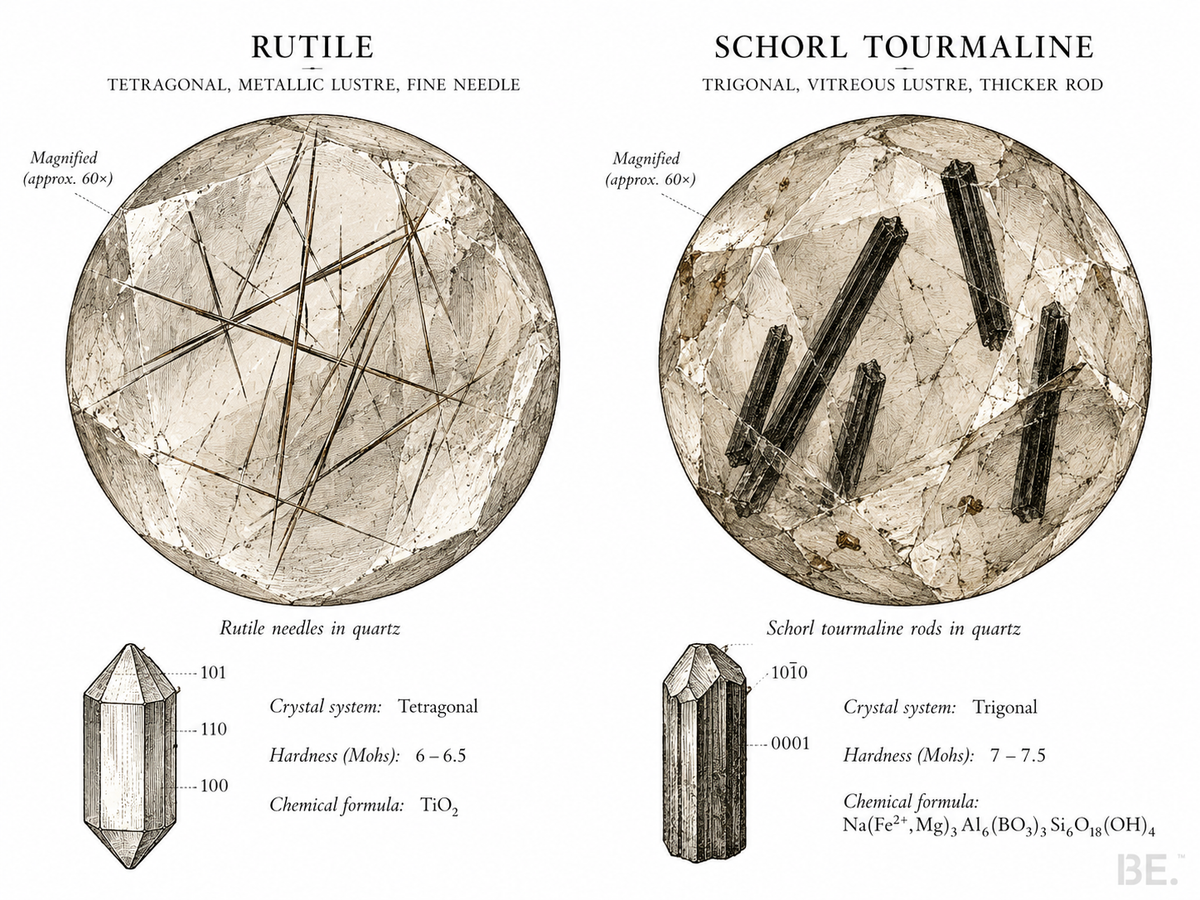
What each inclusion is
Rutile is titanium dioxide (TiO₂) in the tetragonal crystal system. In quartz it can occur as fine needles with several colours, including golden, reddish and dark appearances. Density, composition and viewing geometry may contribute; a dark needle or a 60° pattern is not, by itself, conclusive identification.
Black tourmaline (schorl) is the cyclosilicate NaFe²⁺₃Al₆(BO₃)₃Si₆O₁₈(OH)₄. Confirmed schorl inclusions may appear as opaque prismatic rods with longitudinal striations, but size, orientation and termination vary. Growth timing and fluid history require specimen-specific evidence.
Visual identification: the comparison table
| Feature | Black rutile (TiO₂) | Black tourmaline / schorl |
|---|---|---|
| Needle thickness | Very fine (0.1–0.5 mm); hair-like | Thick rods (1–3 mm); clearly visible width |
| Colour in strong light | Dark brown/reddish-black when backlit; translucent at edges | Opaque jet black even in strong transmitted light |
| Geometric pattern | 60° angle networks; star-burst or sagenite nets common | Random orientation; no angular relationship between rods |
| Surface texture | Smooth, glassy needle surface | Longitudinal striations visible under magnification |
| Termination | Tapered to a point; gradual thinning | Blunt, broken, or flat-ended |
| Flexibility appearance | May appear slightly curved in long specimens | Rigid, straight, rod-like |
Where each forms
| Origin | Typical inclusion type | What to expect |
|---|---|---|
| Bahia, Brazil (Novo Horizonte) | True rutile; golden to dark depending on Fe content | Fine geometric needles; the global benchmark for rutilated quartz |
| Minas Gerais, Brazil | Both rutile and tourmaline occur in separate deposits | Verify by needle thickness and geometry; don’t assume based on origin alone |
| Guangdong, China | Primarily true rutile, often very dense dark bundles | High needle density can make golden rutile appear black en masse |
| Madagascar | Both types reported; tourmalinated more common in pegmatite zones | Check rod thickness. Malagasy tourmalinated quartz is textbook thick-rod material |
| Namibia, Pakistan | Classic tourmalinated quartz sources | Thick schorl rods, often sold correctly labelled |
Reading a strand for inclusion identity
- Backlight test. Hold a neutral light behind the bead and record edge colour and opacity; rutile and schorl observations can overlap.
- Geometry. Record networks, rods and angles as screening clues, not a species verdict.
- Surface and termination. Magnification may show striations, tapering or blunt ends, but cutting and breakage can change them.
- Condition. Inspect host fractures, drilling and surface-reaching inclusions separately from identity.
- Confirmation. Use Raman or equivalent gemmological analysis when the mineral name affects value or disclosure.
Once identity is established, compare the observed rutile colour range in black vs golden rutilated quartz.
Trade names, decoded
- Black rutilated quartz. Should mean TiO₂ needles that appear dark. In practice, used interchangeably (and incorrectly) for both true dark rutile and tourmalinated quartz.
- Tourmalinated quartz. The correct name when schorl or another tourmaline inclusion is supported. Do not infer seller motive from a loose trade label; ask what evidence supports it.
- Black needle quartz. A deliberately vague trade name that avoids committing to either mineral identification. Treat with suspicion.
- Schorl in quartz. The technically precise mineralogical term for tourmalinated quartz. Rarely used commercially.
- Dark rutile / iron rutile. Refers to genuine TiO₂ with high Fe³⁺ substitution causing dark colouration. Legitimate subcategory of rutilated quartz.
Caring for both types
Both quartz varieties sit at Mohs 7. Tourmaline is 7–7.5; rutile is 6–6.5 but fully encased. Neither requires special care beyond standard crystal bracelet maintenance: avoid harsh impacts, clean with lukewarm water and soft cloth, store separately to prevent surface scratching between beads. Neither type’s inclusions are affected by water, light, or temperature under normal wearing conditions.
How BE. grades rutilated quartz
BE. records the supplied and observed inclusion description on the lot record. Crystal 4T then grades Transparency, Tone, Texture and Treasure without converting appearance into unsupported provenance.
BE. Crystal Jewellery states an inclusion mineral as analytically confirmed only where a lot-specific test supports it.Frequently asked questions
Q1. Are black rutilated quartz and tourmalinated quartz the same stone?
No. They share the same host mineral (quartz, SiO₂) but contain completely different inclusions. Black rutile is titanium dioxide (TiO₂); tourmaline is a complex borosilicate (schorl). The chemistry, crystal structure and formation conditions all differ.
Q2. Which is more valuable?
Value is lot-specific and reflects confirmed identity, host clarity, inclusion pattern, condition, cut, provenance and demand. Price is not an identity test, and dark rutile does not carry a universal premium.
Q3. Can a jeweller tell them apart without a lab?
A jeweller can screen thickness, geometry, lustre and backlighting, but these clues overlap and are not always conclusive. Raman or equivalent analysis can distinguish rutile from schorl when identity matters.
Q4. Why do sellers mislabel tourmalinated quartz as rutilated?
The bead trade often uses “black rutilated quartz” loosely for several dark needle inclusions. Ask what observation, supplier record or analytical test supports the label rather than assuming intent.
Q5. Can both types appear in the same stone?
More than one inclusion mineral can occur in quartz, but a mixed claim should be supported by specimen-specific evidence. Visual complexity alone does not confirm both rutile and schorl.
Q6. Does tourmalinated quartz have any advantages over rutilated?
Tourmalinated quartz can offer strong black-on-clear contrast and a different prismatic texture. Price and preference vary by lot; neither inclusion mineral is automatically the better choice.
References
- Mindat: Rutile mineral data
- Mindat: Schorl (black tourmaline) mineral data
- Wikipedia: Rutilated quartz
- Wikipedia: Tourmaline
- Deer, W.A., Howie, R.A. & Zussman, J. (2013). An Introduction to the Rock-Forming Minerals, 3rd ed. Mineralogical Society.
- Webster, R. (2002). Gems: Their Sources, Descriptions and Identification, 5th ed. Butterworth-Heinemann.
Field Notes.
One stone at a time: its geology, and how to read quality. The Stone Buying Checklist comes with your first email.
By subscribing you agree to receive emails from BE. Unsubscribe anytime.
Sent. Check your inbox.