
Natural vs Heated Citrine: A Material-First Honest Look
An honest comparison of natural citrine and heated amethyst citrine — both are quartz, both are natural in mineralogical sense, and what the labels actually mean.
In this field note
Heated disclosure; it should not be sold as natural or untreated citrine. Synthetic quartz and glass imitations are separate material categories. CIBJO Official Gemstone Book, printed pp. 15–16 and 69; Gem-A testing review.The essential distinction: material identity versus colour history
“Natural” can describe the quartz material or the colour, and those are not interchangeable claims. A heat-treated amethyst began as mined natural quartz, but its yellow colour was produced by a treatment after mining. Calling it simply “natural citrine” removes the fact the buyer needs most.
| Category | Material identity | Colour history | Minimum honest disclosure |
|---|---|---|---|
| Natural-colour citrine | Mined quartz | Colour developed without human treatment | Natural-colour or untreated citrine, only when evidence supports it |
| Heated citrine | Mined quartz, commonly amethyst | Human-applied heat changed the colour after mining | Citrine — Heated, or heated citrine / heat-treated amethyst |
| Laboratory-grown citrine quartz | Synthetic quartz | Grown by people; colour may reflect growth or later treatment | Laboratory-grown or synthetic quartz, plus any applicable treatment |
| Imitation | Glass or another look-alike material | Appearance imitates citrine | The actual material name; it must not be sold as quartz |
Dye, coating and artificial irradiation are treatments, not automatically proof that the underlying material is glass. They require their own disclosure rather than being hidden inside a generic “real citrine” label. CIBJO lists H for heated, R for artificial irradiation, D for dyed and C for coated materials. CIBJO, printed p. 16.
Why “Earth heat versus kiln heat” is too simple
Natural citrine colour is not established as one universal case of amethyst being geologically heated underground. Gem-A reviews several proposed natural-colour mechanisms, including aluminium-related irradiation colour centres and iron-oxide-related charge transfer, and notes that the subject remains complex. A human heat treatment and an unresolved natural geological history cannot be described as the same proven mechanism with only a different heat source. Gem-A.
Nor is there one diagnostic treatment temperature. The result of heating quartz depends on the starting material, temperature, duration and treatment environment. A number reported for one experiment, mine or commercial process must not become a universal threshold for every citrine specimen.
The complete citrine guide explains the two stages together: quartz growth first, yellow colour history second.
What appearance can suggest — and what it cannot prove
Buyer-visible observations and gemmologist-observed features require different methods and should not be given equal weight.
Buyer-visible observations
| Observation | Possible interpretation | Practical limit |
|---|---|---|
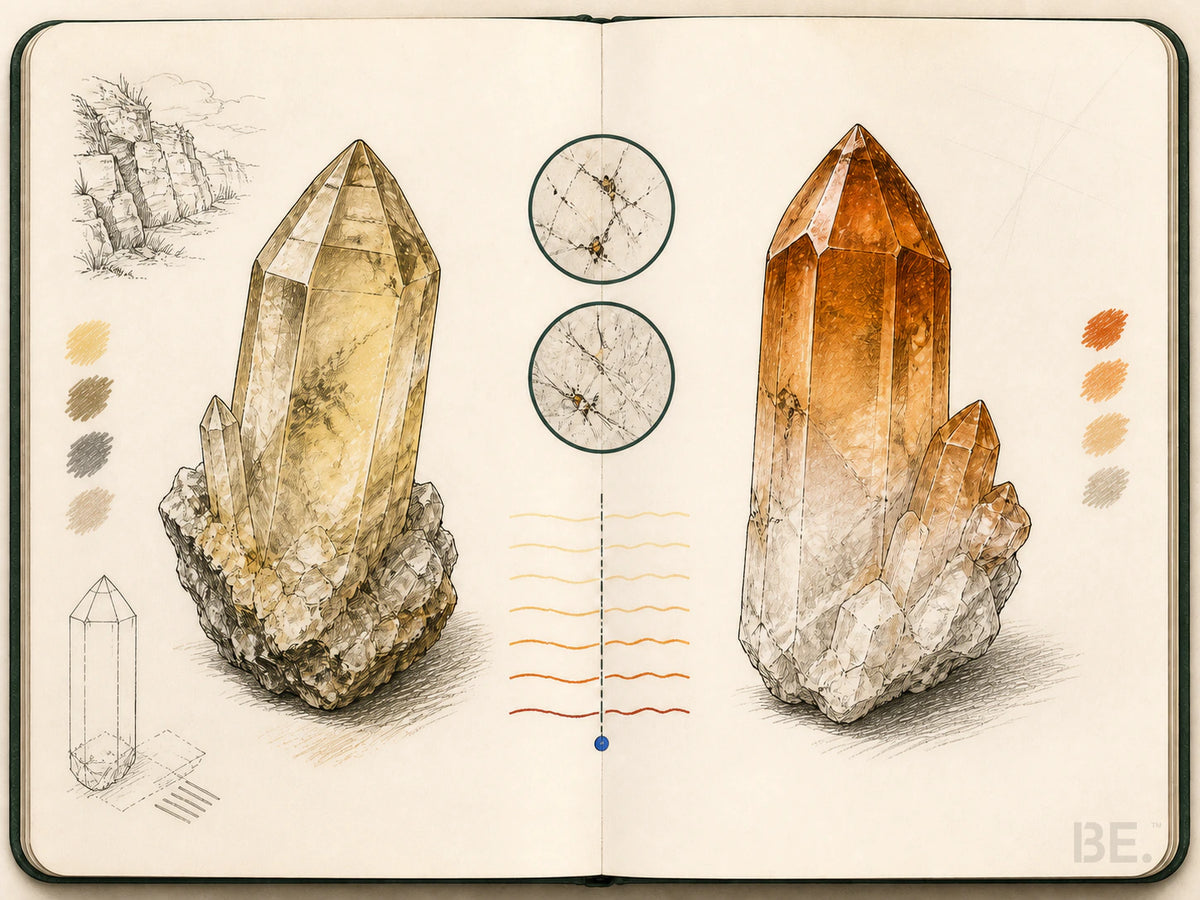
| Pale or relatively even yellow | Seen in some natural-colour citrine | Heated, synthetic and photographed material can overlap |
| Deep orange or brownish orange | Common in some heat-treated material | Record the hue, then ask for treatment disclosure; hue alone is inconclusive |
| A white-looking base or amethyst-style tip zoning in a crystal point | May be consistent with heated amethyst in some specimens | A cut bead can lose the base, tip and original crystal geometry |
Madeira, Palmeira, raw, mine country or seller origin |
Describes colour, finishing state or a commercial representation | Check the separate treatment and provenance evidence |
Features for a trained observer
| Feature | What the term means | Method required | Limit |
|---|---|---|---|
| Weak-to-moderate dichroism | Direction-dependent colour seen in some suitable samples | Controlled orientation with a dichroscope or polarising setup, interpreted by a trained observer | Saturation, cutting and orientation affect visibility |
| Tiger-stripe inclusions | Patterned internal features described in some amethyst-related samples | Gemmological microscopy | A single inclusion does not reconstruct the full colour history |
| Brazil-law twinning | A quartz twin structure that can produce a characteristic optical pattern | Controlled observation between crossed polarisers by a trained observer | The feature must be interpreted with other evidence |
| Brewster fringes | Optical interference or strain bands seen under suitable viewing conditions | Polarising equipment and, where needed, microscopy | Their presence or absence is not a stand-alone treatment determination |
Gem-A presents colour distribution, dichroism, zoning and microscopic features as evidence to interpret together. Buyer-visible colour observations can guide questions; the technical features above require orientation control, equipment and trained interpretation. Gem-A testing review.
Why raw-crystal rules weaken in finished beads
Many online comparisons use complete crystal points or geodes. A round bead has already lost much of that evidence: the original tip, base, growth direction and external morphology may have been cut away. Drilling can expose a pale area without proving that the whole stone began as heat-treated amethyst, and a strand photograph can hide rotation, zoning and white-balance differences.
A finished-bead check should therefore begin with material disclosure and non-destructive observation, then move to documented evidence. It should never ask the buyer to scratch, burn or deliberately damage the jewellery.
To assess quartz versus imitation, finished-bead surfaces, documentation and construction quality together, use the citrine bracelet authenticity guide.
Evidence ladder for a treatment claim
- Single seller photograph: useful for deciding what to inspect; cannot prove material or treatment.
- Neutral-light photographs and rotation video: better for documenting colour distribution; still not proof.
- Seller's written material and treatment disclosure: commercially important and auditable, but still a seller representation.
- Supplier or lot record: improves traceability when its scope and chain of custody are clear; not automatically an independent laboratory opinion.
- Independent gemmological report: can identify material and report treatments detectable by the laboratory's methods.
-
A conclusion limited to the evidence: the strongest wording may still be
no treatment detected,heated,synthetic,imitationortreatment history unresolvedrather than an absolute claim.
GIA states that its coloured-stone identification service identifies material as natural or synthetic and lists detectable treatments. “Detectable” is the boundary: a report should not be paraphrased as a guarantee that the stone was never heated. GIA Colored Stone Reports.
A 1981 GIA article reported that no test then known could distinguish the natural and artificial colour components in the bicolour amethyst-citrine quartz it examined. That historical, sample-specific conclusion should not be expanded into “modern laboratories can never evaluate any citrine”. Kurt Nassau, Gems & Gemology, 1981.
What a seller should disclose
Before purchase, ask for written answers to these questions:
- Is the material mined quartz, laboratory-grown quartz, glass or another material?
- Is the colour represented as naturally occurring, heated, irradiated, dyed or coated?
- If the starting material is known, was it amethyst, colourless quartz or another quartz variety?
- What evidence supports the statement: seller knowledge, supplier document, lot record or independent report?
- If there is a report, what sample did it test and what treatments does it actually address?
If the starting material or mine is not documented, the seller should record it as unknown rather than infer an origin.
CIBJO states that treatment information should be given before sale and shown with the gemstone name in relevant commercial documents and price-bearing promotion. When treatment is suspected but not documented, detectable or economical to establish, the standard favours disclosing the possibility rather than silently omitting it. CIBJO, printed pp. 15–16.
Does treatment affect value?
Treatment status and disclosure can change the commercial category and a buyer's willingness to pay; they do not change the geological rarity of natural-colour citrine. Colour, cut, size, matching, construction, metal, documentation, repair terms and market context also matter. Compare those factors within one bracelet type using the citrine bracelet buying guide. For the separate supply question, see why citrine is rarer than amethyst.
Care
Both untreated and heated citrine are quartz. GIA recommends warm, soapy water for cleaning and cautions against sudden temperature changes. A finished bracelet may require stricter care because of its cord, clasp, adhesive, plating or mixed materials. GIA Citrine Buyer's Guide.
Frequently asked questions
Q1.Is heat-treated citrine fake?
Not in the same sense as glass. It can be mined natural quartz whose colour was changed after mining. It should be labelled as heated and must not be represented as untreated or natural-colour citrine. CIBJO Official Gemstone Book.
Q2.Are natural-colour and heated citrine chemically identical?
Both can be quartz, but shared mineral identity does not establish an identical colour mechanism or treatment history. Their disclosure and rarity are different.
Q3.Does orange colour or a white base prove heat treatment?
No. Both may be useful observations in context, but neither is conclusive by itself. Cutting, lighting and natural variation create overlap. Gem-A.
Q4.Does raw citrine mean untreated citrine?
No. Raw describes the cutting or finishing state. It does not prove that the colour was untreated.
Q5.Can the country of origin prove that citrine is natural-colour?
No. A locality statement and a treatment conclusion are different claims. Both require their own evidence.
Q6.Can a laboratory always prove whether citrine was heated?
Laboratories can identify natural versus synthetic material and report treatments detectable with their methods, but a responsible conclusion may retain uncertainty. GIA Colored Stone Reports.
References
- CIBJO — Official Gemstone Book 2022 — printed pp. 15–16 disclosure requirements and treatment codes; p. 69 citrine/yellow-quartz table.
- GIA — Citrine Gemstone — citrine identity, market treatment overview, synthetics and imitations.
- GIA — Citrine Quality Factors — natural rarity, market treatment and quality factors.
- GIA — Citrine Buyer's Guide — care and report context.
- GIA — Colored Stone Analysis and Identification Reports — natural/synthetic identification and detectable-treatment reporting scope.
- Gem-A — Understanding and Testing for Rare Natural Citrine — terminology, proposed colour mechanisms, heat treatment, visual clues and gemmological limits.
- Kurt Nassau — Artificially Induced Colour in Amethyst-Citrine Quartz, Gems & Gemology 1981 — historical and sample-specific analytical boundary; not a universal modern no-test rule.
Field Notes.
One stone at a time: its geology, and how to read quality. The Stone Buying Checklist comes with your first email.
By subscribing you agree to receive emails from BE. Unsubscribe anytime.
Sent. Check your inbox.