
Emerald Phantom Quartz: Rare Green Inclusions & Origins
A geology-first guide to emerald phantom quartz — what makes the green colour rare, how the chlorite ghosts form, and how to read a strand.
In this field note
The public name sounds simple, but it carries two traps. First, "emerald" describes the green impression; it does not turn quartz into emerald. Emerald is beryl, while this guide is about quartz. Second, "phantom" describes an internal growth record; it does not identify the green material by itself.
The central material question is the growth record. A readable phantom can show an earlier crystal surface enclosed by later quartz, while a green colour impression alone cannot establish the inclusion species, treatment history, locality or rarity of the finished object.
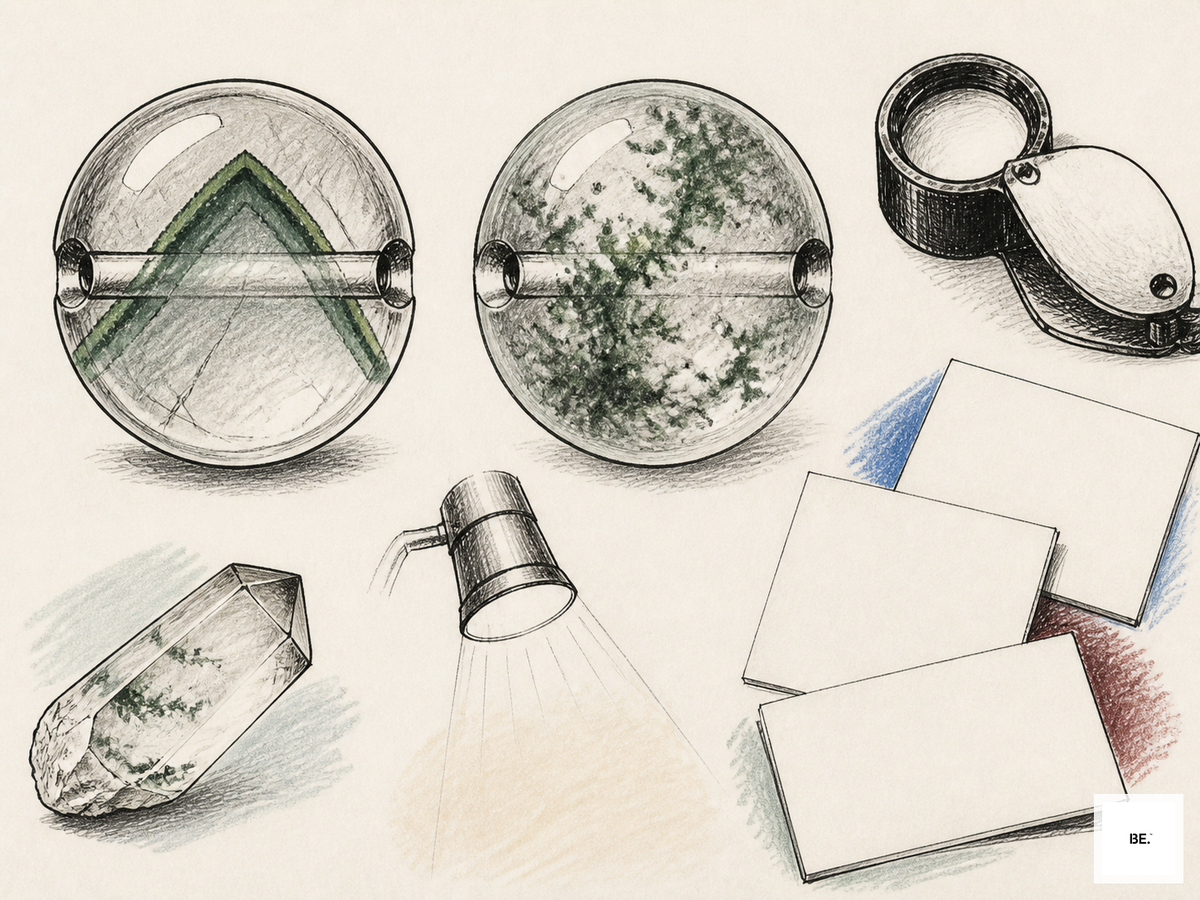
What emerald phantom quartz means
In strict material language, start with quartz. Quartz is SiO2 and sits at about Mohs 7. In a phantom crystal, an earlier crystal surface or growth stage remains visible inside later quartz growth. When that internal boundary is green, dealers may call the material emerald phantom quartz, green phantom quartz, chlorite phantom quartz, or related names depending on habit and selling context.
BE. should use the name as a readable commercial category, not as a mineral promise. A cautious definition is: green-included quartz in which a former growth surface can be read through the host. That definition lets the article explain the object without overclaiming a species or origin from colour alone.
It is not emerald beryl
Emerald belongs to the beryl mineral group. Quartz and beryl are different minerals with different chemistry and identification routes. A green quartz bead can imitate an emerald mood, but it does not become emerald because it is green, translucent, or expensive.
This matters for trust. "Emerald phantom quartz" is acceptable as a trade name when the article immediately explains the boundary. It becomes misleading if the page lets readers believe the bead is emerald, a beryl variety, or a guaranteed rare mineral class.
How the phantom forms
The useful part of the absorbed Ghost article is the growth record. A quartz crystal can grow, pause or change conditions, receive a coating or inclusions on its active surface, and then continue growing. Later quartz encloses that earlier surface. The result is a ghost-like internal outline, sometimes crisp, sometimes partial, sometimes broken by later fractures or cutting.
A sharp triangular or stepped boundary can make the history easy to see. It still does not prove how long the pause lasted, which mineral made the green layer, or which locality produced the crystal. Those are separate evidence fields.
What a finished bead can and cannot prove
A polished bead changes the evidence. It can show host clarity, colour distribution, drill placement, surface condition and the direction of the internal boundary. It can also hide the original crystal habit. A bead can support a phantom description when the boundary remains coherent through the quartz, but bead appearance alone cannot identify chlorite, fuchsite, fluorite, clay minerals, limonite or any other inclusion species.
| Visible feature | Useful reading | Boundary |
|---|---|---|
| Clear quartz host | Lets the internal plane or cloud remain readable. | Does not prove untreated origin. |
| Green internal boundary | Supports the commercial phantom description when it follows a former growth surface. | Does not identify the green mineral. |
| Diffuse green cloud | Can be attractive and material-rich. | May be inclusion texture rather than a readable phantom. |
| Drill edge and fractures | Shows finished-object durability risk. | Mohs 7 does not remove cleavage, fracture or construction concerns. |
| Supplier locality claim | Can be recorded as provenance if documented. | Geometry and colour alone cannot verify locality. |
Green inclusions and the lab boundary
Many older and dealer-facing descriptions default to chlorite. Chlorite is a plausible green inclusion family in quartz, but the article should not make chlorite the universal answer. Published gemmological notes describe phantom quartz inclusions using broader mineral possibilities, including clinochlore, clay minerals, limonite and fuchsite. BE. local Stone Record evidence for No.09 currently treats the Archive lot as quartz with CaF2 fluorite inclusions. That lot-specific record should be kept separate from the public definition.
For stronger conclusions, use the right evidence level: microscopy for internal relationships, refractive index for broad separation, Raman or similar spectroscopy for phase identity, and CT or comparable imaging when assembly or cement is suspected. GIA's emerald-imitation lab note is useful here because it shows how convincing green quartz appearances can still require lab separation.
Genuine, treated, or assembled
The article should not promise authentication from a blog checklist. It can, however, teach the decision boundary. Be cautious when green colour sits only at the surface, when drill holes show dye concentration, when repeated beads have unnaturally identical patterning, when the piece is sold as emerald without quartz disclosure, or when origin and treatment claims are presented without documentation.
Useful questions are concrete: what is the claimed host? What is the claimed inclusion? Is the inclusion internal or surface-reaching? Is the phantom plane readable across more than one viewing angle? Is there any lot, supplier or lab evidence behind a species or locality claim?
Emerald phantom, green phantom, garden quartz and chlorite quartz
These names overlap in the market, so the useful distinction is what each label can honestly describe. Emerald phantom quartz emphasises the emerald-like green impression; green phantom quartz is the broader description; garden quartz refers to a scenic field of inclusions; and chlorite quartz should be used only when chlorite is supported.
None of these labels replaces specimen-level evidence. The same finished bead can invite more than one trade description, but mineral identity, treatment and provenance remain separate claims.
How BE. evaluates a strand
For BE. jewellery, the standard is not "green equals rare." A stronger strand has a clear enough quartz host, a visible and coherent internal boundary, green material that remains readable without muddying the whole bead, careful drilling, and product-level disclosure for construction, care and any lot-specific inclusion claim.
- Transparency. The host should let the internal record remain visible.
- Tone. Green should have depth without becoming a flat dye-like field.
- Texture. The phantom, cloud, fractures and bead polish should be distinguishable.
- Treasure. The object should hold a sequence worth wearing, not only a rare-sounding name.
Care boundary
An intact quartz exterior is about Mohs 7, but that is not the whole object. Fractures, drill edges, surface-reaching inclusions, wire, elastic, clasp and any weaker included mineral set the practical limit. Keep emerald phantom quartz jewellery out of ultrasonic cleaners, steam, hot tubs, pools and repeated soaking. Clean with a dry or barely damp soft cloth and store it alone in a padded compartment.
If a BE. lot is specifically described as fluorite-included quartz, use the stricter care route for that object: no prolonged intense sun, no heat shock, no immersion, and no stacking against harder jewellery.
Emerald phantom strands are listed in the BE. collection, and every strand ships with a Stone Origin Record that states its lot, its four Crystal 4T™ readings and what those readings do not claim.
Frequently asked questions
Q1.Is emerald phantom quartz real?
It is real when used as a trade description for quartz with green internal inclusions and a visible phantom boundary. It is not emerald beryl and not a separate mineral species.
Q2.Is the green always chlorite?
No. Chlorite is possible, but bead colour alone cannot identify the inclusion. The green material may need microscopy, spectroscopy or a lot-specific record before it is named.
Q3.Is emerald phantom quartz rare?
Some readable green phantom quartz material is uncommon in jewellery-grade matched strands, but the name alone is not a rarity grade. Judge host clarity, phantom definition, condition, documentation and finished-object quality.
Q4.How is it different from green phantom quartz?
The two names often overlap. Emerald phantom quartz usually emphasizes an emerald-like green impression; green phantom quartz is the broader material description.
Q5.Can appearance prove locality?
No. Colour, geometry and bead pattern can suggest what to examine, but they cannot prove locality. Locality requires documented provenance or analytical evidence.
Q6.How should I care for it?
Use low-impact wear, clean with a dry or barely damp soft cloth, avoid soaking, heat, steam and ultrasonic cleaning, and store the piece by itself. Follow the stricter route if the lot includes fluorite or surface-reaching fractures.
References
Field Notes.
One stone at a time: its geology, and how to read quality. The Stone Buying Checklist comes with your first email.
By subscribing you agree to receive emails from BE. Unsubscribe anytime.
Sent. Check your inbox.