
Moonstone vs Pearl: Glow, Lustre and Durability
Moonstone is feldspar with adularescence; pearl is a biogenic gem with nacreous lustre. Compare light, hardness, care and bracelet use.
In this field note
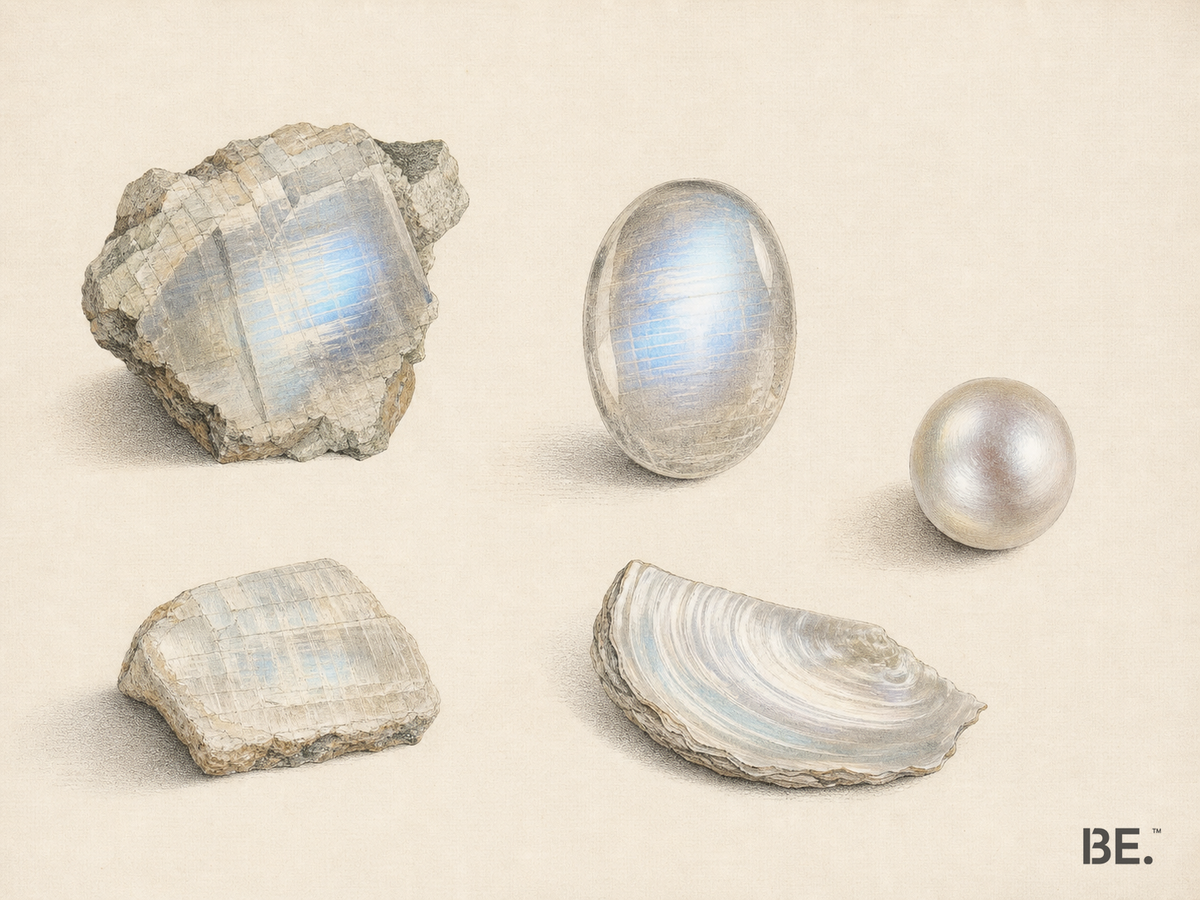
Both materials can hold a quiet white field crossed by blue, silver or rainbow light. That resemblance is strongest in a still photograph. In motion, moonstone often carries a floating band or cloud that shifts inside the bead, while pearl presents a surface-centred reflection with overtone and, in fine material, iridescent orient. The difference begins in structure.
Where do moonstone and pearl form?
Moonstone forms in rock; pearl forms inside a mollusc. Moonstone belongs to the feldspar mineral family. Its familiar optical effect is associated with fine intergrowth structures developed as feldspar cools and separates at a microscopic scale. Cutting orientation determines whether that structure produces a centred, mobile light on the finished surface.
Pearl is produced by a living mollusc around an irritant or implanted nucleus and mantle tissue, depending on pearl type and cultivation method. The mollusc deposits layers that include calcium carbonate and organic material. Nacre quality, thickness and surface condition shape the visible result. A pearl is a gem material, but it is not a mineral crystal in the same sense as moonstone.
Pearl disclosure covers natural versus cultured pearl, mollusc and environment, nucleus, treatments and nacre condition. Moonstone disclosure covers feldspar identity, variety name and treatment; on a BE. strand, the Stone Origin Record states each one. BE. moonstone is Indian potassium feldspar, recorded as Untreated.
How do moonstone and pearl compare?
| Point | Moonstone | Pearl |
|---|---|---|
| Material class | Feldspar mineral | Biogenic gem material |
| Formation | Geological crystallisation and fine feldspar intergrowth | Layer deposition by a mollusc |
| Optical effect | Adularescence: mobile light associated with internal microstructure | Lustre, overtone and orient associated with nacre layers and surface |
| Mohs hardness | About 6–6.5 | Much softer; commonly placed around 2.5–4.5 |
| Main care point | Hard knocks | Surface wear, drying out and chemicals |
| Common shape | Cut cabochons and beads | Natural or cultured round, near-round and baroque forms |
| Disclosure | Feldspar identity, variety name and any treatment | Natural or cultured, pearl type and known treatment |
| Bracelet use | Moderate-care mineral bead | High-care surface, especially exposed at the wrist |
Moonstone resists everyday scratches better than pearl; a hard knock is the one thing to avoid. Pearl picks up fine surface wear from desks, metal, cosmetics and other beads.
Why is their glow not the same?
Moonstone shows adularescence; pearl shows nacreous lustre, overtone and orient. In moonstone, light scatters and interferes within fine feldspar structures, producing a light field that appears to move as the stone or viewer moves. The best cut places that field in the centre of the dome or bead, where it shows.
Pearl light is closely tied to surface quality and the layered structure beneath it. Lustre describes the strength and sharpness of surface reflection. Overtone is an additional colour seen over the body colour. Orient is an iridescent play of colours produced by interference in fine nacre layers.
What can a photograph hide?
A front-lit photograph can make weak moonstone adularescence look centred or blur pearl surface blemishes. In hand, turn a moonstone strand under one lamp and watch the light travel across each bead. For pearl, look at reflection sharpness, surface condition, drilling and the match across the strand.
Does rainbow colour identify moonstone?
No. “Rainbow moonstone” is a trade term often applied to transparent plagioclase feldspar showing colourful phenomena. Opalite glass and other materials can mimic a blue or rainbow look. Pearl orient can also show multiple colours for a completely different structural reason.
How do durability and daily care differ?
Moonstone needs impact care; pearl needs impact, abrasion and chemical care. Remove both before exercise, showering, sleep and manual work. Keep them away from ultrasonic and steam cleaning. Wipe them with a soft, barely damp cloth.
Pearl deserves stricter surface protection. Perfume, hairspray, sunscreen and skin products should be applied first and allowed to dry before jewellery is put on. After wear, wipe the pearls with a clean soft cloth. Do not store them in an airtight, extremely dry environment or against harder gemstones and metal edges.
Store moonstone in its own pouch as well, and keep it away from hard knocks and sudden heat. The Crystal Care Chart lists care stone by stone.
Which soft light should you choose?
Choose moonstone for a moving feldspar light field; choose pearl for nacreous surface lustre and biological origin. Moonstone can feel more changeable as a bead turns. Pearl can carry a calmer reflection with overtone and orient distributed across the surface.
A wrist touches desks and surfaces all day, so pearl bracelets show surface wear faster than pearl earrings. Moonstone holds up better to that daily contact.
- Choose the optical effect: mobile adularescence or nacreous lustre and orient.
- Choose the origin: geological feldspar or mollusc-produced gem material.
- Choose the care load: moderate impact care or stricter surface and chemical care.
- Check disclosure: exact feldspar name, or natural/cultured pearl type and treatment.
- Check the object: drill holes, surface condition, matching and bracelet construction.
Choosing a first moonstone comes down to how strongly and evenly the blue sheen moves across the strand.
Frequently asked questions
Q1. Is moonstone the same material as pearl?
No. Moonstone is feldspar, a mineral formed in rock. Pearl is a biogenic gem material produced by a mollusc. Their soft appearance comes from different structures and optical effects.
Q2. Why do moonstone and pearl glow differently?
Moonstone’s adularescence comes from light interacting with fine feldspar intergrowths below the surface. Pearl lustre and orient come from reflection and interference across nacre layers. One is a moving internal-looking light; the other is tied strongly to the surface and layered nacre.
Q3. Which is harder, moonstone or pearl?
Moonstone is about Mohs 6 to 6.5. Pearl is much softer, roughly Mohs 2.5 to 4.5 depending on type and reference. Moonstone resists scratching better; avoid hard knocks.
Q4. Can moonstone or pearl get wet?
Brief contact with clean water is different from soaking. Avoid prolonged immersion, harsh cleaners and wet storage for both. Pearls are especially sensitive to acids, cosmetics, heat and dehydration; wipe them gently after wear.
Q5. Which is easier to wear in a bracelet?
Moonstone is generally easier against everyday abrasion. Pearl can work in a bracelet but needs more protection because wrists meet desks and surfaces often.
References
- [1] GIA: Moonstone, feldspar identity and adularescence
- [2] GIA: Pearl, pearl formation, structure and value context
- [3] GIA: Pearl care and cleaning, surface, chemical and storage care
Field Notes.
One stone at a time: its geology, and how to read quality. The Stone Buying Checklist comes with your first email.
By subscribing you agree to receive emails from BE. Unsubscribe anytime.
Sent. Check your inbox.