
Lab-Grown vs Natural Amethyst: What Actually Changes?
Lab-grown amethyst is synthetic quartz, not purple glass. Compare chemistry, growth origin, visual limits, laboratory separation and disclosure.
In this field note
The word “real” creates more confusion than clarity. A laboratory-grown quartz crystal is materially different from a purple glass imitation, yet it is also not a natural geological crystal. A treated natural amethyst adds a third route. Without precise labels, four different objects can be pushed into a false real-versus-fake choice.
The wider taxonomy belongs to Real vs Fake Crystals; natural amethyst colour, formation and varieties belong to the Amethyst Guide. This page uses amethyst as a focused case for separating synthetic origin from treatment and imitation.
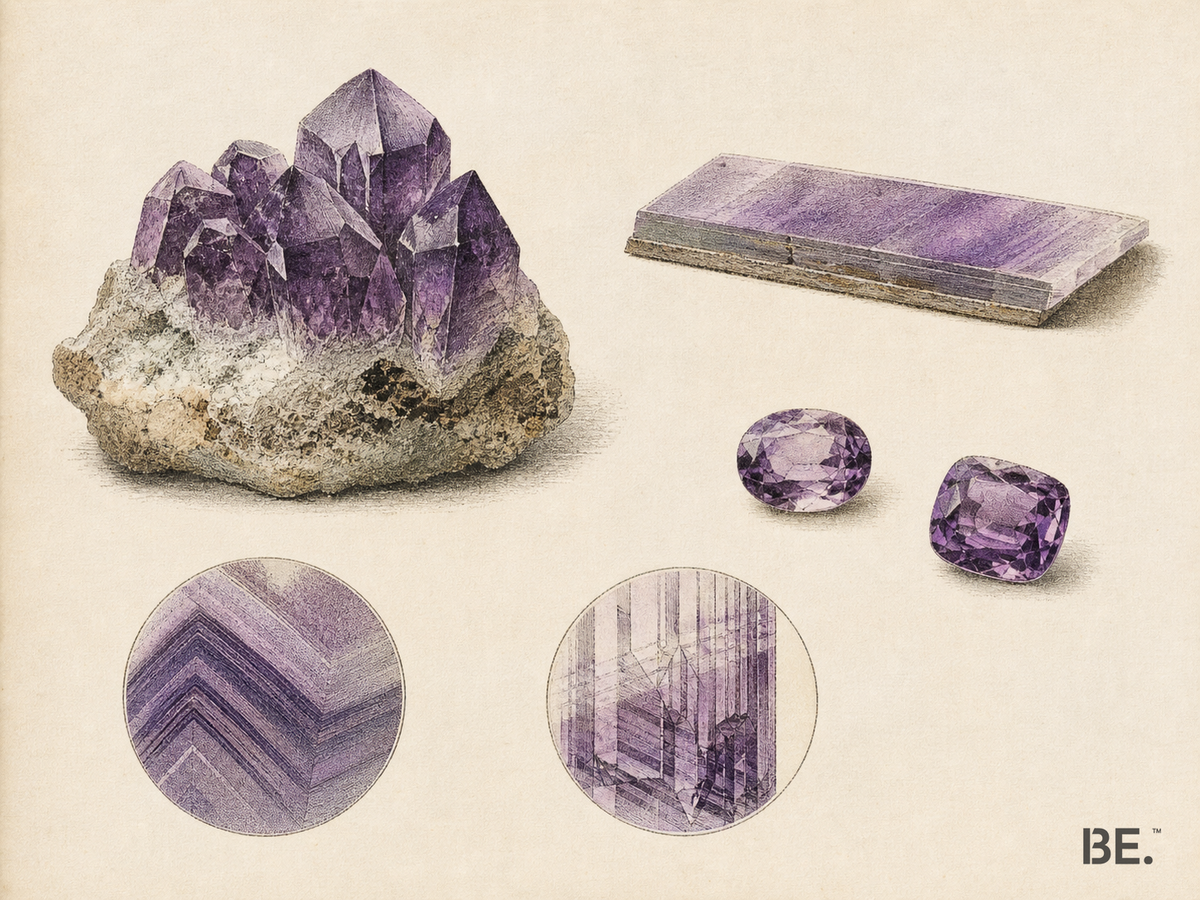
Which four labels must stay separate?
Natural, laboratory-grown, treated and simulant describe different facts. Natural amethyst formed in a geological environment. Laboratory-grown or synthetic amethyst crystallised in equipment under controlled conditions. A treated stone began as natural or synthetic material and was processed to change appearance or stability. A simulant only resembles amethyst.
- Natural amethyst: quartz formed through geological processes; natural does not automatically mean untreated.
- Laboratory-grown amethyst: synthetic quartz grown by people with corresponding composition and structure.
- Treated amethyst or quartz: natural or synthetic material altered by heat, irradiation, coating or another process.
- Simulant: a different material, such as purple glass, used to imitate amethyst’s appearance.
These categories can combine. A natural amethyst can be treated. A synthetic amethyst can also be treated. A glass simulant can be coated. The invoice should record material identity, origin category and treatment as separate lines, each stated on its own.
What stays the same, and what changes?
| Point | Natural amethyst | Laboratory-grown amethyst |
|---|---|---|
| Material identity | Quartz variety | Synthetic quartz variety |
| Basic composition | SiO₂ with trace defects linked to purple colour | SiO₂ grown to reproduce amethyst material |
| Crystal structure | Quartz | Quartz |
| Mohs hardness | About 7 | About 7 |
| Growth environment | Geological cavities, veins and other natural settings | Controlled hydrothermal equipment |
| Appearance | Purple hue, zoning, inclusions and clarity vary | Can overlap natural hue, zoning, inclusions and clarity |
| Rarity and provenance | Tied to natural occurrence and documented source | Production-dependent; no geological origin claim |
| Required disclosure | Natural plus known treatment | Laboratory-grown or synthetic plus known treatment |
Shared chemistry does not erase origin. Origin is part of the product identity because it affects scarcity, documentation and buyer expectation. Different origin does not turn synthetic quartz into glass. Precise language allows a buyer to prefer either route without being misled.
How is lab-grown amethyst made?
Commercial synthetic amethyst is commonly grown by a hydrothermal process. Nutrient material dissolves in hot pressurised solution and crystallises onto seed material in a cooler growth zone. Conditions and chemistry are controlled to produce quartz and purple colour. The process can take time and technical control; “lab-grown” does not mean moulded plastic.
Seed plates and controlled growth can leave structural or spectral evidence. Producers can also refine methods, so a clue described in an older guide may not appear in every modern stone. Identification therefore relies on a combination of observations, and no single folklore test settles it.
The industrial process is mentioned only to explain origin. It is not a household recipe. Pressurised hydrothermal equipment operates under hazardous conditions and belongs in controlled manufacturing and laboratory environments.
Why are visual “tests” unreliable?
Colour, clarity, inclusions and price overlap too widely to separate origin by eye. Natural amethyst can be evenly coloured or very clean. Synthetic amethyst can show zoning, inclusions or growth features. Purple glass can contain bubbles, but not every glass imitation does, and a bubble-like feature can be misread.
A dark saturated purple is not proof of synthetic growth. A pale uneven purple is not proof of natural growth. Camera editing, light source and bead thickness shift apparent colour. Even a seller’s close video mainly documents the offered object; it cannot replace the measurements required for origin determination.
Does a low price prove laboratory-grown origin?
No. Price can reflect size, colour, cutting, source, treatment, inventory and sales strategy. Synthetic supply can change cost, and low-quality natural material exists too. A price that looks out of line should trigger a disclosure request, not a diagnosis.
Are inclusions proof of natural origin?
No. Natural inclusions can support a conclusion when interpreted by a trained examiner, but synthetic crystals may contain inclusions from their growth environment. A surface scratch or polishing residue may also be mistaken for an internal feature. Identification depends on the whole evidence set.
What does a gem laboratory examine?
A laboratory combines microscopy, growth structures, twinning and spectroscopy. Natural and synthetic quartz can differ in Brazil-law twinning patterns, growth zoning, seed-related features, inclusions and infrared absorption. Research has shown FTIR features useful for separating many natural and synthetic amethysts, while also documenting limits and exceptional cases.
Twinning procedures can be effective only when the necessary features are visible and interpreted correctly. Infrared spectra require appropriate instruments and reference data. Some stones remain difficult. A responsible laboratory report states the conclusion at the level supported by the evidence, because not every purple quartz is simple.
For a buyer, the lesson is proportionate escalation. A modest bracelet with clear seller disclosure may not justify a full report. A large premium for natural origin, exceptional provenance or untreated status makes independent examination more sensible. The report must match the actual item.
What should a disclosure-first buying checklist require?
The sale document should state origin category and treatment in durable, specific words. “Amethyst”, “real amethyst” and “created amethyst” can leave different readers with different assumptions. Prefer “natural amethyst” or “laboratory-grown synthetic amethyst”, followed by a separate treatment statement.
- Material: quartz amethyst, not only “purple crystal”.
- Origin category: natural or laboratory-grown/synthetic.
- Treatment: known heat, irradiation, coating, filling or other processing listed separately.
- Evidence: report details for a premium natural-origin claim.
- Condition: fractures, polish and drill holes assessed apart from origin.
- Return path: terms that allow independent inspection when origin is material to the price.
The Treatment Disclosure Chart owns the wider process vocabulary. The High-Quality Amethyst Bracelet guide continues from identity to colour, matching and condition. The cards below are current natural-amethyst product routes; they are not used as visual templates for diagnosing other stones.
Frequently asked questions
Q1. Is lab-grown amethyst real amethyst?
Lab-grown amethyst is synthetic quartz with the basic chemical composition and crystal structure of amethyst. It is not naturally formed, so the correct identity is laboratory-grown or synthetic amethyst, not natural amethyst.
Q2. Is synthetic amethyst the same as fake purple glass?
No. Synthetic amethyst is crystallised quartz grown by people. Purple glass is a simulant: it may resemble amethyst but has a different material identity and structure. Both must be described accurately.
Q3. Can colour separate natural and lab-grown amethyst?
No. Natural and synthetic material can overlap in hue, zoning, transparency and inclusions. Strong colour, perfect clarity, bubbles or a low price may prompt questions, but none gives a universal origin verdict.
Q4. Do natural and lab-grown amethyst have the same hardness?
Both are quartz and are about Mohs 7 when correctly identified. Individual fractures, treatments, bead drilling and construction still affect wear, so equal mineral hardness does not make every bracelet equally durable.
Q5. What does a gem laboratory look for?
A laboratory may examine growth zoning, twinning, inclusions, seed-related features and infrared spectra, then combine the observations. No single visible feature works in every case, and some material needs advanced analysis.
Q6. What should a seller disclose?
The sale document should state natural or laboratory-grown amethyst and list known treatments separately. “Real amethyst” is too vague because it does not distinguish geological origin from synthetic quartz or treatment.
References
- [1] GIA: Synthetic Gem Materials: synthetic identity and disclosure
- [2] GIA: Natural and synthetic amethyst by FTIR: infrared separation and limits
- [3] GIA: Separating natural from synthetic amethyst by twinning: twinning method and applicability
Field Notes.
One stone at a time: its geology, and how to read quality. The Stone Buying Checklist comes with your first email.
By subscribing you agree to receive emails from BE. Unsubscribe anytime.
Sent. Check your inbox.