
Moonstone vs Opalite: Don’t Buy the Wrong Glow
Moonstone is feldspar with adularescence; retail opalite is commonly manufactured glass with an even blue-orange glow. Compare structure, optical movement and disclosure safely.
In this field note
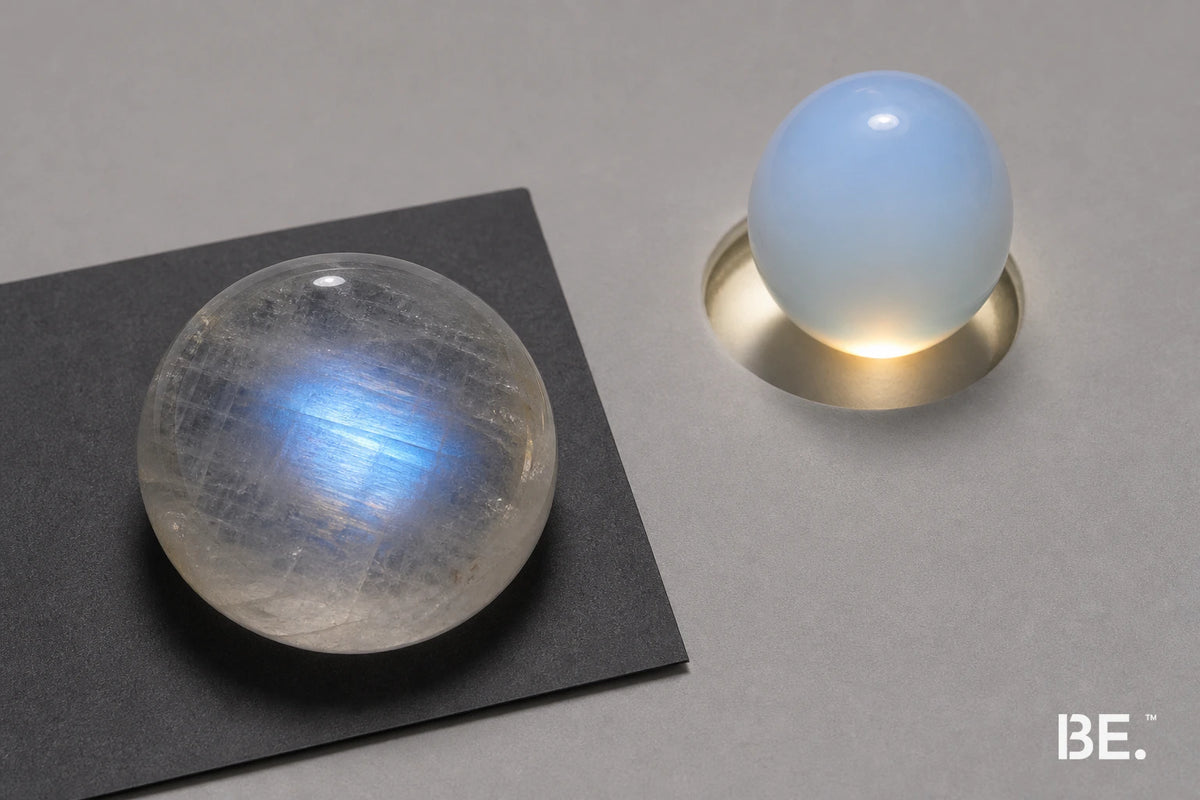
Both materials can look milky, blue and luminous in a product photograph. That shared palette is why the names are confused, but the light is produced differently. Moonstone is a natural feldspar material with an optical effect linked to fine intergrowth structures. Retail opalite is usually glass formulated to scatter light across the body.
The difference matters for price, rarity, care and the story attached to the object. Glass is not an inferior failure when sold as glass; it is a manufactured material with its own visual character. The problem is paying a natural-moonstone price for a bead whose identity has not been disclosed.
What is moonstone made of?
Moonstone belongs to the feldspar group. Its characteristic sheen, called adularescence, is associated with light scattering from extremely fine internal structures formed between feldspar phases. The effect can appear blue, white or silvery and seems to float below the polished surface.
Quality is not determined by body colour alone. A desirable bead may combine a clean or gently translucent body with a distinct moving sheen, good polish and limited surface-reaching fractures. Some natural inclusions, cleavage features and colour variation are compatible with feldspar identity; perfection is not the only sign of authenticity.
Moonstone also needs realistic care. Feldspar is softer than quartz and has cleavage, so a bead can scratch or chip if struck. The moonstone beginner’s guide covers varieties, body appearance, sheen and wearability in more depth.
What is opalite in jewellery listings?
In contemporary bead and jewellery retail, opalite most often means a translucent manufactured glass with a blue-white appearance in reflected light and a warm orange or amber appearance when light passes through it. The change is broad across the body, with no sharply localised band travelling under the surface.
The word is not a secure mineral identity. “Opalite” has also been used historically for natural common opal or other opal-like material. A listing should therefore state “manufactured glass” or the actual natural material, since readers do not all share the same trade-name convention.
Manufactured opalite can be attractive, consistent and durable enough for ordinary jewellery. Its value comes from glass formulation, cutting and design. Accurate description lets the buyer evaluate it within the right category.
How does moonstone glow differ from opalite glass?
Rotate a single bead under one broad light source. In moonstone, the most diagnostic visual clue is directional movement: a sheen or band appears to travel across or within the bead as the viewing angle changes. It may disappear entirely at some angles because the internal structure is oriented.
Opalite glass tends to show a smoother body-wide blue cast against dark surroundings and a warm orange glow when backlit. The effect is often more uniform from bead to bead. Uniformity is a clue, not proof; carefully selected moonstone beads can also be matched, and glass can be cut to vary.
Use both reflected and transmitted light, and examine several beads, including the plainer ones as well as the most dramatic. Product photographs with strong contrast can exaggerate either effect. A short unedited rotation video is more informative than a single image.
| Observation | Moonstone | Retail opalite glass | Limit |
|---|---|---|---|
| Material | Feldspar gemstone | Manufactured glass | Confirm by disclosure or testing |
| Main light effect | Directional adularescence | Broad blue-orange scattering | Photography can exaggerate both |
| Movement on rotation | Sheen often travels or disappears | Body glow usually remains even | Selected glass shapes may vary |
| Backlight | May reveal zoning, inclusions or translucency | Often turns warm orange | Not a stand-alone test |
| Bead-to-bead variation | Common in natural material | Often highly consistent | Sorting can change appearance |
Which home observations are useful and non-destructive?
Use a neutral background, diffuse daylight, a phone torch behind the bead and a 10× loupe if available. Record the same bead from the front, side and drill hole while rotating it. Look for a mobile subsurface sheen, internal planes, bubbles, flow features and whether the optical effect is local or body-wide.
Avoid scratch tests, hot needles, flames, acetone and deliberate impact. These can permanently damage glass, stone, coatings or stringing and still leave the identification uncertain. A temperature-to-touch comparison is unreliable because bead size and room conditions change the result.
If photographs are being sent for help, include an unedited video, a scale, the whole strand and close views of several different beads. One perfect marketing bead may not represent the lot. Keep the original listing and seller disclosure with the images.
What should you ask before paying a moonstone price?
Ask for the material line in writing: natural feldspar moonstone, treated moonstone, glass or another imitation. Ask whether the photographs show the exact bracelet, whether every bead displays adularescence, and whether any treatment or coating affects the effect. “Moonstone colour” is not the same as moonstone material.
Look at the drill holes and surface, not only the glow. Chips, deep surface-reaching fractures and poor polish affect wearability. In natural moonstone, some internal structure and variation are expected; a seller should not call every visible feature damage, nor hide genuine durability issues behind the word natural.
Price should follow identity, optical quality, bead size, matching, polish, construction and disclosure. Origin claims need evidence and should not be inferred from a blue sheen. If the seller cannot state whether the material is glass or feldspar, the uncertainty should be reflected in the decision.
When is a laboratory test worth using?
Laboratory testing is proportionate when the price is high, the seller’s description is contradictory, the result affects resale or insurance, or visual clues do not agree. Refractive index, specific gravity, microscopic features and spectroscopy can separate many glass and feldspar samples without damaging the jewellery, although mounted or drilled beads can limit access.
A photograph can support a probability, not a certificate. A moving sheen strongly supports moonstone when other feldspar features agree; a uniform blue-orange body strongly supports manufactured opalite glass when bubbles or flow structures are present. Neither visual impression should be presented as absolute from one compressed image.
The buying rule is therefore not “avoid opalite”. It is “buy the named material knowingly”. Moonstone offers a directional geological phenomenon; opalite glass offers a designed body glow. Once both are described accurately, preference can rest on looks alone, with identity settled.
Frequently asked questions
Q1.Is opalite the same as moonstone?
No. Moonstone is feldspar with adularescence. In most modern jewellery listings, opalite is manufactured glass with a broad blue-white and orange transmitted glow.
Q2.Is opalite always glass?
The retail bead material is commonly glass, but the word opalite has been used ambiguously for other opal-like materials. Check that the listing states the actual material, since the trade name alone is ambiguous.
Q3.How can I see moonstone adularescence?
Rotate the bead slowly under diffuse light. A moonstone sheen usually appears to travel beneath the surface, strengthen at certain angles and disappear at others.
Q4.Does an orange glow prove a bead is opalite?
A broad orange glow in transmitted light supports the common opalite-glass identification, especially with a blue reflected body, but it is not conclusive without other observations or disclosure.
Q5.Can I scratch-test moonstone and opalite?
No. A scratch test can damage finished jewellery and may not settle the identity. Use magnification, rotation under light and non-destructive gemmological testing instead.
Q6.Why is moonstone usually more expensive than opalite?
Natural moonstone price reflects adularescence quality, body clarity, bead matching, size, polish and construction. Manufactured opalite glass is evaluated as a designed glass material, without the scarcity of a feldspar gemstone.
References
- GIA: Moonstone Gem Overview: feldspar identity and adularescence
- GIA: Moonstone Quality Factors: colour, clarity, cut and optical effect
- U.S. Federal Trade Commission: Advertising Diamonds, Gemstones and Pearls: clear material and imitation disclosure
Field Notes.
One stone at a time: its geology, and how to read quality. The Stone Buying Checklist comes with your first email.
By subscribing you agree to receive emails from BE. Unsubscribe anytime.
Sent. Check your inbox.