
Optical Effects Hub: Sheen, Adularescence, Tyndall
Lustre is surface reflection; sheen is a broad appearance descriptor; adularescence is moonstone’s layered-feldspar interference effect; and the Tyndall effect is fine-particle volume scattering. The terms are not interchangeable.
In this field note
A moving glow can look self-explanatory: gold at the surface, blue below it, haze through the body. But appearance alone cannot tell us which structure produced the light. The first task is to locate the effect—surface, layered interior or particulate volume—then separate observation from mechanism.
The same discipline applies to internal features: an inclusion is evidence, not a verdict. Product names and photographs can show a material route; they do not confirm particle size, mineral phase or optical regime in a particular lot.
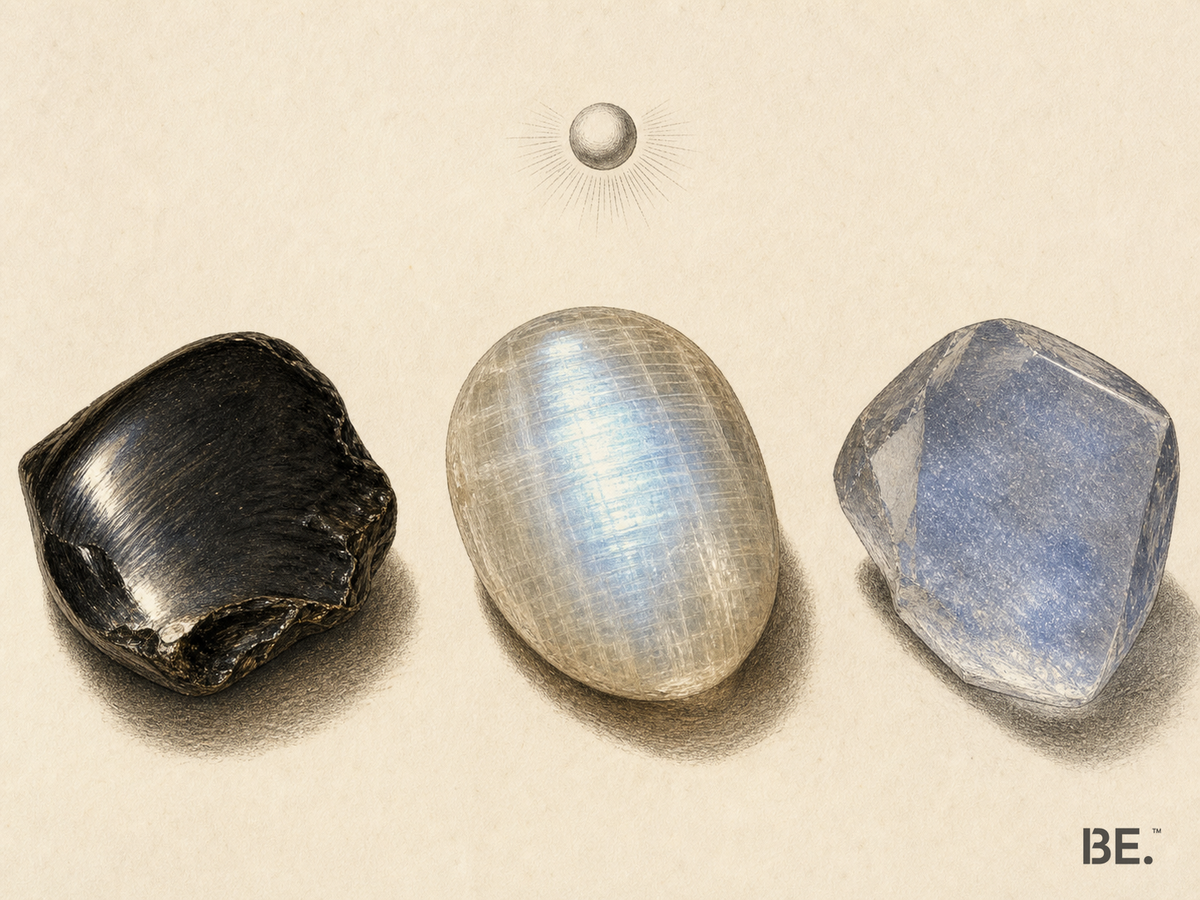
First ask: where does the light appear?
| Term | Observation zone | Conceptual mechanism | What the word does not prove |
|---|---|---|---|
| Lustre | Surface | Reflection from the material–air boundary | Internal structure or gem identity |
| Sheen | Often diffuse, directional or near-surface in appearance | No single mechanism; interpret with the identified material | A specific particle, layer or mineral phase |
| Adularescence | Floating within moonstone | Interference iridescence associated with fine alkali-feldspar intergrowth lamellae | That every pale or blue sheen is moonstone |
| Tyndall effect | Through a particle-bearing volume | Light scattered by finely dispersed colloidal-scale particles | The particles’ identity, size or origin in a specific specimen |
Lustre: how a surface returns light
A surface property, not a name for every inner glow
Lustre records the character of reflected light at a surface. Polished quartz is commonly described as vitreous because its reflection resembles glass; other materials may appear metallic, resinous, waxy or dull. The term belongs to the interface between material and air, even when the reflected highlight seems broad.
Polish, curve and illumination change what you see
A smoother polish sharpens a highlight; surface abrasion softens it. A curved bead or cabochon sweeps the reflection across a larger area than a flat face. Lamp size, angle and background also change the result. Lustre can help describe a material, but a studio highlight is not proof of its internal microstructure.
Sheen: an appearance word, not one mechanism
Describe direction, spread and movement first
In gem use, sheen is a relatively broad, less frequently standardised word for a soft, diffuse or directional schiller-like appearance. A useful description says whether the bright area is tight or broad, gold-grey or blue-white, stationary or mobile, and apparently near the surface or deeper inside.
Pair the word with an identified material
“Sheen” by itself does not name the layers, particles or phases responsible. The mechanism must be tied to a confirmed material and, when the exact microstructure matters, analytical evidence. This is why gold sheen obsidian and moonstone can both be described as showing a sheen while their material systems and optical explanations remain different.
Adularescence: the characteristic moonstone phenomenon
Fine feldspar intergrowth and interference
Moonstone is an alkali-feldspar material in which fine intergrowth lamellae develop as the feldspar system separates during cooling. Light reflected at the internal albite–orthoclase interfaces interferes, producing a soft iridescent light that appears to float below the surface and move as the stone or light moves. The scale and regularity of the lamellae influence the effect.
Record bodycolour and moving light separately
Describe the bodycolour first, then the sheen colour, intensity, coverage, direction and mobility. A colourless or pale body may carry a blue-white effect; other stones show a whiter or silvery one. Those appearance fields help comparison, but photographs, dome shape and lighting can amplify or suppress what the eye sees.
The Moonstone Guide owns the material’s formation, varieties, quality factors and jewellery use. This hub uses moonstone only to define the optical term.
Tyndall scattering: light made visible in a particle-bearing volume
Fine dispersed particles can make a path or haze visible
The Tyndall effect is observed when finely dispersed particles scatter light through a medium, making a beam, cloud or internal haze visible. Peer-reviewed work on rock-forming blue quartz documents submicron mineral inclusions and scattering-related colour in analysed material. That supports a material mechanism in those samples; it does not identify the particles or scattering regime in every blue-looking quartz.
Tyndall and Rayleigh are not interchangeable labels
Rayleigh scattering is a wavelength-dependent scattering model for scatterers much smaller than the wavelength of light. “Tyndall effect” is used for the visible scattering produced by a fine particulate dispersion. The concepts can meet in discussions of particle size, but they are not synonyms, and a blue haze or comparison with the sky is not enough to assign either mechanism to a gemstone.
Bodycolour, fluorescence, surface reflection, inclusions and camera processing can all contribute to a blue appearance. Particle composition, size distribution and optical testing are needed before a microscopic explanation becomes specimen-specific.
A one-lamp observation matrix
- Clean the surface. Work with one small neutral-white lamp and a dark, non-reflective background.
- Hold the stone still and move the lamp. Record whether a sharp surface highlight tracks the lamp.
- Hold the lamp still and rotate the stone. Record whether a soft internal light travels beneath the surface or whether haze remains distributed through the body.
- Change the viewing angle, not the exposure or colour filter. Note bodycolour, effect colour, spread, direction, coverage and mobility separately.
- Photograph the setup only as a record. A phone’s processing, white balance and sharpening can change the apparent effect.
The result is an observation record, not an identification report. Use “surface reflection,” “broad sheen,” “consistent with an internal layered effect,” or “internal haze; mechanism unconfirmed” until material identity and structure are established.
Three material routes
Moonstone: the adularescence route
Moonstone provides the defined reference case for adularescence. The current product route shows the material and its moving blue-white appearance; it is not being used here as microscopy evidence for a particular bead.
Gold sheen obsidian: the directional-sheen route
Gold sheen obsidian demonstrates why the appearance word needs a material name beside it. Read the Gold Sheen Obsidian Guide for its material context; the exact microstructure of the current product lot remains unconfirmed in this hub.
Blue smoky quartz: the blue-haze observation route
Blue smoky quartz offers a route for observing blue-grey internal haze. The Blue Smoky Quartz Guide explores the material story, while this hub keeps particle identity, size and exact scattering model unverified for the current product lot. For broader causes of colour, use How Crystal Colours Form.
Frequently asked questions
Q1. Is sheen a mineral?
No. Sheen is an appearance descriptor. Its cause depends on the identified material and may involve different surface or internal structures.
Q2. Is adularescence found only in moonstone?
Adularescence is the characteristic optical phenomenon used for moonstone. Other materials can show sheen, iridescence or chatoyancy, but those appearances should not automatically be called adularescence.
Q3. Is moonstone’s glow a surface coating?
In moonstone, adularescence comes from light interacting with fine internal feldspar intergrowths, not from the definition of a surface coating. A suspected treatment still requires specimen-specific examination.
Q4. Is the Tyndall effect the same as Rayleigh scattering?
No. Rayleigh scattering is a wavelength-dependent small-scatterer model; the Tyndall effect describes visible scattering by a fine particulate dispersion. They are related optical ideas, not interchangeable names.
Q5. Does every blue haze prove fine-particle scattering?
No. Bodycolour, fluorescence, reflections, inclusions and image processing can also affect a blue appearance. Particle identity and scattering mechanism need material-specific evidence.
Q6. Can a phone light identify an optical effect?
A phone light can help record where an effect appears and how it moves, but it cannot confirm mineral identity or microstructure. Camera exposure, white balance and sharpening can also alter the result.
References
Field Notes.
One stone at a time: its geology, and how to read quality. The Stone Buying Checklist comes with your first email.
By subscribing you agree to receive emails from BE. Unsubscribe anytime.
Sent. Check your inbox.