
How Bracelet Beads Are Made: Rough to Sphere
A material-first guide to the common rough-to-sphere route: planning, preforming, rounding, drilling, polishing and sorting, with clear limits on what a finished bead can prove.
In this field note
A polished sphere hides how many decisions came before it. The cutter first has to decide which volume of a rough piece is usable, where colour or inclusions should sit, and which fractures or weak directions must be avoided. Every later step removes material, so an early choice affects the final diameter, surface and visual balance.
Published records from Jaipur document planning, sawing, preforming, calibration, grouping and final polishing in coloured-stone manufacture. Historical bead studies show still more variation in shaping and drilling tools. Together they support a common route with variants—not the claim that every workshop, material or BE. supplier follows one fixed sequence.
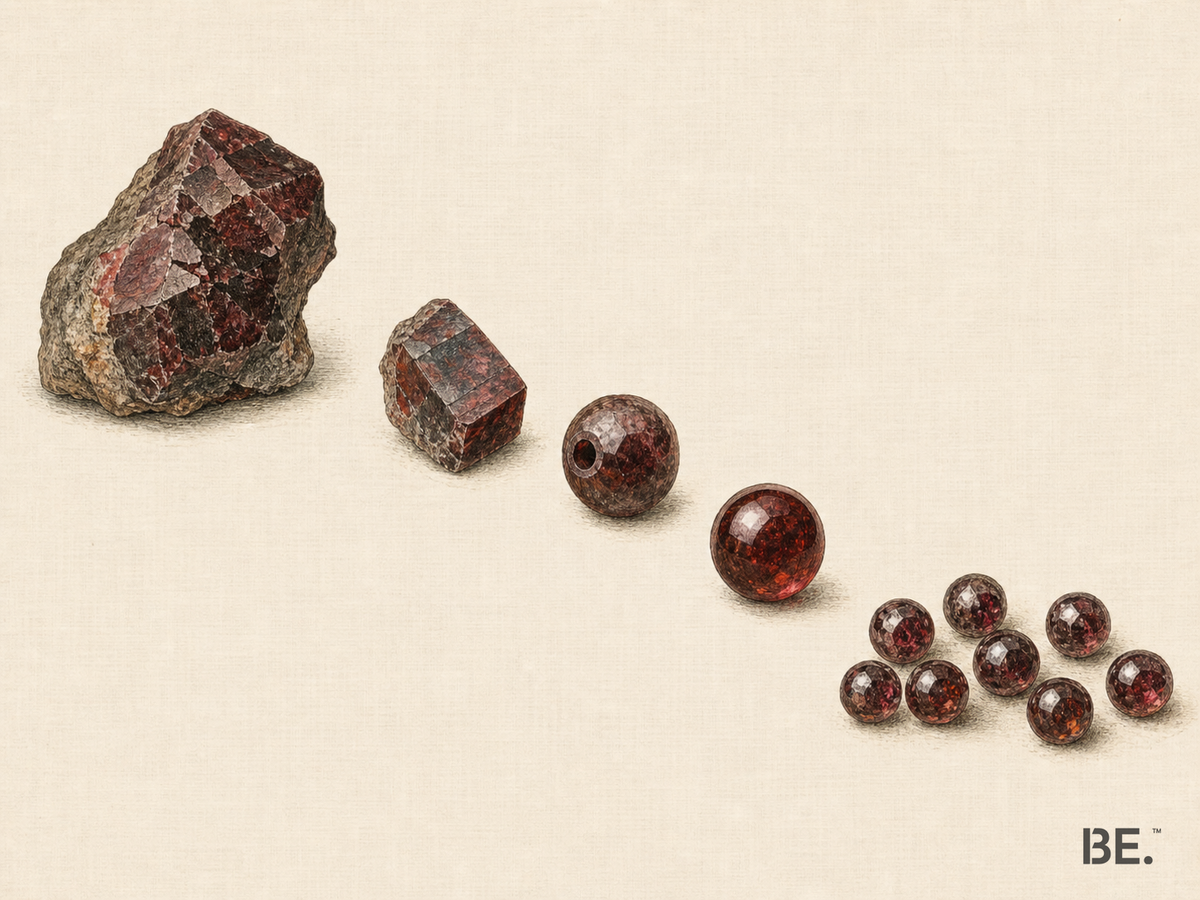
A common route, not a universal sequence
| Stage | Typical purpose | What can vary | What the finished bead cannot prove |
|---|---|---|---|
| Read and plan | Choose usable volume and orientation around colour, inclusions and fractures. | Desired diameter, material structure and acceptable loss. | The mine, workshop or person who made it. |
| Saw or preform | Remove unusable material and create a smaller blank closer to the target shape. | Square, cylindrical, tumbled or other intermediate forms. | A single standard preform used by every producer. |
| Round | Remove corners and bring the blank towards a sphere and target diameter. | Hand-held or mechanised equipment, pressure and sequence. | That the bead was carved entirely by hand. |
| Drill | Create the stringing channel while controlling position and edge damage. | Drilling may occur before or after some polishing stages. | A universal drilling direction or order. |
| Grind and polish | Refine the surface through successively finer abrasives. | Abrasive, medium, duration and number of stages. | Whether a separate treatment or coating was used. |
| Measure and sort | Group beads by diameter, colour, translucency, pattern and finish. | Lot specification and the visual target of the strand. | That every bead shares exact geological provenance. |
Planning starts with what the rough will allow
Rough is not a neutral block. Colour zoning may be stronger on one side, inclusions may form a readable pattern only from one direction, and fractures may cut across the volume needed for a bead. A cutter plans around those features while trying to retain enough material for the intended diameter. The result is a compromise between visual character, structural soundness and yield.
This is also why one piece of rough does not automatically become a set of identical spheres. Each bead samples a different small volume. One may cross a colour band; another may intersect an inclusion; a third may need more material removed to avoid a fissure. The geological variation is present before calibration begins.
From preform to sphere
Sawing or rough grinding first reduces the stone to manageable blanks. Those blanks are then rounded progressively rather than being transformed in one cut. As high points disappear, the maker checks diameter and roundness while preserving enough material for later finishing. A stage that works for quartz may need adjustment for a material with pronounced cleavage, internal fractures or a different hardness.
“Calibrated” means made towards a specified size and form; it does not mean mathematically identical at every point. The useful question is whether the finished set is sufficiently consistent for its intended jewellery construction and whether any allowed range has been disclosed.
Drilling can move within the sequence
A hole introduces concentrated stress and creates two vulnerable rims. Its position, alignment and finish matter, especially where the stone already contains a fissure. Some workflows drill a preform and polish afterwards; others complete more of the surface work first. A finished bead can show an off-centre channel, rough interior or chipped rim, but those observations do not reveal a universal drilling method or prove when the hole was made.
Finishing, measuring and sorting
Grinding and polishing use progressively finer abrasion to remove marks from the previous stage and develop an even surface. Polishing is a finishing process; it is not, by itself, evidence of resin, dye or coating. Any treatment claim needs its own disclosure and evidence.
After finishing, beads can be measured and sorted into a strand. Sorting is where separate beads are made to read as a coherent object. Diameter is only one field: colour, translucency, inclusion pattern, surface finish and the visual rhythm from bead to bead also matter.
| Finished feature | Reasonable observation | Do not infer |
|---|---|---|
| Roundness | How consistently the silhouette turns. | The exact machine or hand process used. |
| Hole position | Whether the channel is centred enough for the intended stringing. | The workshop, country or drilling order. |
| Hole rim | Whether there is visible chipping or stress near the opening. | That every small irregularity means the material is fake. |
| Surface | Whether scratches, flat spots or orange-peel texture remain. | That a glossy surface guarantees coating or treatment. |
| Match | How colour, pattern and diameter work across the strand. | That matched beads came from one mine or one crystal. |
Where process enters price
Planning, material loss, skilled labour, calibration and sorting can all add cost, but none supplies a universal price formula. A difficult rough piece may yield less usable material; a closely matched set may require more sorting; a cleaner polish may require more controlled finishing. For the full material-to-price framework, see why crystal bracelet prices differ.
The workshop-safety boundary
NIOSH warns that cutting or grinding materials containing crystalline silica can generate respirable crystalline silica dust. Its general control guidance includes wet methods, local exhaust ventilation and suitable filtration. That establishes a hazard and control context; it does not establish whether any named workshop or supplier follows those controls. Supplier-level occupational safety needs facility-specific evidence and belongs in a separate due-diligence record.
The Garnet Strand Bracelet is included here only as a current example of finished spherical beads. Its product page does not document the rough, factory, drilling order, abrasives, yield or workshop safety behind those beads.
Frequently asked questions
Q1.Is this the only way to make a stone bead?
No. It is a common documented route. Materials, bead sizes, tools and workshop practices can change both the method and the order.
Q2.Are stone bracelet beads carved entirely by hand?
Not necessarily. Production can combine hand judgement, hand-held tools and mechanised equipment. A finished bead alone does not reveal that mix.
Q3.Are beads drilled before or after polishing?
Either can occur within a broader workflow. The sequence varies, so the hole in a finished bead does not prove one universal order.
Q4.What can cause a small chip at the hole?
Stress can concentrate at the hole rim, especially near an existing fissure. Position, drilling and finishing may contribute, but a photograph cannot identify the exact cause by itself.
Q5.Does a polished bead have a coating?
Not by definition. Polishing refines a surface with abrasives. Coatings, dyes, fillers and other treatments are separate questions that require disclosure or testing.
Q6.Can a finished bead prove its factory or safety conditions?
No. Workmanship can be observed on the bead, but factory identity, labour conditions and dust controls require records from the relevant supply-chain stage.
References
Field Notes.
One stone at a time: its geology, and how to read quality. The Stone Buying Checklist comes with your first email.
By subscribing you agree to receive emails from BE. Unsubscribe anytime.
Sent. Check your inbox.