
Why Crystal Bracelet Strands Vary: Lots, Cutting and Sorting
A geology-first guide to the five layers behind strand variation: material growth, lot assembly, cutting, sorting and photographic presentation.
In this field note
A matched strand is a selection, not a geological duplicate machine. Its beads may share a commercial material name, a diameter target and an intended colour range while still differing in tone, zoning, transparency, inclusions, polish and apparent size. Those differences are not one phenomenon with one cause.
The practical task is to separate material variation from manufacturing variation, sorting decisions and photographic presentation. That makes it possible to judge the strand in front of you without turning every difference into either a defect or an authenticity claim.
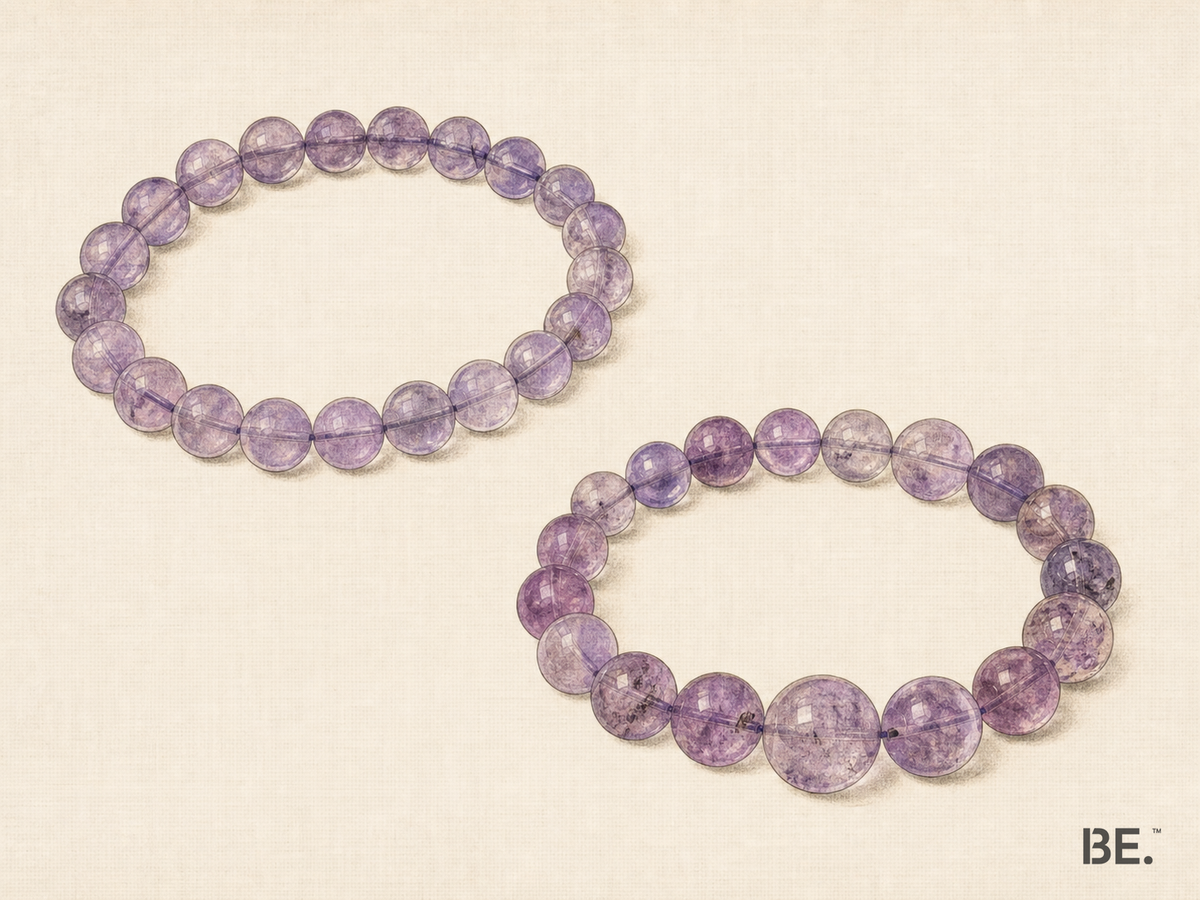
Matched does not mean identical
In jewellery, matching is a design judgement. A sorter may aim for a narrow diameter band, a dominant hue, similar translucency and a balanced distribution of distinctive beads. The target can be tight or broad. Unless a seller publishes a measurable tolerance, the word “matched” should not be converted into an assumed universal millimetre or colour standard.
“Same lot” also needs restraint. A lot is an operational grouping used for buying, cutting, sorting or inventory. Depending on the record system, it may contain material from one upstream parcel or combine several parcels. The label alone does not prove a single crystal, vein, mine, country or geological event.
Five layers where variation enters
| Layer | What can vary | What you may observe | What it does not prove |
|---|---|---|---|
| Geological growth | Colour zoning, inclusions, fractures and growth boundaries. | Lighter and darker areas, clouds, needles or internal planes. | Natural origin from appearance alone. |
| Lot assembly | Which rough pieces or parcels were grouped together. | A wider or narrower overall range. | One mine, one crystal or complete chain of custody. |
| Cutting | Orientation, retained volume, diameter, roundness and hole position. | Different patterns at the surface, slight size changes or varied centring. | Carelessness without a stated specification and closer inspection. |
| Sorting | Colour, translucency, pattern, finish and visual rhythm. | A coherent gradient, deliberate contrast or outlier bead. | A universal grade or tolerance. |
| Presentation | Light source, diffusion, background, exposure, white balance and display. | Changes in apparent saturation, brightness and contrast. | That one image is a fixed colour measurement. |
Geology varies before a bead is cut
Amethyst commonly shows angular zones of lighter and darker violet. GIA also documents differences in transparency and inclusions within natural deposits. When a sphere is cut, it samples a three-dimensional volume: one bead may cross a strongly coloured sector, another may retain a pale zone, and another may intersect a fluid inclusion or small iron-oxide flake.
The direction of the cut changes which features meet the surface and how much coloured material lies along the viewing path. This is why two beads cut from related rough can still present different patterns. For the common route from rough to calibrated sphere, see how bracelet beads are made.
A lot is not a provenance certificate
Lot language is useful for operations, but its evidentiary strength depends on the records attached to it. A supplier lot number can help reconnect finished goods to invoices, parcel notes or test results. Without those records, it is only an identifier.
- A single-lot claim should state what the business means by “lot” and which stage assigned it.
- A single-origin claim needs traceable source documentation or suitable gemological work; visual similarity is not enough.
- A one-mine claim is narrower again and should not be inferred from a country name, colour family or matching strand.
Cutting creates another range
Calibration aims towards a specified diameter and form, but the cutter works with physical constraints. Removing a fissure, correcting a flat spot or centring a hole can reduce one bead more than another. A nominal “6 mm” strand therefore needs its own published specification if an exact allowable range matters.
Small differences can also change how a strand hangs. Diameter affects apparent scale, while hole position and bead roundness affect spacing and alignment. These are workmanship observations. They are separate from whether the underlying material is natural or synthetic.
Sorting is a design decision
After polishing, a strand is assembled by selecting which beads belong together and where each one sits. A highly uniform set can require more sorting. A deliberately varied set can preserve broader geological character. Neither approach is automatically superior; the correct question is whether the actual range is shown and described clearly.
| Comparison field | Useful question | Evidence boundary |
|---|---|---|
| Diameter | Is the nominal size stated, and is a tolerance published? | No universal tolerance should be assumed. |
| Tone | Is the strand broadly even, graduated or intentionally mixed? | Tone can shift under different light. |
| Zoning | Are lighter and darker sectors visible across several beads? | Zoning needs gemological interpretation; it is not proof of natural origin. |
| Transparency | Is the range from transparent to translucent represented accurately? | A bright background can make material appear clearer. |
| Finish | Are scratches, flat spots, pits or chipped hole rims visible? | A photo may conceal small surface features. |
| Outliers | Does one bead sit outside the disclosed visual range? | An outlier is a sorting question, not automatic evidence of fakery. |
Photographs can change the reading
GIA’s photography guidance explains that background, lighting direction, diffusion, colour temperature and positioning all affect a gemstone’s appearance. Diffuse light can reveal colour more evenly; direct light can create hotspots or deepen shadows; a light background can bounce light through translucent material. Camera exposure, white balance and the viewer’s screen add further variables.
For a fair comparison, use images of the actual strand when possible, ask whether photos were taken under the same setup, and compare at least one neutral-light view with one closer view. A product photograph is evidence of presentation under stated or unknown conditions—not a laboratory colour reading.
Variation is not authentication
The shortcut “natural stones vary, so variation proves natural” fails. GIA research separates natural and synthetic amethyst using combinations of features such as the nature of colour zoning, inclusions, Brazil-law twinning and, when needed, spectroscopy. Some synthetic amethyst can show zoning or twinning in forms that require trained interpretation.
Therefore, neither perfect uniformity nor visible variation settles identity. Natural material can be tightly sorted; synthetic material can vary; treatments can alter colour; and images can exaggerate or suppress differences. Authentication belongs to disclosure, documented testing and qualified gemological examination.
How to compare a strand fairly
- Confirm whether the listing shows the exact strand or a representative sample.
- Read the nominal bead size, then look for any published tolerance rather than inventing one.
- Compare tone, zoning, transparency, inclusions, roundness, hole placement and finish as separate fields.
- Ask what “lot” means in that seller’s records before treating it as provenance.
- Do not use variation alone to decide natural versus synthetic or treated versus untreated.
- Allow for the stated lighting, background and normal screen differences when comparing photographs.
The Bolivian Amethyst 6mm Strand Bracelet is included only as a current, finished example for applying this comparison method. Its product page supports the product identity and current seller description; it does not establish a universal tolerance, one-mine continuity or independent natural-origin proof for all amethyst strands.
Frequently asked questions
Q1.Why do beads in one crystal bracelet strand vary?
Variation can come from geological zoning and inclusions, the rough pieces grouped into a lot, the volume sampled by each cut, small calibration differences, sorting choices and photographic conditions.
Q2.Does visible variation prove that a strand is natural?
No. Natural material can be tightly sorted, while synthetic material can show variation. Identification may require a combination of inclusions, zoning, twinning, spectroscopy and documented testing.
Q3.Does “same lot” mean every bead came from one mine?
Not automatically. A lot is an operational grouping whose scope depends on the seller’s records. It can support traceability only when linked to documented upstream parcels and source information.
Q4.Should every bead in a nominal 6 mm strand measure exactly 6 mm?
Do not assume an exact universal tolerance. Calibration targets a size and form, but the acceptable range should come from the seller’s published specification for that product.
Q5.Do product photographs show a strand’s exact colour?
They show its appearance under particular lighting, background, exposure and display conditions. Neutral-light and close-up views of the actual strand are more useful, but no screen image is a fixed colour measurement.
Q6.Is more variation better or worse?
Neither by itself. A tightly matched strand and a deliberately varied strand can both be well made. Judge whether the range is accurately shown, whether finish and construction meet the stated specification, and whether material claims are supported separately.
References
- GIA — Amethyst description
- GIA — Amethyst quality factors
- Gems & Gemology — Separating natural from synthetic amethyst by twinning
- Gems & Gemology — Infrared spectroscopy of natural versus synthetic amethyst
- GIA — How to photograph gems and jewellery
- GIA — Jaipur, India: Global Gem and Jewellery Manufacturing
Field Notes.
One stone at a time: its geology, and how to read quality. The Stone Buying Checklist comes with your first email.
By subscribing you agree to receive emails from BE. Unsubscribe anytime.
Sent. Check your inbox.