
Why Is Citrine Rarer Than Amethyst?
Natural-colour citrine is rarer than amethyst, but citrine jewellery is widely available because heat treatment converts part of the abundant amethyst supply into yellow-orange quartz.
In this field note
Shop windows create a puzzle. Purple amethyst is recognised as common quartz, while citrine is described as rarer, yet rows of orange-yellow citrine beads are easy to find. The explanation is that geological abundance and market supply are different measures.
GIA describes natural citrine as rare and notes that citrine in the market can result from heating amethyst. No reliable global production ratio exists, so “rare” should not be converted into a percentage. Heated material remains quartz, but its colour history and appropriate price disclosure differ from naturally coloured citrine.
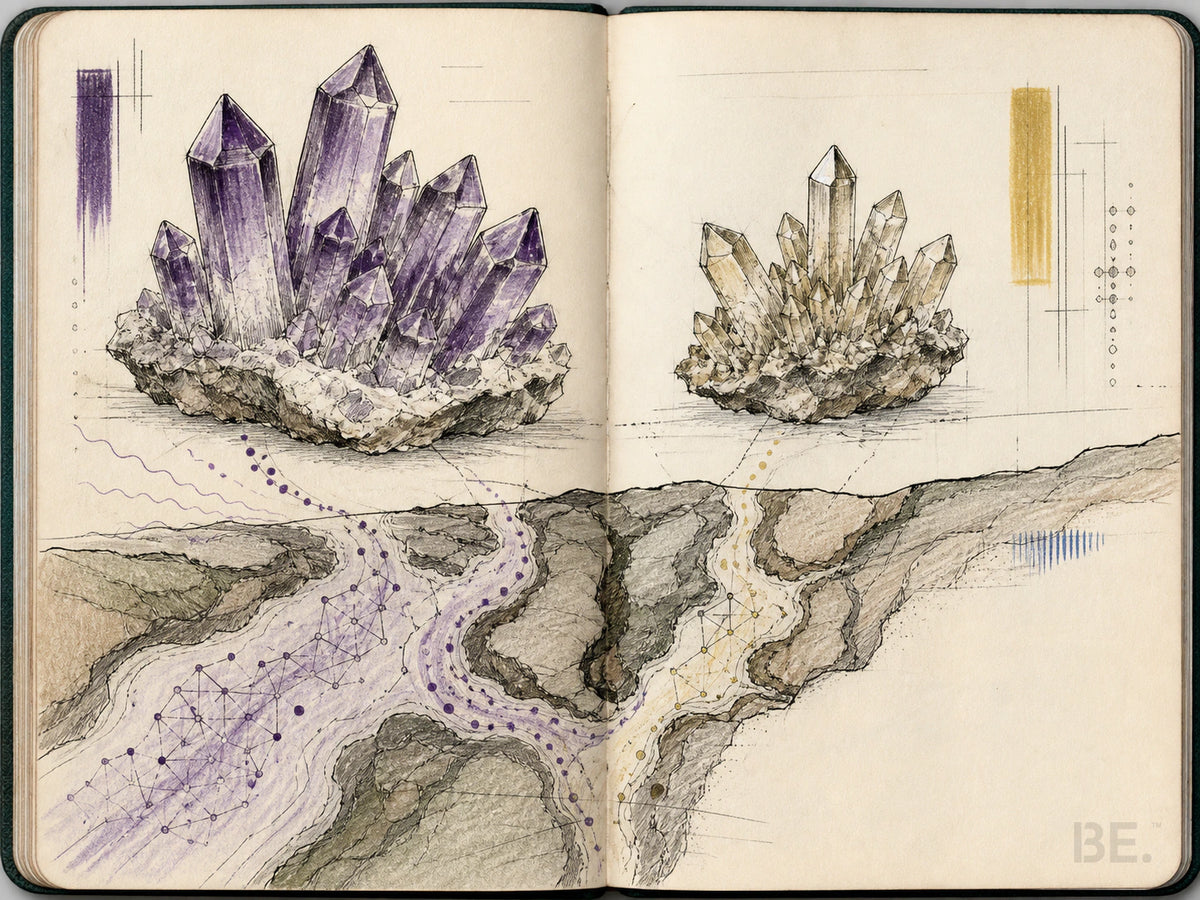
How are citrine and amethyst related?
Both are colour varieties of crystalline quartz, silicon dioxide, with the same basic crystal structure and a Mohs hardness of 7. Their colours reflect impurity- and defect-related processes together with irradiation and thermal history. Proposed mechanisms include aluminium-related irradiation hole centres and iron-related processes. A 2024 experiment supports specific iron/oxygen mechanisms only for its analysed quartz samples; no single microscopic model safely covers every deposit.
Amethyst occupies the purple range; citrine occupies yellow to orange and brownish orange. Ametrine contains zones of both colours in one crystal. The names describe colour varieties, not separate mineral species, which is why treatment can change the variety name without changing quartz into another substance.
Visual overlap is substantial. Pale natural citrine can resemble smoky quartz or heated material, and colour alone does not establish treatment. Spectroscopy, zoning, inclusions and mine context may contribute to a gemmological opinion, but some individual stones remain difficult to separate conclusively.
Why is natural-colour citrine geologically uncommon?
Quartz is abundant, but naturally coloured citrine is described as rare. Amethyst-forming environments and deposits occur widely, and no like-for-like global count of natural citrine localities or volumes exists. A common host mineral does not guarantee a common colour variety.
Natural citrine is often pale yellow, golden or smoky yellow, and less often the intense burnt orange familiar from many commercial lots. That is a tendency, not a test. Some natural stones are saturated, and treatment can produce lighter colours; photographs, saturation and colour zoning alone cannot prove origin.
Usable rough is a separate jewellery-supply question from geological rarity. A deposit may contain quartz, but only part is transparent, clean enough, large enough and coloured well enough for matched beads. Drilling removes more material and a uniform strand requires sorting many pieces, so finished jewellery supply reflects manufacturing yield as well as geology; without lot-level data, that yield should not be used to quantify geological rarity.
Why is commercial citrine still easy to buy?
GIA notes that commercial citrine can be produced by heating amethyst to create yellow, orange or reddish-brown quartz. CIBJO’s Official Gemstone Book permits the trade name “Citrine, or Yellow Quartz” for heated material but requires the treatment description “Heated”. Heating is not a surface dye, and CIBJO lists the resulting colour as stable; treatment disclosure remains necessary.
This route makes attractive quartz available at a wider range of prices. It also explains why deeply orange clusters with white bases are common in décor markets: many began as amethyst geodes and were heated. The treatment must be disclosed because it affects rarity and how buyers compare price, even though the mineral remains natural quartz.
Laboratory-grown quartz and coated or dyed imitations are separate categories. “Heat-treated amethyst” should not be collapsed into “synthetic” or “fake”. Clear terminology preserves the difference between natural material whose colour was altered and material grown or manufactured by people.
| Material | Mineral identity | Colour history | Market implication |
|---|---|---|---|
| Natural-colour citrine | Natural quartz | Yellow formed through geological history | Scarcer; evidence and disclosure matter |
| Heated amethyst sold as citrine | Natural quartz | Purple quartz heated to yellow-orange | Common; treatment should be disclosed |
| Laboratory-grown citrine-colour quartz | Synthetic quartz | Grown and coloured under controlled conditions | Must be disclosed as laboratory-grown |
| Dyed or coated imitation | Varies | Surface or introduced colour | Identity and treatment both required |
| Amethyst | Natural quartz | Purple colour variety | Broad geological and market supply |
Can colour reveal whether citrine was heated?
Colour can raise questions but rarely supplies a verdict. Very dark orange-brown colour, abrupt zoning and a chalky white base in a cluster are commonly associated with heated amethyst material. Pale straw or smoky yellow may be consistent with natural citrine. None of these observations proves the history of a loose bead by itself.
Photographs create further uncertainty. White balance, warm lighting, background colour and screen settings can shift yellow towards orange or green. Beads also average internal colour differently from faceted gems. Daylight photographs and a treatment disclosure are better evidence than a colour chart, which is no certificate.
A laboratory may use spectroscopy, inclusion features and other evidence to support an opinion, but heat detection in quartz can be challenging. The honest commercial answer is often based on traceable sourcing and disclosure, not a claim that every treated bead can be identified visually.
Does heat-treated citrine count as real quartz?
Yes. If natural amethyst was heated, the material remains natural crystalline quartz. It is treated, not simulated. Calling it fake erases an important distinction and can mislead buyers just as much as hiding the treatment.
Treatment should still affect description and comparison. A listing can state “natural quartz, heat-treated for colour” and avoid suggesting that the orange colour formed entirely in the deposit. A natural-colour claim should be supported by supplier documentation or testing proportionate to the value.
Value is not determined by treatment alone. Colour, transparency, zoning, inclusions, bead matching, polish, drill quality, size, construction and evidence all matter. The correct comparison is between accurately described pieces, not between an undocumented romantic claim and a disclosed treated strand.
How should you choose between citrine and amethyst?
Choose first by verified material and visible quality. For citrine, ask whether the colour is represented as natural or heat-treated and what evidence supports that statement. For amethyst, inspect zoning, transparency, surface-reaching fractures, polish and matching. In both, check the drill holes and the finished construction.
Do not pay a natural-citrine premium for colour alone. A saturated orange is not automatically rarer, and a pale stone is not automatically untreated. Conversely, disclosed heated citrine can be a sound choice when the colour, cutting and price are judged within that category.
The market only looks contradictory when every yellow quartz bead is treated as the same product. Separate natural-colour citrine, heat-treated amethyst, laboratory-grown quartz and imitation materials, and the pattern becomes clear: natural citrine is scarce, while the broader commercial citrine category is not.
Frequently asked questions
Q1.Is natural citrine rarer than amethyst?
Yes. Quartz is abundant, but naturally yellow citrine is described as rare, while purple amethyst is common in the trade. Finished natural-colour citrine also requires usable clarity, colour and cutting yield.
Q2.Why is citrine jewellery so common if natural citrine is rare?
Some commercial citrine is natural amethyst heated to produce yellow, orange or brownish-orange colour. This adds to market supply while the material remains quartz.
Q3.Is heat-treated citrine fake?
No. Heated natural amethyst remains natural crystalline quartz; it is treated. The treatment should be disclosed because its colour history and rarity differ from natural-colour citrine.
Q4.Can dark orange colour prove citrine was heated?
No. Strong orange-brown colour may be associated with heated material, but colour, zoning and photographs alone are not conclusive. Sourcing, disclosure and sometimes laboratory evidence are needed.
Q5.Are citrine and amethyst the same mineral?
They are both colour varieties of crystalline quartz. Their different colour centres and thermal histories create yellow-orange citrine and purple amethyst.
Q6.Should natural citrine cost more than heated citrine?
Natural-colour citrine is generally scarcer, but price also depends on evidence, colour, transparency, size, matching, polish, drilling and construction. Treatment disclosure is essential for a fair comparison.
References
- GIA: Citrine Gem Overview: quartz identity, colour and treatment context
- GIA: Citrine Quality Factors: colour, clarity, cut and commercial supply
- GIA: Amethyst Gem Overview: amethyst identity and occurrence
- CIBJO: Official Gemstone Book 2022, pp. 15–16, 69: treatment disclosure, H/Heated code and Citrine/Yellow Quartz table
- Gem-A: Understanding and Testing for Rare Natural Citrine: proposed colour mechanisms and clue-versus-proof limits
- Wu et al., CrystEngComm (2024), DOI 10.1039/D4CE00250D: sample-limited experimental evidence for iron/oxygen-related colour mechanisms
Field Notes.
One stone at a time: its geology, and how to read quality. The Stone Buying Checklist comes with your first email.
By subscribing you agree to receive emails from BE. Unsubscribe anytime.
Sent. Check your inbox.