
What Stone Is My Bracelet? Narrow It in 4 Questions
Identify an unknown bracelet by recording transparency, lustre, inclusions, optical effects, texture and drill-hole features, then follow the right material branch.
In this field note
An unknown bracelet usually arrives with too little information: a colour name, a seller’s trade term or no label at all. Online image search then produces dozens of confident matches because different minerals, rocks, glass, dyes and coatings can share the same colour.
- Transparency. Hold the bead against daylight. Transparent, translucent at the edge, or fully opaque?
- Lustre. Under a single light source, does the surface read glassy, waxy, silky or metallic?
- Movement. Tilt the bead slowly. Does a sheen, a band or a coloured flash travel across it?
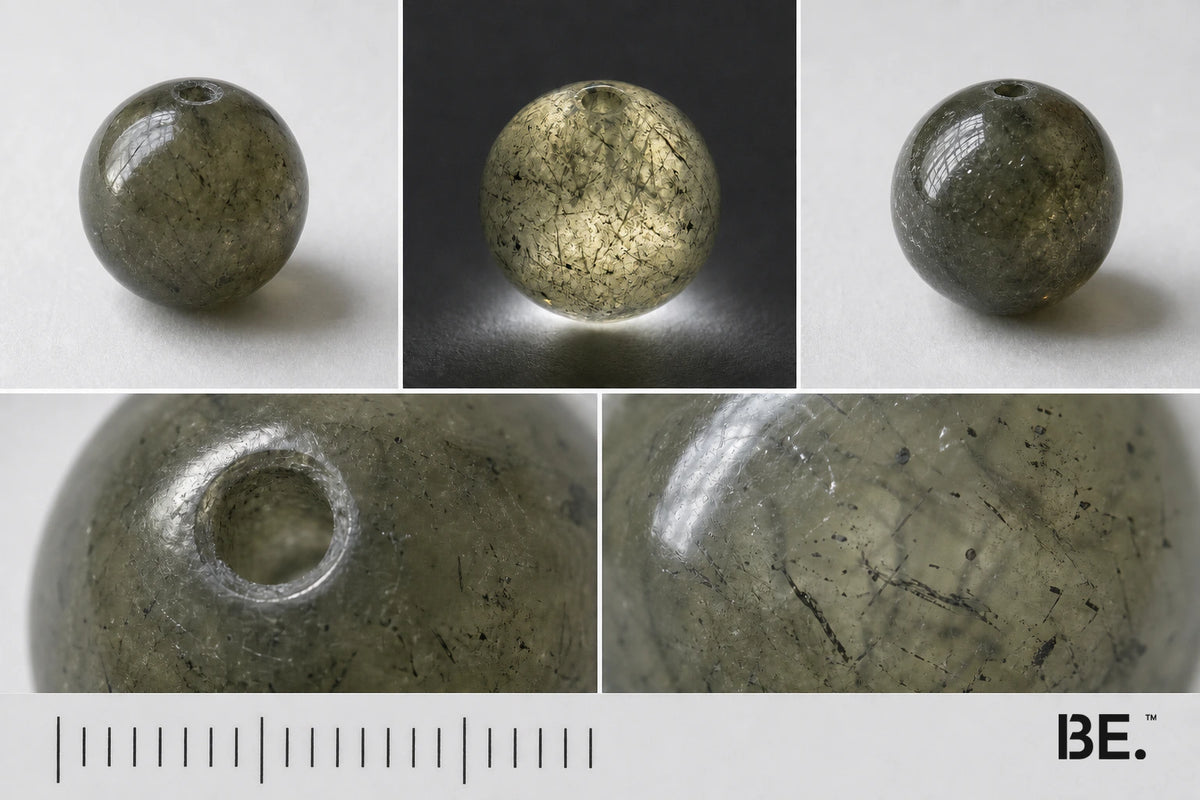
- Drill hole. Look at the hole edge under magnification. Chipping, pooled dye, or a colourless core under a coloured surface?
Can a bracelet stone be identified by colour alone?
No. Black can describe obsidian, chalcedony, tourmaline, glass and many other materials. Milky blue can describe moonstone, opalite glass, chalcedony or coated quartz. Red speckles can occur in natural included quartz and can also be manufactured in glass. Colour is a useful first filter only when paired with structure.
Lighting makes the problem worse. Warm bulbs shift clear and yellow stones; phone processing deepens black; backlighting can turn a translucent edge bright while the same bead appears opaque on the wrist. Record colour under neutral daylight and state whether the observation is reflected or transmitted light.
Do not begin by asking “Which crystal is this?” Begin with “What can be seen and repeated?” That change prevents a popular name from steering every later observation towards confirmation.
Which photographs make identification more useful?
Photograph the whole bracelet in diffuse daylight, then three different beads close up. Add a backlit view, a moving video, a surface reflection and both sides of a drill hole. Include a ruler or known bead diameter and keep the original files, since social media compresses screenshots.
Use a clean neutral background and turn off beauty filters, colour presets and portrait blur. Photograph scratches or chips with side light. If the bead shows a flash, sheen, star or moving band, record the effect while rotating the bead; one still image removes the direction information that makes the phenomenon useful.
Keep provenance with the images: the listing, receipt, stated material, treatment, origin and seller response. Identification is stronger when physical observations and documentary evidence agree. A country name copied from a listing is not laboratory origin evidence. It still belongs in the file, as part of the claim being assessed.
Which observations narrow the first branch?
First classify transparency: can text be read through the bead, does only a thin edge transmit light, or does no light pass? Next record lustre: glassy, waxy, silky, metallic or dull. Then note internal structure such as needles, plates, bubbles, colour bands, grains, fractures or clouds.
Then look for an optical phenomenon. A directional floating sheen points towards materials such as moonstone or sheen obsidian, depending on body colour and structure. A fixed glitter may be inclusions or manufactured particles. A cat’s-eye band, star or rainbow requires movement testing and careful separation from a surface reflection.
Surface and drill-hole evidence can reveal layers. Concentrated dye at a hole, a worn coating at an edge, mould seams, flow lines or a different-coloured interior all matter. None should be interpreted alone, but several agreeing observations can route the bracelet to a focused comparison guide.
How should a colour-and-feature decision tree work?
Use colour only as the entrance, then require a second observation before naming candidates. A clear bead with golden needles routes towards rutilated quartz; a milky bead with moving blue sheen routes towards moonstone; a uniformly glowing milky bead may route towards opalite glass; a black bead with directional gold sheen routes towards sheen obsidian.
The table is an identification map. It does not list every possibility. Follow the linked spoke and compare the full set of properties. If a bead contradicts the expected structure, for example a “rutilated quartz” with round bubbles and no crystalline needles, go back to the previous branch instead of forcing the label.
| First observation | Second observation | Useful branch | Next guide |
|---|---|---|---|
| Colourless to transparent | Needles, red plates, green layers or no inclusions | Clear, rutilated, hematoid or phantom quartz | Quartz inclusion guides |
| White or milky | Moving sheen or even body glow | Moonstone, opalite glass or other glass | Moonstone vs opalite |
| Black or very dark | Sheen, bands, striations, edge transmission or bubbles | Obsidian, onyx, tourmaline or glass | Black bead ID |
| Pink to red | Plates, speckles, flow lines or dye concentration | Included quartz, glass or dyed material | Cherry and strawberry quartz |
| Yellow to orange | Quartz zoning, smoky tone or surface coating | Citrine, heated quartz, glass or coated material | Natural vs heated citrine |
What clues suggest glass, dye or another imitation?
Rounded gas bubbles, flow structures and repeated swirls support a glass identification. Dye may collect in fractures and drill holes. Coatings can abrade along bead edges and reveal a different substrate. Mould seams and identical internal patterns across many beads point to manufacture.
These are clues, not verdicts. Natural quartz can contain fluid inclusions, agate can show colour bands, and a well-made glass can be free of obvious bubbles. Phone-flash rainbows, cold touch and sound tests are too dependent on shape and environment to establish identity.
Use the real-vs-fake crystal guide for a complete evidence ladder. Avoid scratch, flame, hot-needle and chemical tests on finished jewellery. A destructive result may still be ambiguous and can erase evidence of a coating or treatment.
When is laboratory identification the responsible answer?
Laboratory testing is appropriate when the material is black and opaque, the price or insurance value is high, a treatment claim matters, a geographic origin is used to justify value, or visual observations conflict. Opaque materials in particular may require a combination of microscopy, refractive-index methods, specific gravity, spectroscopy, X-ray techniques or chemical analysis.
A standard report may identify the material and detectable treatment without naming a mine. Origin determination is a separate and sometimes impossible question, especially for common quartz. Ask what the report covers before treating it as proof of every claim in a listing.
Until testing, use graded language: “consistent with”, “likely”, “possible” and “not resolved”. That wording records what the evidence can and cannot carry. A colour guess should end as a short candidate list, and the list should stop where the observations stop.
Frequently asked questions
Q1.What stone is my bracelet made from?
Start by recording transparency, lustre, internal features, moving optical effects, surface texture and drill holes. Colour alone cannot separate minerals, rocks, glass and treated materials.
Q2.Can I identify a crystal bracelet from a photo?
A good photograph and rotation video can narrow candidates, but many materials overlap visually. Opaque, treated or high-value beads may need non-destructive laboratory testing.
Q3.Which photos are best for gemstone identification?
Use diffuse daylight, backlight, side light, close views of several beads, drill holes, a ruler and an unedited rotation video. Keep the whole-bracelet image and original listing too.
Q4.Do bubbles mean a bead is glass?
Rounded gas bubbles and flow lines support glass, but a single sphere may be a fluid inclusion in a natural mineral. Several agreeing observations or laboratory tests are needed.
Q5.Can bead colour prove the mineral type?
No. Different natural minerals, rocks, glasses, dyes and coatings can share the same colour. Colour should only select the next observation branch.
Q6.When should I use a gem laboratory?
Use one when value is high, identity affects insurance or resale, the bead is black and opaque, treatment or origin matters, or visual evidence remains contradictory.
References
- GIA: A Case of Mistaken Identity. Why visual resemblance does not establish gem identity
- GIA: Gem Identification. Professional observation and testing framework
- GIA Gems & Gemology: Identification of Black Opaque Gem Materials. Multi-method testing for difficult opaque materials
Field Notes.
One stone at a time: its geology, and how to read quality. The Stone Buying Checklist comes with your first email.
By subscribing you agree to receive emails from BE. Unsubscribe anytime.
Sent. Check your inbox.