
Cherry, Berry and Strawberry Quartz: Glass or Stone?
Cherry, berry and strawberry quartz are not interchangeable mineral names. Learn which labels commonly describe glass, which can describe natural included quartz and what disclosure to request.
In this field note
Fruit names are effective retail language because they describe colour quickly. They are poor mineral labels because sellers can apply the same appetising word to natural quartz, glass, dyed material or a composite. A bracelet may be attractive and well made in any of those categories, but the category must be disclosed accurately. For the underlying pink-quartz boundary, use the Rose Quartz material guide.
The central distinction is not whether a bead looks “natural”. It is whether the material is crystalline quartz, manufactured glass or another product, and whether its colour comes from geological inclusions, treatment or ingredients added during manufacture. Those questions can be answered only with evidence, not a name printed on a listing.
Rose Quartz vs Strawberry Quartz
Rose Quartz and Strawberry Quartz can both be pink quartz, but the names point to different material questions. Common massive Rose Quartz is usually cloudy to translucent; studied material contains colour-bearing nanofibres related to dumortierite. Strawberry Quartz usually refers to transparent or translucent rock crystal with visible red-to-pink mineral inclusions. Neither appearance proves an untested object’s identity or treatment.
| Reading axis | Rose Quartz | Strawberry Quartz |
|---|---|---|
| Typical structure | Commonly massive quartz | Rock crystal with visible inclusions |
| Typical appearance | Cloudy to translucent pink | Clearer quartz with red-to-pink specks or clouds |
| What the name cannot prove | Identity, treatment, inclusion species, origin or quality of the exact object | |
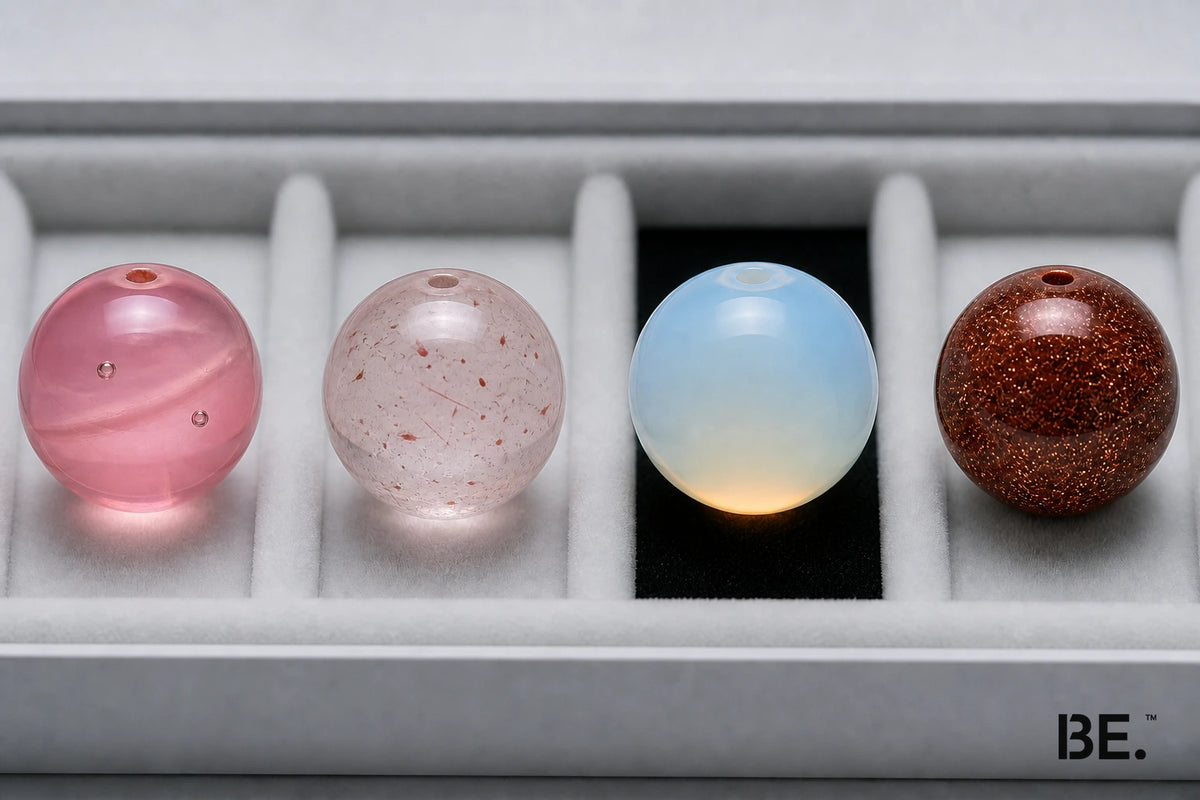
Is cherry quartz a natural variety of quartz?
A Spring 2003 Gems & Gemology report examined one material sold as “cherry quartz” and identified a manufactured glass with gas bubbles and swirled colour. That documented sample supports caution; it does not prove that every object carrying the inconsistent trade name has identical manufacture. Ask for the underlying material in plain language.
That does not make every cherry-coloured bead fraudulent. Glass is a legitimate jewellery material when it is described as glass. The problem appears when a manufactured product is presented as a rare natural crystal, given an unsupported mine origin or priced on the assumption of geological scarcity.
Because trade names are used inconsistently, do not decide from the listing title alone. Look for the material stated in plain language: natural quartz, treated natural quartz, laboratory-grown quartz, glass or composite. A responsible listing says so and does not retreat into “cherry quartz is its own stone”.
Can strawberry quartz be a natural stone?
Yes. Natural material sold as Strawberry Quartz is commonly rock crystal with abundant red to pink inclusions, often identified as hematite in documented samples. Other published material under the same non-strict name has included mica-bearing assemblages. The label describes an appearance across more than one inclusion system; it is not a tightly defined mineral species.
Imitations also exist. Pink glass with particles, dyed crackled quartz, coated beads and reconstructed material can produce a similar first impression. Natural strawberry quartz should therefore be supported by internal features consistent with inclusions in quartz and, when value matters, standard gemmological testing.
A seller should avoid naming a specific inclusion mineral unless it has been identified. Hematite may be a well-supported candidate for typical material, but mica or other phases occur in published samples. “Red or pink mineral inclusions in quartz” is safer when the exact inclusion species remains untested.
What does the name berry quartz actually mean?
“Berry quartz” is not a fixed mineral name; sellers use it for colour-led products that may be quartz, dyed material or glass. It may be used as a colour-led marketing name for purple, pink or red beads, a blend of glass colours, dyed quartz or a seller’s own collection. The word gives almost no information about composition.
Treat berry quartz as a prompt for a second line of description. The listing should identify the actual material and any treatment. If it does not, the buyer cannot compare price, durability or rarity responsibly. Colour poetry may sit beside the facts; it cannot replace them.
The same caution applies to names such as blueberry quartz or raspberry quartz. A new adjective does not establish a new mineral. Check whether the material appears in a recognised mineralogical reference, then look for a transparent seller disclosure. How often a name appears in search results settles nothing.
Which observations point to glass, and which to quartz?
Rounded gas bubbles, flow lines, swirled colour and an extremely uniform body can support a glass hypothesis. Inclusions that all appear to move in a viscous flow direction are different from mineral crystals enclosed during geological growth. Mould seams or repeated identical patterns across beads add further evidence of manufacture.
None of these clues is absolute alone. A spherical feature can be a fluid inclusion in natural quartz, and glass can be made without obvious bubbles. Surface temperature, sound, weight and phone-flash tests are especially unreliable because bead size, polish and room conditions dominate the result.
Do not use a scratch test on finished jewellery. It can damage the bead and still fail to distinguish materials with overlapping properties. The real-vs-fake crystal guide explains why several observations must agree before a conclusion is reasonable.
| Market label | What it may describe | Useful evidence | Disclosure needed |
|---|---|---|---|
| Cherry quartz | Commonly pink-red manufactured glass | Bubbles, flow structure, gem tests | State glass if glass |
| Strawberry quartz | Natural included quartz or imitation | Quartz properties plus inclusion study | Identity, treatment, inclusion claim |
| Berry quartz | Undefined colour-led trade name | Underlying material specification | Plain material name |
| Dyed quartz | Natural quartz with introduced colour | Colour concentration, treatment evidence | Dye disclosure |
| Coated glass or quartz | Surface-created colour or effect | Abrasion at holes and facet edges | Coating and substrate |
What should a seller disclose before you buy?
The minimum useful disclosure is the material category, whether the colour or effect is treated, and whether a variety name is only descriptive. If a seller states “natural strawberry quartz”, ask whether the beads are natural quartz and whether the red inclusions or colour have been independently identified.
Origin claims require their own evidence. A country or mine name cannot be inferred from colour. Laboratory reports may identify material and treatment but often cannot establish geographic origin for common quartz. A confident origin story without supporting documentation should not be used to justify a premium.
Consumer-protection guidance for gemstones requires clear disclosure when a product is laboratory-created, simulated or treated in a way that affects value or care. The principle is straightforward: a buyer should understand what was made by geology, what was made or changed by people, and what remains unverified.
How should price and quality be judged across these materials?
Do not rank natural quartz, glass and treated quartz on one imaginary ladder. Each can be judged honestly within its category. For natural included quartz, look at identity, inclusion character, transparency, polish, drill quality and documentation. For glass, look at colour design, consistency, craftsmanship, durability and truthful labelling.
Rarity belongs only to a defined material. A limited production of artist-made glass may be scarce as design, but it is not a rare geological deposit. Conversely, a natural quartz bead with attractive inclusions is not automatically valuable if it is badly drilled or its treatment is undisclosed.
The best purchase is not the one with the most romantic fruit name. It is the one whose description remains accurate after the name is removed. Read the material line, inspect the holes and surface, compare the price within the correct category, and keep uncertainty visible when the evidence cannot settle it.
Frequently asked questions
Q1.Is cherry quartz real quartz?
Material sold as cherry quartz is commonly manufactured pink-red glass. Because trade names are inconsistent, look for the material stated plainly, with evidence behind it, and do not rely on the word quartz.
Q2.Is strawberry quartz a natural crystal?
It can be. Natural strawberry quartz is quartz containing abundant red or pink inclusions, but glass, dyed and coated imitations also use the name. Identity and treatment still need evidence.
Q3.Is berry quartz an official mineral name?
No single accepted mineral definition exists for berry quartz. It is usually a colour-led trade name, so the listing should separately identify the underlying material and any treatment.
Q4.Do bubbles prove a bead is glass?
Rounded gas bubbles support a glass identification, especially with flow lines, but one spherical feature is not conclusive because natural quartz can contain fluid inclusions. Use several observations or laboratory tests.
Q5.Can I scratch-test cherry quartz at home?
Do not scratch finished jewellery. The test can damage the bead, coatings or polish and may still be inconclusive. Magnified observation and non-destructive gemmological testing are better routes.
Q6.What disclosure should a quartz listing include?
It should state whether the material is natural quartz, treated natural quartz, laboratory-grown quartz, glass or a composite, and disclose treatments or simulations that affect value, appearance or care.
References
- GIA Gems & Gemology, Spring 2003, “Cherry Quartz” Glass: gemmological examination of material sold as cherry quartz
- GIA Gems & Gemology, Fall 2021, Gem News International: research on strawberry quartz and its inclusions
- U.S. Federal Trade Commission, Advertising Diamonds, Gemstones and Pearls: disclosure principles for treatments and imitations
Field Notes.
One stone at a time: its geology, and how to read quality. The Stone Buying Checklist comes with your first email.
By subscribing you agree to receive emails from BE. Unsubscribe anytime.
Sent. Check your inbox.