
Pink Crystals: A Material-First Naming Guide
A material-first map of pink gem names, from quartz, beryl and spodumene to corundum, tourmaline, patterned minerals, dyed chalcedony, glass and synthetics, with visual clues kept separate from identification.
In this field note
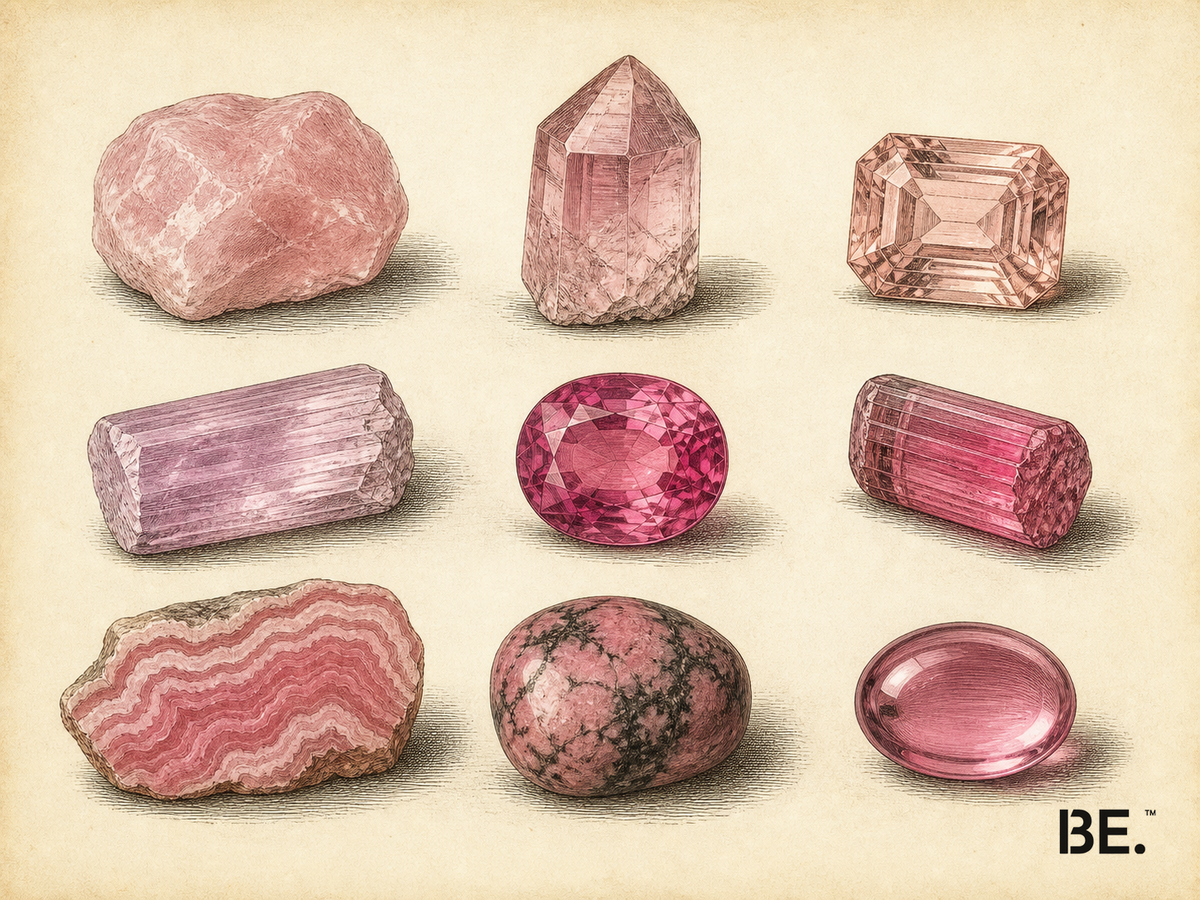
Pink is a visual category
Pink may be pale and cloudy, saturated and transparent, peach-leaning, purple-leaning or patterned with white and black. Lighting and photography can move the same object between those descriptions. A colour name is therefore a practical browsing tool, but it needs a material field beneath it.
Keep four levels separate:
- Species: quartz, beryl, spodumene, corundum and rhodonite are mineral identities. Rocks or aggregates, organic gem materials, manufactured glass and manufactured resin require different class labels.
- Variety or gem name: rose quartz, morganite, kunzite and pink sapphire connect a colour or gem convention to a mineral.
- Commercial name: names such as “rubellite” or fruit-named quartz can be applied with varying precision.
- Origin and modification: natural, synthetic, treated, dyed and imitation answer different questions. Manufactured glass and manufactured resin are artificial products rather than laboratory-grown mineral equivalents; natural organic gem material is a separate non-mineral class, and origin still does not answer treatment.
This separation avoids two common errors: calling every pale pink object rose quartz, and calling every non-natural object “glass” or “fake”.
Pink crystal names: ten routes to check first
| Name | Material class | Visual route | Wear or treatment question | Owner |
|---|---|---|---|---|
| Rose Quartz | Quartz | Commonly cloudy to translucent pink | Is the material natural Quartz, and is any treatment disclosed? | Rose Quartz Guide |
| Morganite | Beryl | Transparent pink to orange-pink | Ask for beryl identity, treatment and setting condition. | Pink map |
| Kunzite | Spodumene | Transparent pink to violet with directional colour | Protect cleavage; ask about heating, irradiation and light sensitivity. | Pink map |
| Pink Sapphire | Corundum | Transparent pink | Separate species, natural or laboratory origin, and treatment. | Pink map |
| Pink Tourmaline | Tourmaline group | Pink to red-pink, transparent to translucent | Do not assume every saturated stone is rubellite; ask for treatment. | Pink map |
| Rhodochrosite | Manganese-carbonate mineral | Pink-and-white bands or transparent crystal | Banding is not identification; protect the finished surface from impact. | Pink map |
| Rhodonite | Manganese-silicate mineral | Pink with dark veining | Ask whether the object is a single material, rock or composite. | Pink map |
| Dyed Chalcedony | Microcrystalline Quartz with colour treatment | Even pink or colour concentrated near fractures and drill holes | Keep the dye disclosure with the object and clean to the treatment limit. | Fruit-name guide |
| Manufactured Glass | Artificial uncrystallised product | Transparent, translucent, bubbly or mould-related features | Ask about coating, filling and assembly; avoid identity by bubbles alone. | Glass-name guide |
| Synthetic Corundum | Laboratory-grown corundum | Can overlap natural pink sapphire visually | Synthetic origin is not imitation, but it must be disclosed. | Pink map |
A material map of common pink names
Quartz: rose quartz and transparent pink quartz
Rose quartz is the familiar pink quartz material, commonly translucent and used for beads, cabochons and carvings. Its colour can be uneven, and internal haze or fine features may soften transmitted light. Those traits can support a rose-quartz candidate but are not universal and do not establish origin.
Gemmological research distinguishes common massive rose quartz from uncommon transparent pink quartz material with different colour behaviour and internal features. A seller may use “rose quartz” broadly, but a transparent faceted pink stone should not be assigned to that category from colour alone.
Commercial names such as strawberry, cherry or berry quartz create another layer. They may be used for inclusion-rich quartz, treated material or manufactured glass. A colour-led trade label does not disclose whether the object is a single material, a resin-filled material or a composite. For that specific naming problem, use the dedicated owner guide rather than treating the fruit word as a mineral species.
Beryl and spodumene: morganite and kunzite
Morganite is the pink to orange-pink variety of beryl. It belongs to the same mineral species as aquamarine but occupies a different colour variety. Pale colour and high transparency can overlap visually with other faceted pink gems, so the beryl identity requires more than a palette match.
Kunzite is the pink to violet-purple gem variety of spodumene. It can show strong pleochroism, with colour changing by viewing direction, and its colour may be sensitive to prolonged intense light. Its cleavage also makes impact a separate care risk. Directional colour is useful evidence, but it does not by itself separate kunzite from every other pleochroic or colour-shifting candidate.
Corundum and tourmaline
Pink sapphire is pink corundum. The naming boundary between pink sapphire and ruby depends on colour convention and laboratory or market practice; it is not resolved by a single phone photograph. Species, natural or synthetic origin, and detectable treatment are separate report questions. A report supports only the stone whose identifying details it matches; a card or report for another item is not transferable.
Pink tourmaline belongs to the tourmaline group. Rubellite is a name used for saturated pink to red tourmaline, but not every pink tourmaline is automatically rubellite. A responsible listing retains the tourmaline identity and uses the variety or trade name with colour evidence and clear disclosure.
Opaque patterned minerals: rhodochrosite and rhodonite
Rhodochrosite is a manganese carbonate mineral. Ornamental material may show pink and white banding, although transparent crystals also exist. Rhodonite is a manganese silicate mineral and may show pink material with dark manganese-oxide veining.
Banding or black veins can direct attention to these candidates, but neither pattern is exclusive. Dyed stone, composites and other manganese-rich materials can overlap visually. The pattern should be documented before the mineral name is tested, not used as the test itself.
Glass, dyed chalcedony and synthetics
Manufactured pink glass can be transparent, translucent or filled with decorative internal effects. Bubbles, mould seams or flow features may support a glass candidate; their absence does not rule it out. Manufactured resin is also non-mineral and can imitate a coloured stone. Dyed chalcedony can produce even or concentrated pink colour. Colour gathering near fractures or drill holes may be a treatment clue, not proof by itself.
A synthetic pink sapphire is laboratory-grown corundum, whereas pink glass is an imitation of a different material. Synthetic origin and imitation are not synonyms. The same distinction applies to other laboratory-grown gems: name the material first, then the origin. Organic gem material is a separate non-mineral class; origin and treatment still require separate disclosure.
Visual navigation without identification
| Visual route | Candidates to keep | Boundary |
|---|---|---|
| Pale, cloudy or translucent pink | Rose quartz, dyed chalcedony, glass and other translucent materials | Haze and colour do not prove quartz |
| Transparent peach-pink | Morganite, tourmaline, sapphire, glass or synthetic gem | Hue does not establish beryl or natural origin |
| Transparent pink to violet-pink with directional colour | Kunzite, tourmaline and other pleochroic candidates | Pleochroism requires controlled viewing and supporting tests |
| Pink-and-white bands | Rhodochrosite, banded or dyed materials | Banding is not a species result |
| Pink with dark veins | Rhodonite and other veined or composite materials | Black veining does not prove rhodonite |
| Bright transparent material with bubbles or mould features | Manufactured glass remains plausible | Not all glass has visible bubbles; inclusions need context |
Record whether the feature is inside the material, on the surface or concentrated at a drill hole. That distinction can improve a candidate list without pretending to be a laboratory identification.
Naming and disclosure checkpoints
A complete listing should answer:
- What material is claimed—quartz, beryl, spodumene, corundum, tourmaline, rhodochrosite, rhodonite or glass?
- Is the descriptive name a recognised variety, a colour adjective or a commercial label?
- Is the material claimed to be natural or laboratory-grown?
- Is dyeing, heating, filling, coating, diffusion or assembly disclosed when known?
- Does any independent laboratory report apply to this exact object and match the listing?
An “AAA pink crystal” label does not answer those questions. Commercial quality grades are not a substitute for identity or treatment disclosure; when a report is used as evidence, it must match the exact object.
A safe screening sequence
- Preserve the exact seller wording, measurements, images and report identifiers.
- Observe colour and transparency in neutral, diffused light and through a thin edge where practical.
- Rotate transparent material to record directional colour without assigning a species.
- Inspect at about 10× for zoning, fractures, dye concentration, bubbles, coatings, seams and assembled boundaries.
- Record dimensions and weight together; do not identify by hand-feel alone.
- Avoid scratching, heating, chemicals and improvised ultraviolet conclusions. These can damage jewellery or create ambiguous results. Care also depends on cleavage, toughness, light or heat sensitivity, treatment and assembly—not hardness alone.
- Seek a qualified gemmologist or laboratory when origin, treatment or species affects value or trust.
Where the owner guides take over
For rose-quartz identity, material context, quality and care, continue to the Rose Quartz Guide. The neutral material content of that page owns the quartz depth. For bracelet-specific authenticity and quality, use the safe Rose Quartz bracelet guide.
For the pale lavender boundary, use Amethyst vs Rose Quartz. For fruit-named quartz and glass terminology, use Cherry, Berry and Strawberry Quartz: Glass or Stone?. This hub only maps the routes.
For the science behind pink and every other crystal colour, continue to How Crystal Colours Form. This page owns the cross-material pink map; the linked Rose Quartz, lavender-comparison and fruit-name guides take over when the question becomes material-specific.
Frequently asked questions
Q1.Are all pink crystals rose quartz?
No. Pink materials include quartz, beryl, spodumene, corundum, tourmaline, rhodochrosite, rhodonite, dyed chalcedony, glass and synthetics. Rose quartz is one material route within the wider colour category.
Q2.Is morganite pink quartz?
No. Morganite is pink to orange-pink beryl. Rose quartz and transparent pink quartz belong to the quartz family. Similar colour does not make their mineral identity the same.
Q3.Is every pink tourmaline rubellite?
No. Rubellite is used for saturated pink to red tourmaline, but naming conventions and colour thresholds vary. “Pink tourmaline” is the safer material-and-colour description unless the stronger variety name is supported.
Q4.Do black veins prove a stone is rhodonite?
No. Dark manganese-oxide veining is associated with much rhodonite material, but other natural, dyed and composite materials can look similar. Veining is a screening clue, not an identity test.
Q5.Is synthetic pink sapphire an imitation?
Synthetic pink sapphire is laboratory-grown corundum, so it has essentially the same mineral identity as natural sapphire. Pink glass is an imitation because it is a different material. Both origins must be disclosed accurately.
Q6.Can a photo identify a pink stone?
A photograph can document colour, transparency, pattern and visible features. It cannot reliably establish mineral species, natural or synthetic origin, or treatment. Testing is appropriate when the distinction matters.
References
Field Notes.
One stone at a time: its geology, and how to read quality. The Stone Buying Checklist comes with your first email.
By subscribing you agree to receive emails from BE. Unsubscribe anytime.
Sent. Check your inbox.