
Black Bead ID: Obsidian, Onyx, Tourmaline or Glass?
Black colour is not an identification. Compare obsidian, onyx, black tourmaline and manufactured glass through lustre, texture, edge light, internal features and laboratory limits.
In this field note
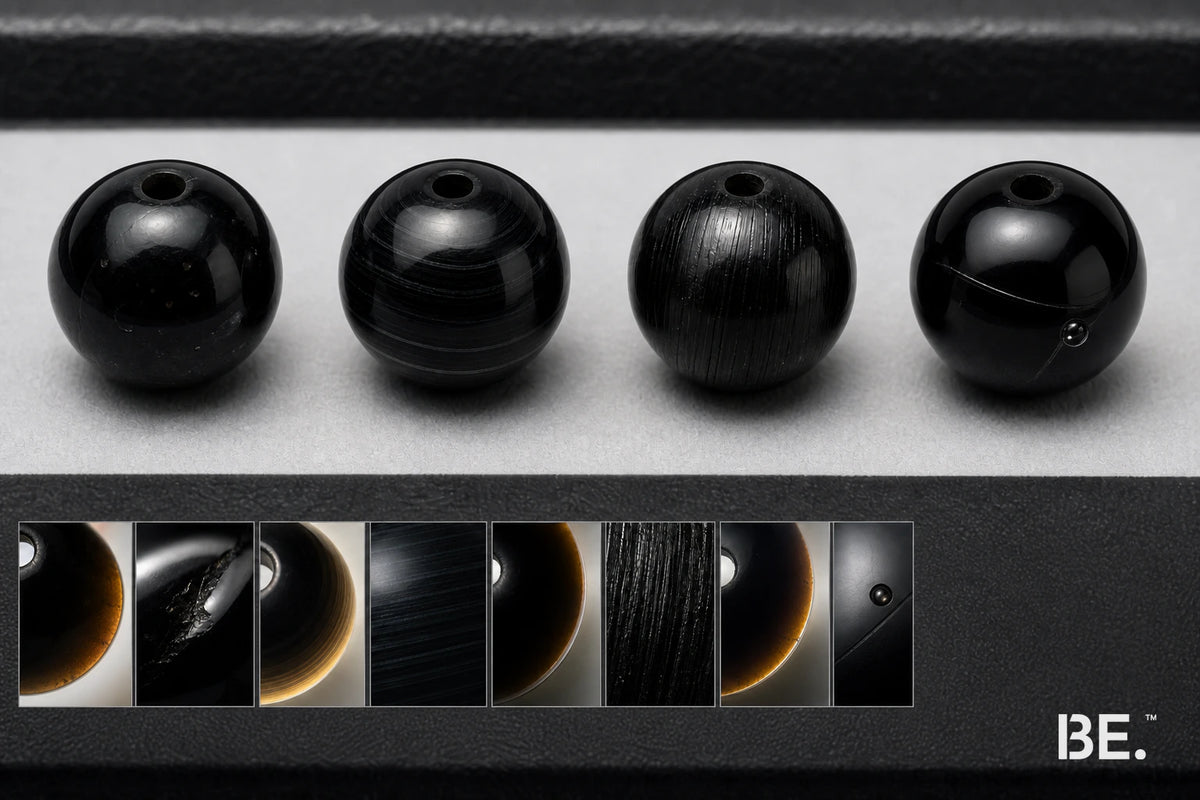
Black beads compress very different materials into the same first impression. Strong front lighting clips their surfaces into a bright reflection; dark backgrounds remove edge detail; phone processing makes every body equally black. Search results then assign a mineral name from shape alone.
A useful comparison begins with material class. Obsidian and manufactured glass are glasses, one geological and one made by people. Onyx is microcrystalline quartz, while black tourmaline is a crystalline borosilicate mineral, most commonly schorl. Their internal structures differ even when polish hides them.
What is black obsidian?
Obsidian is natural volcanic glass formed when silica-rich lava cools rapidly enough to prevent a regular crystal structure from developing. It commonly has a vitreous lustre and conchoidal fracture. In thin edges it may transmit brown, grey or greenish light, although thick black beads can appear fully opaque.
Gold-sheen and silver-sheen obsidian contain oriented microscopic features that reflect light directionally. Rotate the bead and the sheen should move, strengthen or disappear with angle. A painted metallic surface or evenly distributed glitter does not reproduce the same subsurface directional behaviour.
Obsidian can contain bubbles, flow bands and small mineral inclusions, so one bubble does not distinguish it from manufactured glass. Geological context, a coherent set of microscopic features and physical testing are needed when the distinction affects value.
What does black onyx mean in the jewellery market?
Mineralogically, onyx is banded chalcedony with roughly parallel layers. Much uniformly black material sold as onyx has been dyed to produce a strong even colour. Dyed natural chalcedony is still natural quartz material, but the treatment should be disclosed because colour, care and rarity are part of the purchase.
For a direct two-material comparison, see Obsidian vs Onyx: material and structure.
Look at thin edges, drill holes and any chips for banding, a lighter substrate or concentrated colour. Absence of visible bands does not rule out chalcedony in a small polished bead, and a perfectly black surface does not prove treatment. Magnification and spectroscopy may be needed.
The word onyx is also used loosely for other banded stones, including calcite materials marketed as “Mexican onyx”. A plain material description should accompany the trade name so hardness and care are not inferred from the wrong mineral.
How does black tourmaline differ from glassy black beads?
Black tourmaline is usually schorl, a crystalline tourmaline rich in iron. Rough crystals commonly show strong lengthwise striations and a prismatic form. In a highly polished round bead, those external crystal clues may be removed, leaving fractures, uneven texture or small mineral inclusions as possible evidence.
Tourmaline is harder than common glass and obsidian on the Mohs scale, but a scratch test is not appropriate on jewellery. It may damage the polish and cannot reliably account for coatings, treatments or mixed lots. Density and refractive behaviour are more useful in trained hands.
Some commercial black tourmaline beads are intentionally textured or retain pits from the rough; others are polished smooth. Surface roughness is therefore not a definition. Identity should be based on multiple properties, not the idea that tourmaline must look “more natural”.
Which clues suggest manufactured black glass?
Manufactured glass may show rounded gas bubbles, flow lines, swirl patterns, mould seams or exceptionally repeated features across beads. Colour may remain evenly black at every edge, or a thin edge may reveal the colourants used. A chip often has a curved glassy fracture, though obsidian can fracture in the same way because it is also glass.
That overlap is important. Bubbles and conchoidal fracture do not automatically mean “fake obsidian”; both natural volcanic glass and manufactured glass can share them. Natural obsidian may show flow banding and mineral inclusions, while manufactured glass can be made with few visible bubbles. Provenance and laboratory evidence carry more weight than one dramatic clue.
| Feature | Obsidian | Onyx / chalcedony | Black tourmaline | Manufactured glass |
|---|---|---|---|---|
| Material class | Natural volcanic glass | Microcrystalline quartz | Crystalline mineral, usually schorl | Human-made glass |
| Common structure | Flow bands, bubbles, sheen varieties | Parallel banding; may be dyed | Striations or mineral texture | Bubbles, flow or mould features |
| Thin-edge light | May appear brown-grey or greenish | May show bands or lighter substrate | Often remains dark | Varies with formulation |
| Diagnostic limit | Overlaps strongly with glass | Small beads may hide banding | Polish removes crystal form | Can imitate natural glass closely |
| Best next step | Microscopy plus provenance | Check treatment and banding | Gem tests | Microscopy and physical tests |
Which home checks are useful without damaging the bracelet?
Use diffuse daylight, strong backlight at a thin edge and a 10× loupe. Rotate several beads, not only one. Record whether a sheen moves, whether bands continue through the bead, whether bubbles are rounded or stretched, whether colour concentrates near drill holes and whether the same internal pattern repeats.
Photograph chips or drill holes with side light and a scale. Do not use a flame, hot needle, acid, acetone or deliberate scratch. These tests can damage the bead, coating, dye, polish or construction and may still fail to distinguish natural from manufactured glass.
Compare the observations with the broader bracelet identification hub. If the candidate list remains longer than one material, keep it open. “Black stone” is an honest interim description; a confident wrong mineral is not better.
When can a photograph not identify a black bead?
A photograph is insufficient when the bead is uniformly opaque, polished smooth and lacks a directional optical effect or visible structure. It is also insufficient when the commercial claim depends on treatment, exact glass origin, geographic source or a distinction between materials with overlapping appearances.
Gemmologists may combine microscopy with refractive-index techniques, specific gravity, spectroscopy, X-ray diffraction or chemical analysis. No single test fits every opaque object, and mounted beads can restrict access. A credible report should state the method, conclusion and limits, and keep a probability from being presented as certainty.
The practical buying rule is to demand proportionate disclosure. A seller offering ordinary black beads should at least state the material and known treatment. A collector-grade or origin-priced claim needs stronger evidence. Until then, evaluate the bracelet for design and workmanship without inventing geological rarity from the colour black.
Black bead strands are listed in the BE. collection, and every strand ships with a Stone Origin Record that states its lot, its four Crystal 4T™ readings and what those readings do not claim.
Frequently asked questions
Q1.How can I tell if a black bead is obsidian?
Look for vitreous lustre, possible thin-edge transmission, flow features and any directional sheen, but remember that natural obsidian overlaps strongly with manufactured glass. Provenance and testing may be needed.
Q2.Is black onyx naturally black?
Onyx is banded chalcedony, but much uniformly black commercial onyx is dyed. Dyed natural chalcedony remains natural material, and the colour treatment should be disclosed.
Q3.Does a rough surface prove black tourmaline?
No. Tourmaline rough often has striations, but beads can be polished smooth, and other materials can be textured. Use several mineral properties, since surface roughness alone decides nothing.
Q4.Do bubbles prove a black bead is manufactured glass?
No. Manufactured glass can contain gas bubbles, but obsidian is also a glass and may contain bubbles. Bubble shape, flow structure, other inclusions and testing must be considered together.
Q5.Can I identify black beads with a scratch test?
Do not scratch finished jewellery. The test can damage polish or coatings and may remain ambiguous. Magnification, backlighting and professional non-destructive tests are safer.
Q6.When should a black bracelet go to a gem laboratory?
Use a laboratory when the bead is opaque and visually featureless, the price is high, treatment or origin affects value, or obsidian, chalcedony, tourmaline and glass remain plausible after observation.
References
- GIA Gems & Gemology: Identification of Black Opaque Gem Materials, multi-method identification of difficult black materials
- GIA Gems & Gemology: “Bubble Obsidian” from Armenia, volcanic-glass identity, bubbles and conchoidal fracture
- GIA: Tourmaline Gem Overview, tourmaline identity, colour and properties
Field Notes.
One stone at a time: its geology, and how to read quality. The Stone Buying Checklist comes with your first email.
By subscribing you agree to receive emails from BE. Unsubscribe anytime.
Sent. Check your inbox.