
Garnet vs Ruby: How to Tell Them Apart and Choose
Garnet is a silicate mineral group; ruby is red corundum. Compare identity, hardness, visual overlap and what to ask before buying.
In this field note
A red bead can look decisive in a photograph and become far less certain in the hand. Dark lighting can make ruby appear garnet-like; strong backlighting can make a transparent garnet appear unusually bright. Polishing removes many crystal-shape clues, and camera processing compresses subtle differences in hue. The useful comparison therefore begins with material identity, since colour stereotypes do not separate the two.
This guide keeps a narrow boundary. It compares garnet with ruby for identification and bracelet selection. The wider garnet family belongs to the Garnet Guide; differences among garnet species belong to Understanding the Garnet Group. Ruby deserves its own full buying guide. Here, it acts as the corundum side of one precise comparison.
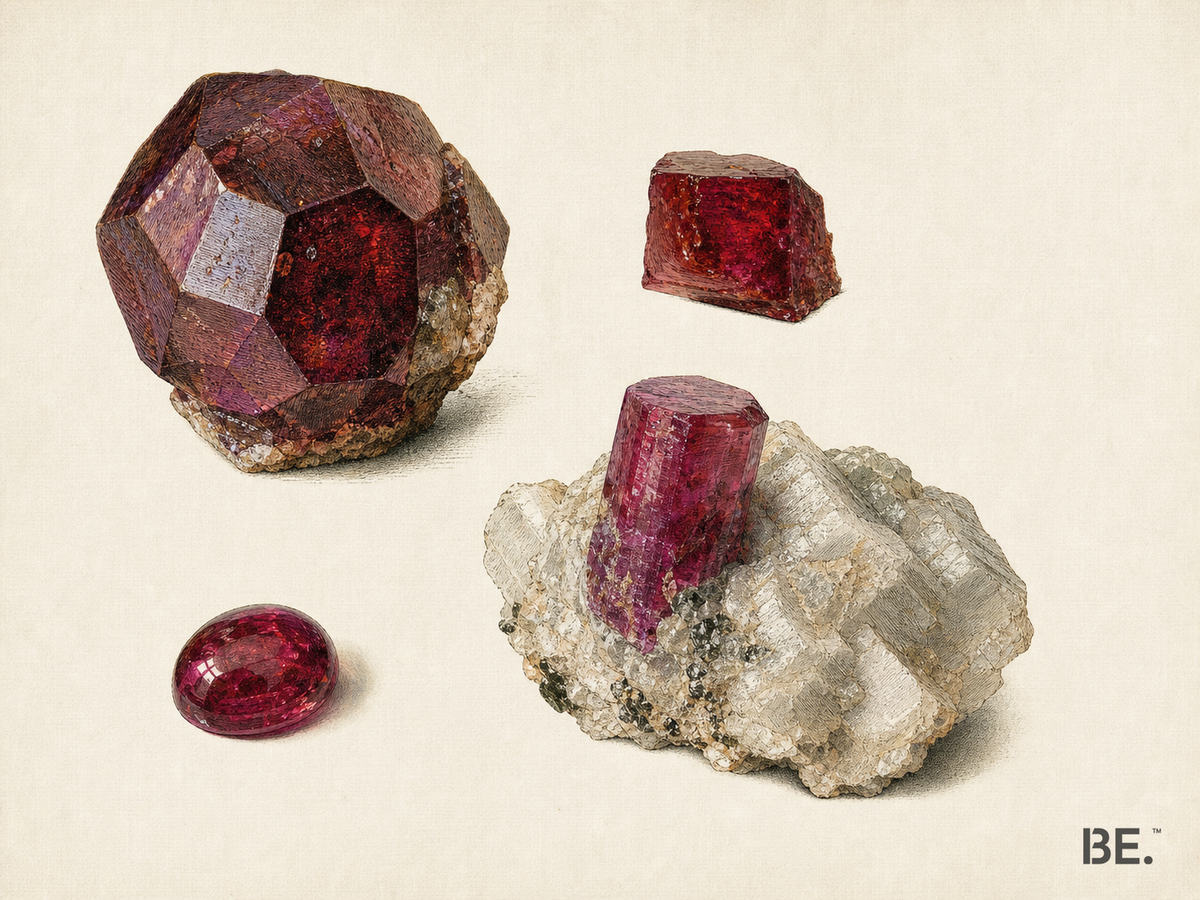
What makes garnet and ruby different materials?
Ruby is red corundum, while garnet names a mineral group. Corundum is crystalline aluminium oxide. In ruby, chromium contributes the red colour. Garnets share a common crystal-structure pattern but allow different elements to occupy structural sites, producing species and mixtures such as almandine, pyrope, spessartine and others. Red jewellery garnet is often almandine-rich, pyrope-rich or intermediate material.
This difference matters because a trade name should describe an identity, not only a colour. “Ruby red” can describe a hue in ordinary language, but it does not turn a garnet into ruby. The word “garnet” also does not guarantee one fixed chemistry. A serious listing should name the material at the level the seller can support and avoid implying a laboratory conclusion from colour alone.
Both materials form crystals, but their structures and properties are distinct. Corundum sits at Mohs 9, below diamond but above quartz. Common red garnets sit lower, generally around Mohs 6.5–7.5 depending on composition. That gap is meaningful for scratch resistance; it is not permission to run a destructive scratch test on finished jewellery.
How do garnet and ruby compare at a glance?
| Point | Garnet | Ruby |
|---|---|---|
| Material identity | Silicate mineral group | Red corundum |
| Basic composition | Composition varies by garnet species and mixture | Al₂O₃ with chromium associated with red colour |
| Mohs hardness | Usually about 6.5–7.5 for common jewellery garnets | 9 |
| Red range | Orange-red, pure red, wine-red, purplish red and very dark red | Pinkish red through vivid red to purplish or dark red |
| Visual overlap | Can be transparent and strongly saturated | Can be included, dark or unevenly coloured |
| Laboratory-grown material | Less central in ordinary bracelet trade | Commercial synthetic ruby exists and must be disclosed |
| Treatment questions | Ask for any treatment and exact material claim | Ask natural or laboratory-grown, then ask about heat, filling and other treatment |
| Bracelet reason | Deep colour range and mineral-group character | High scratch resistance and ruby identity |
The table is a decision frame, not a visual identification key. Two stones can occupy the same colour range while differing in refractive behaviour, spectrum, inclusions and growth features. Those measurements belong to gemmology. The buyer-facing task is to separate observable clues from claims that need evidence.
What can the eye screen, and what cannot prove identity?
The eye can screen colour, transparency, zoning, inclusions and surface condition; it cannot certify garnet or ruby. A garnet may show a deep wine-red body colour and become brighter at a thin edge. A ruby may show purplish red, silk-like inclusions, healed fissures or uneven colour. None of those traits is universal. Clean-looking material can occur on both sides, and an included stone is not automatically natural.
Start with neutral daylight and a white background. Compare several beads, and do not stop at the brightest one. Look for consistent drill holes, chips, surface-reaching fractures, colour concentrated in cracks and abrupt differences between beads. These observations help judge construction and whether further questions are needed. They do not transform the buyer into a laboratory.
Why is UV fluorescence only a clue?
Many rubies fluoresce red under long-wave ultraviolet light because chromium can emit visible light. The response can be reduced by iron, altered by the lamp and affected by the material itself. Garnets are often inert or different in response, yet “ruby glows, garnet does not” is too absolute for a purchase decision. Glass, synthetic corundum and other red materials add further ambiguity. Use fluorescence as a reason to ask, not as a final verdict.
Why should a finished bead not be scratch-tested?
A scratch result is hard to interpret without controlled reference points and can damage polish, drill edges or neighbouring beads. Surface coatings, dirt and tool material can confuse the mark. The Crystal Hardness Chart explains what Mohs values mean without turning jewellery into a test sample. For a valuable ruby claim, documentation is safer than abrasion.
Which material suits a bracelet?
Ruby offers greater scratch resistance; garnet offers a wider, often more accessible red-mineral field. A bracelet rubs against desks, cuffs and other jewellery, so ruby’s Mohs 9 surface is advantageous. Yet even ruby can chip at an exposed edge or fail where a bead is fractured around the drill hole. Garnet asks for more care against abrasion but is not automatically too fragile for ordinary bracelet wear.
Visual preference should remain material-specific. Garnet can provide dense wine red, brown-red or vivid pyrope-rich colour with a weighty, terrestrial presence. Ruby can carry a brighter chromium red and a different light response. Neither choice needs a symbolic claim. The material, cut, bead matching and construction are enough to compare.
For a strand, inspect roundness, polish, hole alignment and the transitions between beads. A well-matched garnet bracelet can be more satisfying than a poorly disclosed ruby bracelet. A ruby label does not excuse cavities filled with glass, unstable treatment, weak construction or a refusal to state laboratory-grown origin.
What should a garnet-or-ruby buying checklist include?
Ask for the exact material name, origin category, treatment disclosure and return terms before paying. “Red gemstone” is not enough. For ruby, the invoice or listing should distinguish natural from laboratory-grown and state known treatments. Heat treatment is common in ruby; fracture filling and composite material change care and value more substantially. For garnet, ask what identification supports the garnet claim and whether any treatment is disclosed.
- Identity: Does the document say garnet, ruby, synthetic ruby or only a colour name?
- Origin category: For ruby, is natural or laboratory-grown written clearly?
- Treatment: Is heat, filling, coating or another process disclosed in durable wording?
- Condition: Are chips, surface-reaching fractures and drill-hole damage visible in close photographs?
- Evidence: Does a costly ruby have an independent report whose number and object match the sale?
- Return path: Can the piece be returned if independent inspection contradicts the claim?
Independent laboratory reporting becomes proportionate when the ruby premium is large, origin is part of the price, or treatment would materially alter value. A report is not a guarantee of beauty; it is evidence for identity and disclosed characteristics. For a garnet bracelet, careful seller disclosure and close inspection may be sufficient at a lower price point.
For a garnet route, the high-quality garnet bracelet guide moves from identity to bead selection. The current product path below is garnet only; no ruby product is inserted because no corresponding BE. PDP was approved for this article.
Frequently asked questions
Q1. Is garnet the same stone as ruby?
No. Garnet is a group of silicate minerals that share a structural pattern, while ruby is the red variety of corundum, aluminium oxide. Similar red colour does not make the materials identical.
Q2. Can garnet be as red as ruby?
Yes. Some pyrope-rich and mixed garnets can approach a vivid red associated with ruby, while some rubies are dark or purplish. Hue and saturation overlap, so colour alone cannot confirm identity.
Q3. Is ruby always more durable than garnet?
Ruby is much harder against scratching at Mohs 9, while common jewellery garnets are usually about 6.5 to 7.5. Hardness is only one part of wear: existing fractures, bead drilling and impacts also affect survival.
Q4. Can UV light reliably separate ruby from garnet?
No. Fluorescence can supply a clue, but strength varies with trace elements, material and light source. A weak or strong response is not a stand-alone identity test and cannot replace gemmological examination.
Q5. Which is better for a bracelet: garnet or ruby?
Choose ruby when exceptional scratch resistance and ruby identity justify the price. Choose garnet for a broad range of deep reds, visible mineral character and a more accessible route. In either case, demand exact material and treatment disclosure.
References
- [1] GIA: Ruby: corundum identity, colour and durability
- [2] GIA: Garnet Buyer’s Guide: garnet selection and durability context
- [3] GIA: Can garnet match ruby red?: documented colour overlap
Field Notes.
One stone at a time: its geology, and how to read quality. The Stone Buying Checklist comes with your first email.
By subscribing you agree to receive emails from BE. Unsubscribe anytime.
Sent. Check your inbox.