
Black Crystals: A Material-First Naming Guide
A material-first map of black gem names, separating minerals, chalcedony, natural glass, organic material and manufactured glass while keeping visual observations as screening clues rather than identification.
In this field note
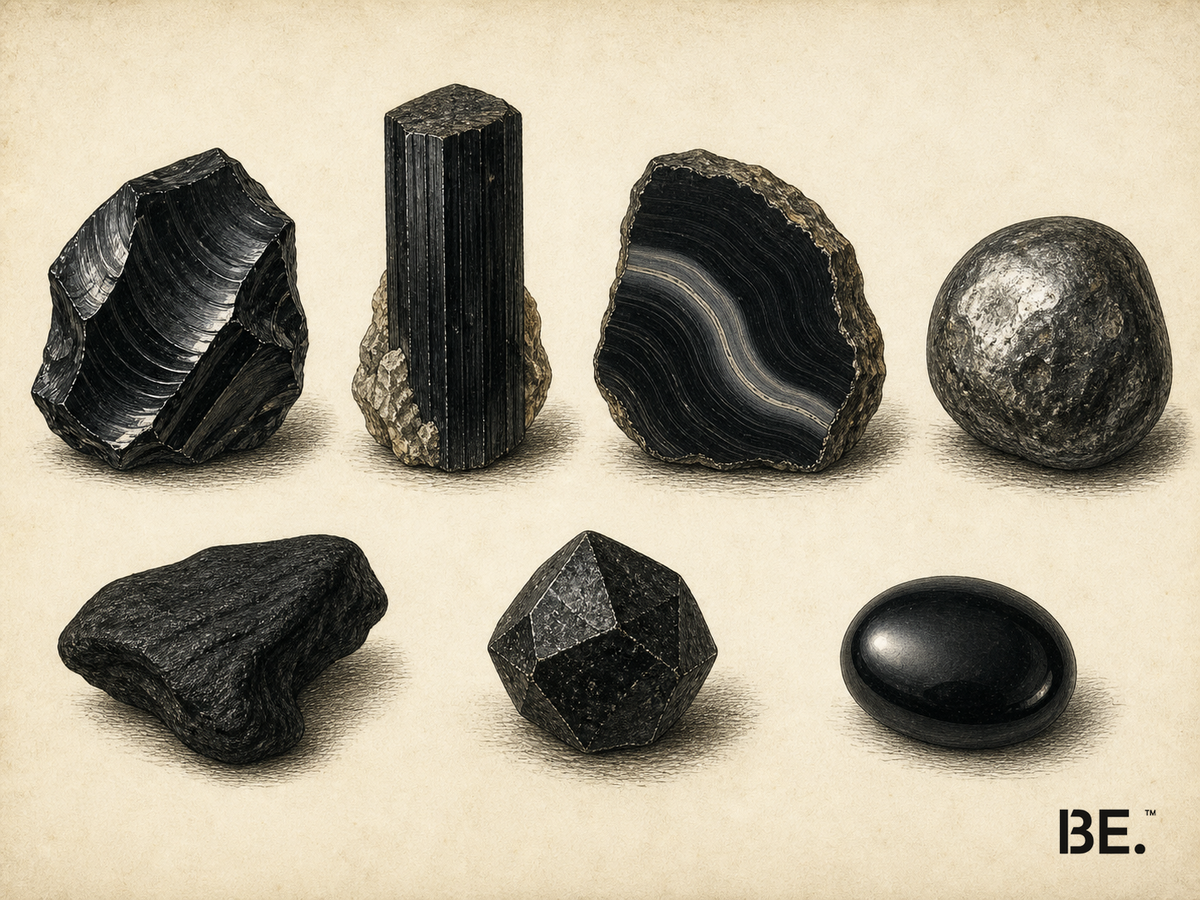
Why “black crystal” is a navigation term
Colour is the first thing we notice, but it is rarely the whole material story. A bead may look black because it absorbs most visible light, because it is strongly coloured and nearly opaque, because its body contains dense inclusions, or because the material was manufactured or treated to appear uniformly dark. Different structures and compositions can therefore arrive at a similar visual result.
The word “crystal” adds another complication. In strict mineralogy, a crystal has an ordered internal structure. Obsidian is natural volcanic glass and does not have that crystalline structure. Jet is an organic gem material. Manufactured glass is neither a natural mineral nor a rock. All three may still appear in retail searches for “black crystals”. The search phrase is understandable; the label should not replace the material name.
A material-first description keeps three questions separate:
- What is it? Mineral, rock, natural glass, organic gem material or manufactured material.
- What has happened to it? Natural, treated, dyed, assembled or otherwise modified, where evidence supports that conclusion.
- What is the object? Bead, cabochon, carving, rough specimen or faceted stone.
One photograph usually cannot settle all three.
For the colour mechanisms behind dark appearance—including selective absorption, dense inclusions and structural effects—continue to How Crystal Colors Form. Here, the focus stays on material naming and safe screening.
A material map of common black names
Minerals: schorl, black spinel and haematite
Schorl is a mineral species in the tourmaline supergroup and is commonly black. “Black tourmaline” is often used for schorl in jewellery, but a retail colour phrase is not a laboratory determination. Prismatic form and lengthwise striations can be useful specimen observations; polishing may remove or obscure them, and moulded glass can imitate surface lines.
Black spinel is a crystalline mineral, not black glass. It may occur as an opaque polished or faceted gem. Its appearance overlaps with other dark materials, especially when reflections hide the body colour. Instrumental properties, rather than colour alone, are what separate it reliably.
Haematite is an iron oxide mineral. Polished pieces can have a bright metallic to submetallic surface and a dense feel for their size. Those features make haematite a reasonable candidate, not an automatic answer: coated, composite and manufactured materials can be made to look metallic, and an impression of heft changes with bead diameter and drilling.
Chalcedony names: onyx and dyed material
In gemmological naming, onyx refers to chalcedony with straight, parallel bands, traditionally in contrasting colours. Much black onyx in commerce is chalcedony whose colour has been modified, commonly by dyeing. A seller should disclose treatment when known. Uniform black colour does not prove dye, while a visible concentration of colour near fractures or drill holes is only a screening clue.
The name is also used loosely for materials that do not meet that banded chalcedony definition. That is why a purchase record should say more than “onyx”: ask whether the object is chalcedony, whether the colour is natural or treated, and whether the name is being used as a trade label.
Natural glass, organic material and manufactured glass
Obsidian is natural volcanic glass formed when silica-rich lava cools rapidly enough to inhibit substantial crystal growth. Its surfaces may show a glassy lustre, flow-related features or curved, shell-like fracture. A finished black bead may reveal few of those features, so the category cannot be confirmed from gloss alone.
Jet is an organic gem material derived from altered wood. It can be black, relatively lightweight and capable of taking a polish. Its organic origin separates it from black minerals even though retail colour pages may place them together. Apparent lightness is affected by size, hollowing and construction, so it is not proof.
Manufactured black glass can be shaped, moulded, cut or polished to resemble natural materials. Rounded gas bubbles, mould seams and flow features may support a glass candidate when correctly observed. Their absence does not rule glass out, and natural materials can contain rounded-looking inclusions. The whole evidence pattern matters.
Navigate by appearance—without calling it identification
Use appearance to choose the next question, not to announce a result.
| First observation | Candidates worth keeping | What the observation cannot prove |
|---|---|---|
| Very glassy surface or curved chip | Obsidian, manufactured glass, some highly polished minerals | Natural versus manufactured glass |
| Straight banding or waxy translucency at a thin edge | Onyx or another chalcedony; also layered or assembled material | That the colour is natural or that “onyx” is correctly used |
| Metallic or submetallic reflection | Haematite; coated or manufactured material | Composition, coating status or solid construction |
| Prismatic form or lengthwise striations | Schorl may remain in the candidate set | That a polished bead is tourmaline |
| Opaque, evenly black faceted stone | Black spinel, glass and other dark materials | Mineral species or natural origin |
| Noticeably light for its size | Jet, hollow or composite construction | Organic origin |
Transparency also needs careful language. A bead that looks opaque face-up may show brown, grey or green at a thin edge under transmitted light. Record the observation, light source and angle. Do not convert that edge colour into a species name.
A safe screening sequence
- Keep the seller’s wording. Save the invoice, listing, treatment disclosure and any report number. A trade name without a material field is incomplete evidence.
- Describe the object before the material. Record bead diameter, drill-hole appearance, polish, chips, banding, lustre and whether thin edges transmit light.
- Use neutral illumination. Compare diffused daylight or a high-quality white light with transmitted light. Phone processing and dark backgrounds can erase colour and internal features.
- Inspect at about 10× magnification. Look for surface-reaching fractures, bubbles, flow features, dye concentrations, coatings, seams and natural-looking growth features. Treat each as a clue requiring context.
- Record dimensions and weight together. Heft is meaningful only when size and construction are comparable. It is not a freehand identity test.
- Stop before destructive testing. Scratching, heating, filing and chemical tests can damage jewellery and still produce ambiguous results.
- Escalate when the answer matters. A gemmologist can use optical and physical properties; a laboratory may add spectroscopy, chemistry or imaging where the question requires it.
Colour change under ultraviolet light, a cool touch, magnetic response or a phone-torch effect can be interesting observations. They are not universal black-material tests and should not be presented as authentication.
Where the owner guides take over
This page is the naming map. For a bead-level decision tree covering obsidian, onyx, tourmaline and glass, continue to How to Identify Black Beads: Obsidian, Onyx, Tourmaline or Glass. It owns the deeper screening workflow.
If the candidate set has narrowed specifically to natural volcanic glass versus chalcedony, use Obsidian vs Onyx. It owns that two-material comparison. Keeping those questions in their owner pages prevents a colour hub from becoming a second, shallower identification guide.
Buying and naming notes
A useful listing identifies the material, object type and known treatment separately. “Black crystal bracelet” describes appearance and product form. “Schorl tourmaline beads”, “dyed black chalcedony”, “natural obsidian” or “manufactured glass” makes a testable material claim. If the seller cannot explain which level the name belongs to, treat the identity as unverified rather than filling the gap with a guess.
Laboratory reports also have scope. A report applies to the submitted object, not every bead with a similar colour. Check whether the document states species or variety, natural or synthetic origin where determinable, and detectable treatment. Match report identifiers and measurements to the item.
Frequently asked questions
Q1.Is every black crystal a mineral?
No. Retail searches may group minerals, rocks, natural volcanic glass, organic gem materials and manufactured glass under “black crystals”. The colour page is a navigation layer; the material description should state the actual category.
Q2.Is black tourmaline always schorl?
“Black tourmaline” commonly refers to schorl, a species in the tourmaline supergroup. The trade phrase alone does not establish species. A reliable conclusion uses the specimen’s properties and, when necessary, gemmological testing.
Q3.Is onyx the same as obsidian?
No. Onyx is a banded form of chalcedony, which is crystalline silica at the microstructural scale. Obsidian is natural volcanic glass. Black polished examples can look similar, so use the dedicated comparison rather than colour alone.
Q4.Do bubbles prove a black bead is glass?
No. Rounded gas bubbles can support a manufactured-glass candidate, but not all glass contains visible bubbles, and rounded-looking inclusions can occur in natural materials. Magnification must be interpreted with the rest of the evidence.
Q5.Can a scratch test identify a black stone?
Not safely or reliably in finished jewellery. A scratch result can be affected by coatings, weathered surfaces, tool hardness and technique, and the test causes permanent damage. Use non-destructive observation and professional testing instead.
Q6.When is a laboratory report useful?
Consider one when the item is valuable, the seller’s claim is disputed, treatment or natural origin affects the decision, or visual and basic gemmological tests remain inconclusive. The conclusion applies only to the tested object.
References
Field Notes.
One stone at a time: its geology, and how to read quality. The Stone Buying Checklist comes with your first email.
By subscribing you agree to receive emails from BE. Unsubscribe anytime.
Sent. Check your inbox.