
Purple Crystals: A Material-First Naming Guide
A material-first guide to purple gem names, separating amethyst, sapphire, spinel, iolite, tanzanite, other minerals, mica-rich material, glass and synthetics without treating colour as identification.
In this field note
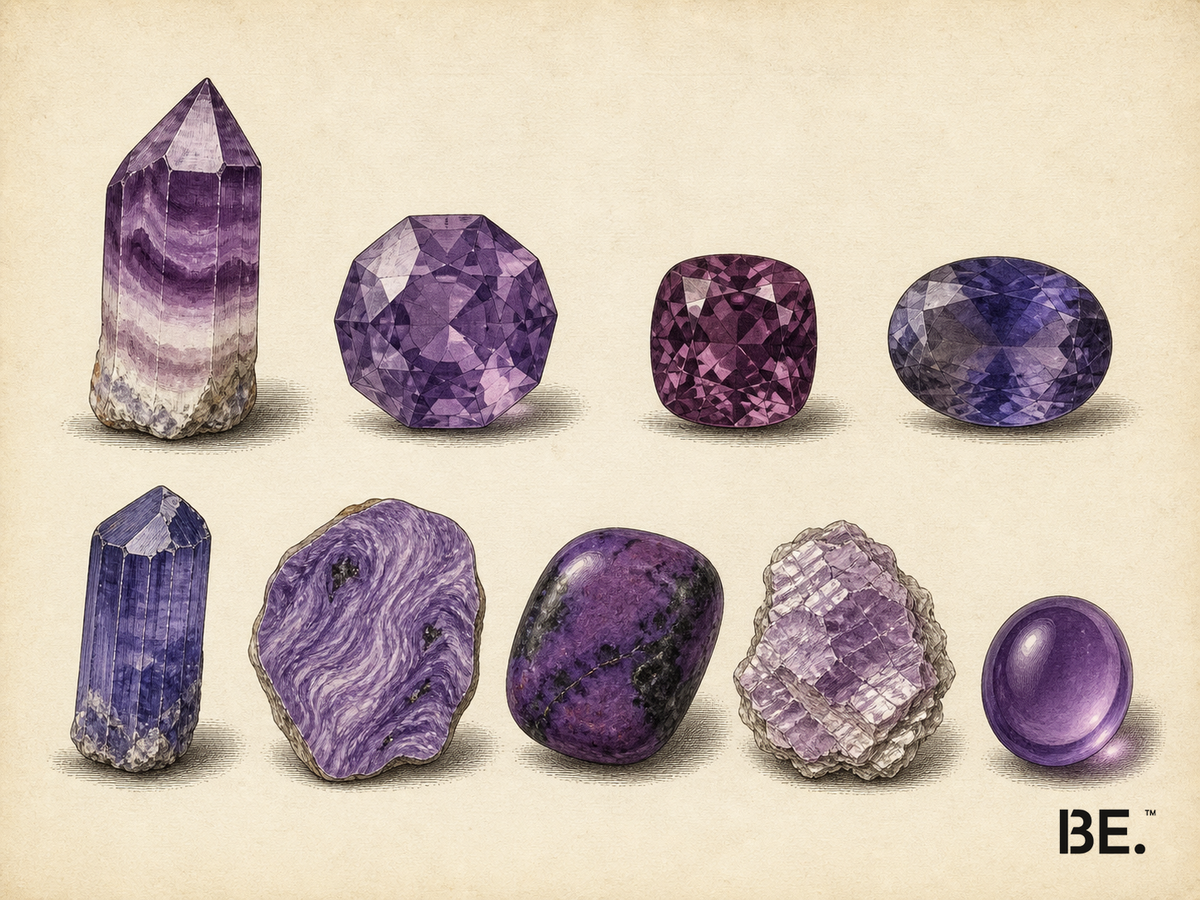
Purple is a palette, not a species
Purple can range from red-violet and grape to cool blue-violet and pale lavender. Camera white balance, mixed lighting, background colour and screen settings can shift all of them. Even in controlled light, two unrelated materials may occupy the same part of the palette.
Start by asking which level a name describes:
- Mineral species or group: spinel, fluorite, cordierite and zoisite refer to mineral identities or recognised mineral categories. A rock or aggregate needs a material-level label; manufactured glass is neither mineral nor rock.
- Gem variety: amethyst is purple quartz; purple sapphire is a colour variety of corundum; tanzanite is a blue-to-violet gem variety of zoisite.
- Commercial or field name: a seller may use a familiar name more broadly than mineral analysis permits.
- Origin and modification: natural, synthetic, treated and imitation describe different questions and must not be collapsed into “real” or “fake”.
The useful sequence is material first, colour second, disclosed modification third.
For the wider optical and chemical routes that produce colour across crystal materials, continue to How Crystal Colors Form. Here, the focus stays on purple material names and their boundaries.
A material map of common purple names
Quartz: amethyst
Amethyst is the purple variety of quartz. It can be transparent to translucent and may show uneven colour or zoning. Those observations are compatible with some natural amethyst, but they do not prove natural origin. Laboratory-grown quartz can reproduce convincing colour and growth features, while treatment history may require more than visual examination.
Pale material is sometimes sold as lavender amethyst. “Lavender” describes appearance, not a separate mineral species. If the question is whether a pale bead belongs with amethyst or pink quartz material, use the dedicated Amethyst vs Rose Quartz comparison. A photograph cannot assign identity.
Corundum, spinel and cordierite
Purple sapphire is corundum. Sapphire is not only blue: the name covers gem corundum colours other than ruby’s red range. A purple sapphire and an amethyst may share hue, yet they are different mineral species with different optical and physical properties.
Purple spinel is the mineral spinel. It is not a sapphire variety, despite possible overlap in colour and faceted appearance. Transparent stones in jewellery can require refractive, spectroscopic and inclusion evidence to separate confidently.
Iolite is the gem name used for cordierite. It is known for strong pleochroism: different viewing directions can show different blue-violet, pale or yellowish appearances. That directional change is useful evidence when properly observed, but it is not unique enough to replace a full identification. Cut orientation also changes what the wearer sees.
Zoisite and other purple minerals
Tanzanite is the blue-to-violet gem variety of zoisite. Most commercial tanzanite is heat treated to reduce yellow-green or brownish pleochroic colour and maximise blue and violet. Heating leaves it tanzanite, and known treatment should be disclosed. Its face-up colour also depends on pleochroism, cut orientation and lighting. “Purple” alone does not distinguish tanzanite from sapphire, spinel, iolite, amethyst or glass.
Charoite is a distinct mineral associated with swirling, fibrous-looking purple patterns in ornamental material. Sugilite is another distinct mineral and can range from purple to violet-red, often in opaque material. Patterned appearance can guide a candidate list, but similar-looking composite, dyed and manufactured materials exist.
Fluorite is a mineral that commonly occurs in purple, sometimes with colour zoning. It is substantially softer than quartz, but this is a care consideration, not permission to scratch-test a finished piece. Visual purple fluorite remains a candidate until its properties are checked.
Mica-group names, glass and synthetics
Lepidolite is widely used for purple lithium-rich mica material. Mineralogically, the name sits in a complex mica-series context and is not a simple colour variety. A glittering, platy texture may support a mica-rich candidate, but it cannot determine the exact mica species or composition. If the object is a mica-rich rock or aggregate, label it at that material level and do not assume a single mica species.
Manufactured purple glass can imitate transparent or translucent gem materials. Bubbles, mould seams and flow features may support glass; their absence does not exclude it. It is manufactured and amorphous, and is neither mineral nor rock. Synthetic amethyst, by contrast, is laboratory-grown crystalline quartz with essentially the same mineral identity as natural amethyst. It counts as synthetic material, a category separate from imitation. Correct disclosure separates origin from material identity.
Visual navigation without visual identification
| Visual route | Candidates to keep | Boundary |
|---|---|---|
| Transparent grape to violet | Amethyst, purple sapphire, spinel, fluorite, glass, synthetic material | Hue does not establish species or origin |
| Blue-violet with directional colour change | Iolite, tanzanite and other pleochroic candidates | Pleochroism needs controlled observation and supporting tests |
| Pale lavender, translucent | Pale amethyst, quartz material, fluorite, glass | “Lavender” is an appearance word, not a species |
| Swirling, fibrous-looking or mottled opaque pattern | Charoite, sugilite, composite or dyed material | Pattern recognition from a photo is not identification |
| Platy or micaceous sparkle | Lithium-rich mica material and other micaceous rocks | Sparkle cannot specify “lepidolite” composition |
| Rounded bubbles or mould-related features | Manufactured glass remains plausible | Not all glass has visible bubbles; inclusions need context |
Record the light source and viewing direction. If colour changes between photographs, first test the photography conditions before proposing a gemmological mechanism.
Natural, synthetic, treated and imitation are different questions
These terms answer different questions:
- Natural describes geological origin.
- Synthetic describes laboratory growth of a material with essentially the same composition and crystal structure as its natural counterpart.
- Treated describes a process applied to a material to alter appearance or another property.
- Imitation describes a different material used to resemble the named gem.
Natural amethyst, heated tanzanite, synthetic amethyst and purple glass are therefore four distinct disclosure states. “Fake” hides the distinction and makes comparison harder. A good listing states material, origin and known treatment separately. Record heating, irradiation, coating, dyeing, filling or assembly as separate disclosures when known; visual inspection may not resolve them.
A safe screening sequence
- Save the exact listing name, treatment statement, measurements and report information.
- Observe face-up colour, transmitted-light colour, translucency, pattern and surface texture in neutral light.
- Rotate transparent material and record directional colour changes without assuming a species.
- Inspect at about 10× for zoning, fractures, growth features, bubbles, coatings or assembled boundaries. Each observation needs context.
- Compare dimensions and weight only as recorded data, not as a hand-feel verdict.
- Avoid scratches, heat, chemicals and prolonged ultraviolet exposure. Destructive tests can damage the object and remain ambiguous. Care also depends on cleavage, toughness, thermal sensitivity, treatment and assembly as well as hardness.
- Use a qualified gemmologist or laboratory when species, natural origin or treatment changes value or purchase confidence.
Where the owner guides take over
For quartz-specific identity, colour, formation, quality and care, continue to the Amethyst Complete Guide. It owns amethyst depth.
For the lavender boundary between two quartz colour families, use Amethyst vs Rose Quartz. For origin questions within amethyst, use Lab-Grown Amethyst vs Natural Amethyst. This hub does not duplicate those comparisons.
Frequently asked questions
Q1.Are all purple crystals amethyst?
No. Amethyst is purple quartz, but purple sapphire, spinel, iolite, tanzanite, fluorite, charoite, sugilite, mica-rich material and glass belong to different material categories. Colour starts the search; it does not finish identification.
Q2.Is purple sapphire the same as amethyst?
No. Purple sapphire is corundum, while amethyst is quartz. Their colour can overlap, but their composition, crystal structure and gemmological properties differ.
Q3.Is tanzanite naturally purple?
Tanzanite is a blue-to-violet variety of zoisite and is pleochroic. Much material is heated to modify the visible colour. A purple appearance alone cannot establish whether a stone is tanzanite or whether it was heated.
Q4.Is synthetic amethyst fake?
Synthetic amethyst is laboratory-grown quartz with essentially the same composition and crystal structure as natural amethyst. Purple glass is an imitation; synthetic amethyst is a separate category, and its synthetic origin must be disclosed.
Q5.Does colour zoning prove natural amethyst?
No. Zoning can be informative when interpreted with growth structures and instrumental data, but one visible band or uneven patch is not proof of natural origin. Synthetic and treated materials require their own evidence pattern.
Q6.Can a photo identify a purple stone?
A photo can document colour, transparency, texture and visible features, but it cannot reliably establish mineral species, natural or synthetic origin, or treatment. Use testing when the conclusion matters.
References
Field Notes.
One stone at a time: its geology, and how to read quality. The Stone Buying Checklist comes with your first email.
By subscribing you agree to receive emails from BE. Unsubscribe anytime.
Sent. Check your inbox.