
Super Seven vs Amethyst: Material, Look & How to Choose
A two-way material comparison for choosing coherent violet amethyst or visibly zoned and included Super Seven quartz.
In this field note
These materials can overlap in chemistry and colour, yet they ask for different ways of looking. One directs attention to tone, saturation and continuity. The other directs attention to a matrix: colour zones, needles, plates, clouds and the spaces between them.
The choice is not a ranking. Neither name proves rarity, quality or value. A better decision compares the actual material, the evidence attached to it, the finish of the jewellery and the visual character intended for the wrist.
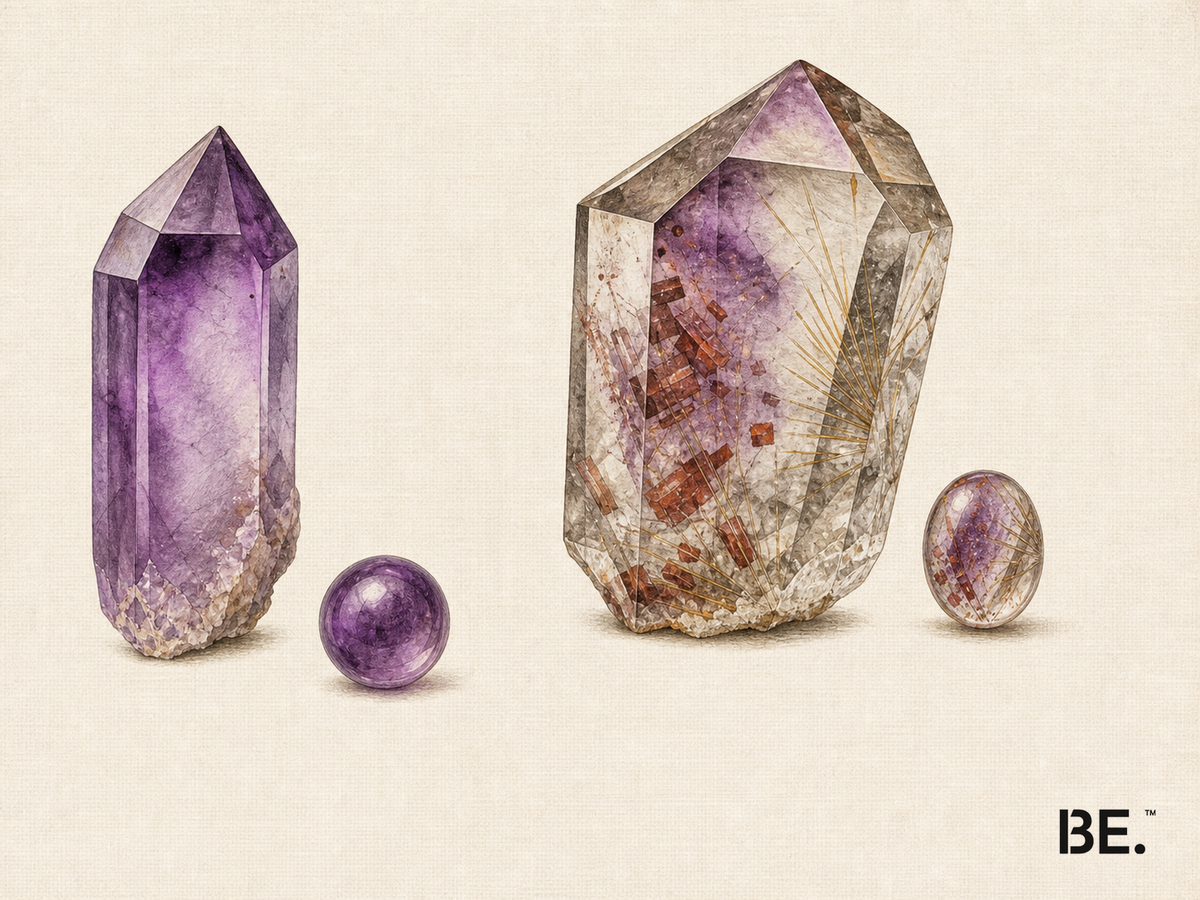
Super Seven vs amethyst at a glance
| Question | Amethyst | Super Seven |
|---|---|---|
| Formal identity | Violet variety of quartz | Commercial label; specimen identity must be described separately |
| Host | Quartz | Usually described as a quartz host or quartz-family matrix |
| Primary visual read | Violet hue, tone, saturation and consistency | Colour zoning, visible inclusions and bead-to-bead matrix variation |
| Inclusions | May be present, but not required by the variety name | Central to the market presentation, but species need evidence |
| Quality language | Colour, clarity, cut and carat or calibrated size are established comparison factors | Host readability, disclosed inclusions, treatment, finish and lot coherence need separate assessment |
| Hardness baseline | Mohs 7 | Quartz-host baseline is Mohs 7; fractures and construction still matter |
| Price comparison | Valid only when size, weight, treatment, construction, evidence and date are comparable | |
What they share
A quartz baseline
A quartz host gives both materials the same broad Mohs-hardness baseline. It also means violet zones in a Super Seven specimen can belong to the same quartz colour family seen in amethyst. Shared host chemistry does not make two finished beads visually or commercially interchangeable.
Natural variation
Both can vary from piece to piece. Amethyst may change in tone, saturation, zoning and clarity. Included quartz may change more dramatically because the cut passes through different concentrations and orientations of internal features. Product photographs should show the actual range rather than imply mechanical uniformity.
How the visual experience differs
Amethyst: colour coherence
GIA describes colour as the most important amethyst quality factor. A strand can therefore be read by whether its violet remains attractive across daylight and indoor light, whether beads sit in a coherent tonal range, and whether cutting supports rather than muddies the colour.
Consistency does not mean every bead must be identical. It means the range is deliberate enough to read as one object. Darker is not automatically better: material that becomes nearly black in ordinary light can lose the violet information that gave it value.
Super Seven: matrix variation
The visual interest lies in relationships inside the quartz: a needle against a smoky zone, a violet boundary crossing a bead, a quiet clear area beside a denser cloud. Each sphere becomes a different section through heterogeneous rough.
Density alone is not a quality rule. A very crowded bead may hide the host, while a more open bead may make one inclusion legible. “Matrix legibility” is a design and selection standard, not a laboratory grade and not a claim that every visible phase has been identified.
Why one quality ruler cannot grade both
Amethyst has an established gem-market vocabulary around colour, clarity, cut and size or weight. GIA notes that fine amethyst is sufficiently available that locality alone does not automatically add value, and labels such as “AAA” have no universal independent standard.
Super Seven needs a different scorecard. The buyer should ask whether the quartz host is correctly described, which inclusions are actually documented, whether the matrix remains visually readable, whether treatment is disclosed, and whether the drilling, polish and bracelet construction are sound. Applying an amethyst colour grade to that matrix would erase the reason it is being considered.
Treatment and evidence
Neither name is a treatment statement. Amethyst colour can be altered by heating, and quartz can be irradiated or otherwise treated. Included quartz can also be dyed, coated, filled, assembled or imitated. The sales description should state material and treatment clearly rather than leaving the buyer to infer them from appearance.
For amethyst, a seller’s colour and treatment disclosure may be enough for an ordinary purchase, while a significant purchase can justify an independent report. For Super Seven, the same principle applies with one extra caution: a laboratory report on the quartz host is not automatically a full identification of every microscopic inclusion.
Hardness, care and daily wear
Both sit on a quartz-host Mohs 7 baseline. That makes them practical jewellery materials, but it does not make them immune to chipping, impact or damage around drill holes. Included or heavily fractured material deserves the more conservative care routine.
- Remove either bracelet before impact, sport, showering, swimming or chemical contact.
- Clean with a soft, slightly damp cloth, then dry fully.
- Avoid ultrasonic and steam cleaning when fractures, fillings or included phases have not been assessed.
- Store each strand away from harder gems and sharp metal edges, and inspect cord, wire and clasp as well as the stone.
Which one to choose
| Priority | Choose amethyst when… | Choose Super Seven when… |
|---|---|---|
| Colour | A sustained violet field is the reason for the purchase | Violet may appear, but colour zoning and internal contrast are part of the appeal |
| Consistency | A controlled tonal rhythm across the strand matters | Bead-to-bead variation is welcome and actual-piece images are available |
| Close looking | Colour and transparency should read from ordinary distance | Needles, plates, clouds and zones should reward inspection |
| Evidence tolerance | A formal variety name and straightforward treatment disclosure are preferred | A trade name is acceptable because the host and lot-level claims are stated precisely |
| Wardrobe | A coherent purple accent is useful | A neutral-to-violet, internally complex object fits better |
There is no geological reason that one must be the “advanced” choice and the other the “beginner” choice. The better material is the one whose visible character, specification and evidence match the decision being made.
Why the prices cannot be read alone
On 10 August 2026, the current BE. Super Seven strand was listed at €349 and the Bolivian Amethyst 10mm strand at €489. That is a dated retail snapshot, not a controlled price comparison. The Super Seven listing did not disclose bead diameter, count or finished weight, while the amethyst product names a 10mm bead size; construction also differs.
A valid comparison needs matched identity, treatment, bead diameter, count, weight, bracelet length, construction, evidence and date. Without that set, the prices describe two specific products. They do not prove that amethyst is intrinsically more valuable or that Super Seven is a bargain.
Frequently asked questions
Q1.Is Super Seven a type of amethyst?
No. A Super Seven specimen may contain violet amethyst zones within a quartz host, but the trade label covers a broader included or zoned quartz material.
Q2.Is Super Seven always rarer than amethyst?
No. The trade name alone supplies no controlled rarity data. Rarity claims need a defined material, documented source, measurable supply and a comparable market.
Q3.Which has more consistent colour?
Amethyst is generally selected for a coherent violet range, while Super Seven is commonly selected for visible zoning and inclusion variation. The actual strand photographs remain decisive.
Q4.Are they equally hard?
The quartz in both has a Mohs hardness of 7. Fractures, exposed inclusions, drill holes and bracelet construction can still create different durability risks.
Q5.Which one is more expensive?
A product price is not a material verdict. Compare matched identity, treatment, bead size, weight, construction, evidence and date before drawing any conclusion.
Q6.Which should a first-time buyer choose?
Choose amethyst when coherent violet colour is the priority. Choose Super Seven when visible matrix variation is the priority and the lot-level evidence is precise enough for the purchase.
References
Field Notes.
One stone at a time: its geology, and how to read quality. The Stone Buying Checklist comes with your first email.
By subscribing you agree to receive emails from BE. Unsubscribe anytime.
Sent. Check your inbox.