
Is Super Seven Worth It? Six Checks Before You Buy
A six-part material scorecard for deciding whether a Super Seven bracelet is worth buying without treating the trade name as proof of value.
In this field note
“Worth it” is not one universal number. It can mean that the object will be worn often, that its specification supports its price relative to comparable jewellery, or that the evidence is proportionate to the amount being spent. Those questions can be tested. Future resale value cannot be promised.
The framework below stays deliberately narrow. It does not score metaphysical claims, rarity slogans or percentage grades that cannot be checked against a published market standard. It asks six material questions, in order.
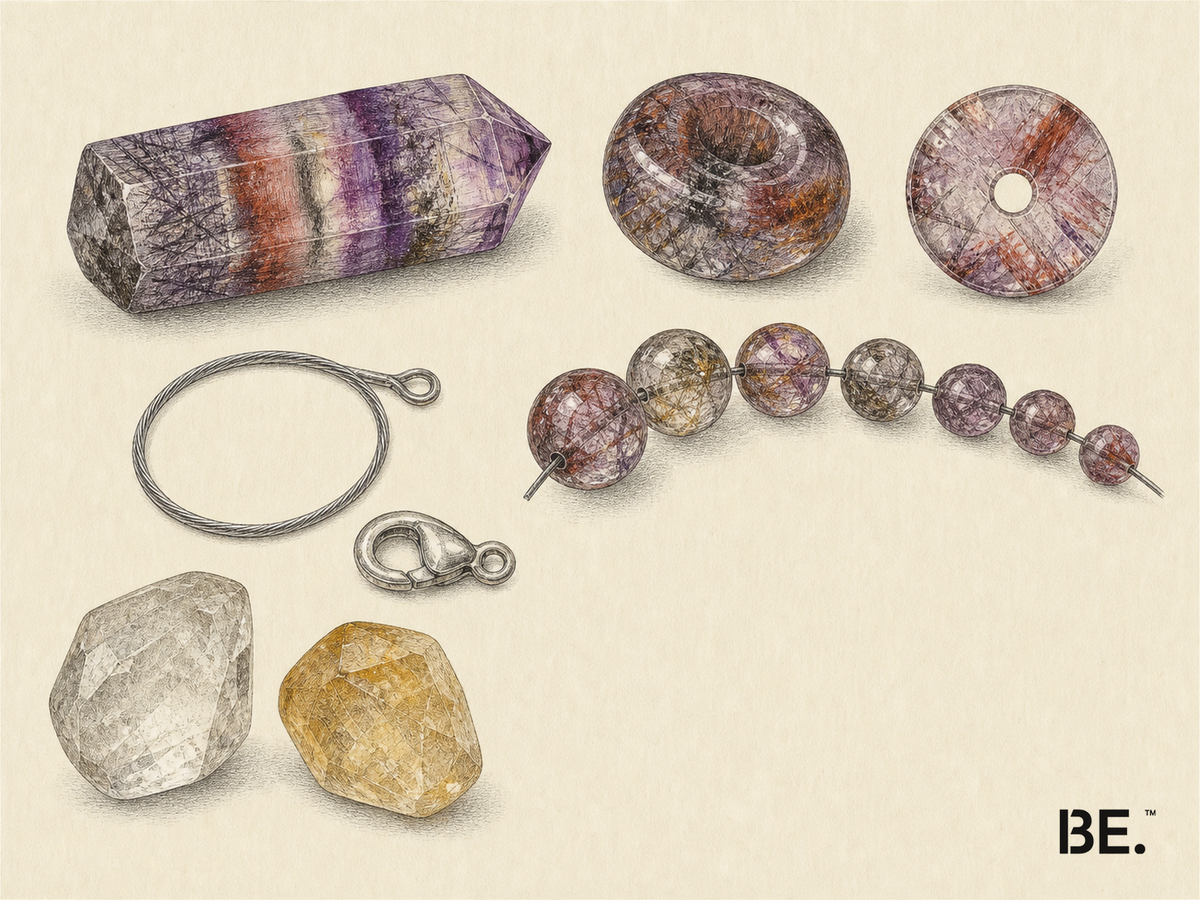
The six-check Super Seven scorecard
1. Identity
Start with what the material is, not what the name suggests. Super Seven is a trade label rather than a mineral species. A useful listing identifies the quartz host and names only the colour zones or inclusions supported for that lot. The Super Seven identity guide explains the full host-zone-inclusion boundary.
Evidence has levels. A seller’s statement, supplier document, in-house observation and independent laboratory report are not interchangeable. The more specific the claim—especially a list of microscopic included minerals—the more specific the supporting evidence needs to be. “Needle-like inclusions are visible” is a different claim from “Raman confirmed rutile in the tested point”.
Sourcing precision belongs to the same identity check. “Ethically sourced” is a general first-party statement. It does not by itself establish a country, mine, working conditions or an independently audited chain of custody.
2. Treatment and disclosure
Natural origin does not automatically mean untreated. Quartz colour may be modified by heat or irradiation; material can also be dyed, coated, filled, assembled or imitated. FTC guidance centres on truthful description and clear disclosure of treatments or imitation status when omission could mislead a buyer.
A strong listing answers the treatment question directly and says who is making the statement. “Untreated according to the seller’s lot record” is transparent. It should not be silently upgraded to “independently certified untreated” unless an appropriate report exists and corresponds to the purchased piece or defined lot.
3. Craft
Complex rough does not excuse weak lapidary work. Inspect the polish under side light, especially where inclusions or fractures reach the surface. Look for chips at drill holes, flat spots, polish drag, residue, irregular bead matching and an opening that abrades the stringing material.
Then inspect the finished construction. Elastic, steel wire and other systems behave differently. The clasp, crimps, knots and terminations have to suit the weight and movement of the strand. Craft is not a poetic claim; it is visible in alignment, finish, tension and serviceability.
4. Size
Bracelet length alone is not a full size specification. Bead diameter, bead count and finished weight affect how much material is present, how the internal matrix can be seen, how the strand sits on the wrist and whether two prices are truly comparable.
Ask for millimetres, not visual guesses from photographs. A 6.5-inch and a 7.5-inch bracelet can use the same bead diameter but different counts; two strands of the same length can also have different total material volume. Missing size data creates a comparison gap, even when the product photographs are excellent.
5. Aesthetic
Included quartz is bought partly for the specific internal scene. Judge the actual piece or an honest representation of its range: whether the host remains readable, whether zones and inclusions have enough separation, whether dense areas feel deliberate and whether bead-to-bead variation forms a coherent strand.
More inclusions are not automatically better. A sparse, well-positioned needle can be more legible than an opaque cluster. A quiet colourless interval can give the denser beads room. This is aesthetic judgement, not mineral authentication and not a universal market grade.
6. Price comparability
Price becomes meaningful only beside a like-for-like set. Match the material identity, treatment status, bead diameter, bead count, weight, bracelet length, construction, evidence level, condition, seller obligations and date. If one of those fields is missing, record the gap before making a value statement.
A retail price can still be personally acceptable without proving fair-market value. The test is whether the known specification and visual result justify the spend for this buyer. It is not whether a commercial name sounds rare, whether an internal brand grade uses a high percentage, or whether someone predicts appreciation.
The current BE. lot against the six checks
Current lot checked 10 August 2026
| Check | What the current source states | Evidence boundary |
|---|---|---|
| Identity | Lot 2026.02 / BE-SSQ-0249; quartz-family matrix with amethyst zoning and rutile inclusions; sourcing line says “Ethically sourced” | First-party lot statement; it does not prove a seven-mineral suite, country, mine or independent custody |
| Treatment and disclosure | PDP states untreated, with no heat, dye, coating or artificial irradiation | First-party disclosure, not an independent laboratory report |
| Craft | PDP describes spherical polish; current-lot construction is steel wire with a magnetic clasp | Actual-piece finish and assembly still require visual and handling QA; older lots used elastic |
| Size | 6.5-inch and 7.5-inch variants were available | Bead diameter, count and finished weight were not disclosed in the reviewed source |
| Aesthetic | PDP presents a layered, visibly included matrix | Natural variation means the received piece may differ; actual-piece representation remains the decisive check |
| Price comparability | €349; both listed lengths available at the check time | No controlled comparable set with matched size, weight, construction and evidence was established; fair-market price cannot be determined |
The table supports a bounded conclusion. This lot has more disclosure than a listing that relies only on the Super Seven name, but material gaps remain: bead diameter, count, finished weight and independent identity or treatment evidence. The current evidence is enough to describe the offer. It is not enough to declare €349 a fair market price.
When Super Seven can be worth it
- The host and lot-level inclusion claims are stated precisely, without treating the seven-part list as automatic fact.
- Treatment, filler, coating, synthetic or imitation status is addressed directly.
- Polish, drill holes and bracelet construction can be inspected and suit the expected wear.
- Diameter, count, length and weight are available or the missing fields are accepted knowingly.
- The actual matrix—not a generic reference specimen—is the reason for choosing the object.
- The price is compared with materially matched offers, or the purchase is consciously made as an aesthetic decision without a market-value claim.
When to pause the purchase
- The seller uses “seven minerals” as proof while supplying no specimen or lot evidence.
- “Natural” is used to avoid a direct treatment answer.
- Surface pits, damaged drill holes or weak construction are hidden by distant imagery.
- Only bracelet length is supplied, making material quantity and price comparisons impossible.
- The product shown is a reference specimen and the range of natural variation is not disclosed.
- The sales case depends on guaranteed rarity, resale, investment grade or future appreciation.
Six questions before ordering
- What is the host, and which inclusions have been identified for this lot?
- What treatments, fillers, coatings, synthetic components or imitations have been ruled in or disclosed, and by whom?
- How are the beads polished, drilled and assembled, and what construction does this lot use?
- What are the bead diameter, count, bracelet length and finished weight?
- Do the images show the actual piece or an accurate range for the lot under neutral light?
- Which genuinely matched products support the price comparison, and when were those prices checked?
Frequently asked questions
Q1.Is a €349 Super Seven bracelet worth it?
It can be worth it as a personal purchase when the six checks support the actual object. Without a matched comparable set, the available evidence cannot determine whether €349 is a fair market price.
Q2.Do seven minerals automatically add value?
No. The trade list is not proof that all seven occur in a specimen, and a count alone does not measure beauty, craft, durability, rarity or market value.
Q3.Do I need a laboratory report?
Not for every purchase. A report becomes more useful as price, claim specificity or uncertainty rises, but even a host identification may not name every microscopic inclusion.
Q4.Why does bead size matter?
Diameter, count and weight affect material quantity, wrist presence, matrix visibility and price comparability. Bracelet length alone does not supply those facts.
Q5.What does untreated mean?
It means the source states that no relevant treatment was applied. The evidence level still matters: a seller’s lot disclosure is not the same as an independent laboratory finding.
Q6.Is Super Seven an investment?
No investment return can be promised. Buy it as jewellery only when the material evidence, construction, appearance and price make sense without relying on future resale or appreciation.
References
- FTC — Jewelry Guides
- FTC Consumer Advice — Buying gemstones, diamonds and pearls
- FTC — The Loupe: advertising disclosures
- GIA — Amethyst buyer’s guide
- GIA — Raman Spectroscopy and X-Ray Diffraction
- GIA — More than the Mohs scale: gem durability
- Mindat — Super Seven
- BE. — Current Super Seven lot disclosure
Field Notes.
One stone at a time: its geology, and how to read quality. The Stone Buying Checklist comes with your first email.
By subscribing you agree to receive emails from BE. Unsubscribe anytime.
Sent. Check your inbox.