
Why Does Super Seven Feel Like Plastic? What Touch Can—and Can’t—Tell You
A touch-first symptom guide that keeps temperature, size, polish, residue, glass, plastic, resin and composite material open in parallel, excludes destructive tests and escalates to disclosure and laboratory evidence.
In this field note
The phrase “feels like plastic” compresses several sensations into one verdict. It can mean warmer than expected, unusually light, very smooth, slightly tacky, hollow-sounding or simply different from another bracelet. Those impressions should be separated before any material conclusion is attempted.
Super Seven is a commercial name used for included quartz material, not one mineral species or a guaranteed seven-mineral recipe. Its identity and inclusion boundaries belong to the Super Seven mineral-matrix guide. Here, the narrower question is what touch can—and cannot—tell.
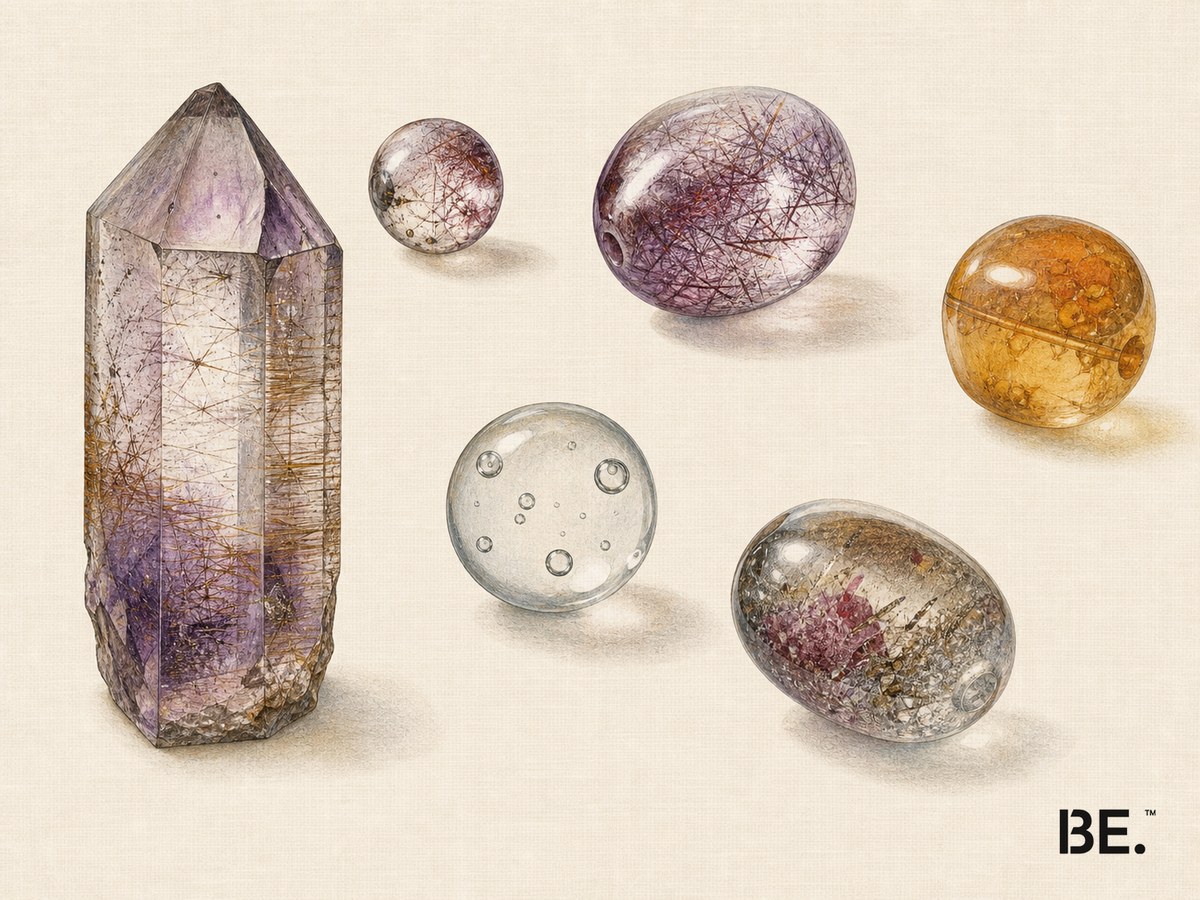
Touch is a clue, not identification
When skin contacts an object, heat moves according to the temperature difference and the thermal properties of both surfaces. Materials that draw heat from skin more quickly tend to feel colder at first. Controlled research shows that people can discriminate some materials from these thermal cues, but the task has thresholds and errors. Recognition worsens when objects begin near skin temperature or when size, contact and prior experience change.
A fingertip is not a calibrated probe. It brings changing skin temperature, moisture, pressure and movement to a curved bead that may already be connected to neighbouring beads, a clasp and stringing material. Even instrument-based thermal testing requires calibration and can be affected by sample size, mounting, contact angle and surface finish. A momentary “warm” or “cold” impression is therefore weaker evidence than a controlled instrument reading—and a thermal instrument is itself only an ancillary test for most coloured stones.
Why natural quartz may feel unexpectedly warm, light or slick
Starting temperature
A bracelet taken from a wrist, pocket, vehicle, sunlit surface or warm room does not begin at the same temperature as a specimen stored in a cooler drawer. If the bead is already close to skin temperature, little heat moves during the first contact and the usual “cold stone” cue becomes faint. This does not change the material; it changes the measurement conditions.
Bead size and total mass
A small bead contains less material than a larger specimen and can move towards skin temperature more quickly. Its curved surface also limits the initial contact area. The weight perceived at the wrist includes every bead, the drill loss, stringing, spacers and clasp. A lighter-than-expected bracelet is a reason to check recorded dimensions and construction, not a density result.
Polish, shape and contact
A spherical high polish removes much of the roughness associated with an uncut crystal. Smoothness can read as “plastic-like” even when the underlying material is crystalline quartz. Surface roughness, contact angle and pressure alter the real contact area and the way heat and friction are perceived. A scratched, frosted or matte bead will not provide the same tactile cue as a mirror-polished one.
Surface residue
Skin oil, hand cream, sunscreen, soap, polishing residue or an inadequately rinsed cleaner can create slip, drag or tackiness. Treat residue as a surface candidate first. Wipe the piece with a clean, soft, slightly damp cloth only if its care instructions allow it, then dry it. A changed sensation after cleaning describes the surface; it still does not prove the underlying material.
Expectation and visual context
Material recognition is not thermal perception alone. Texture, compliance, friction, sight and remembered categories all contribute. Highly uniform spheres, a vivid polish or a surprisingly light colour can prime the expectation of plastic before contact. That expectation should be recorded, not converted into evidence.
Other candidates that remain open
Keeping natural-material explanations open does not remove the possibility of an imitation or treatment. It prevents one candidate from being announced as the cause before the evidence separates them.
| Candidate | Why it might produce the impression | Useful evidence | Can touch confirm it? |
|---|---|---|---|
| Warm natural quartz | Little temperature difference remains after wear or warm storage. | Storage history; repeat observation after controlled rest. | No |
| Small or low-mass construction | Less material warms faster; components alter total weight. | Bead diameter, count, bracelet mass and construction record. | No |
| High polish | Low roughness can feel unusually slick and uniform. | Raking-light surface inspection; comparison with documented finish. | No |
| Surface film | Oil, lotion, soap or polishing residue changes friction. | Care-safe cleaning and inspection around drill holes. | No |
| Manufactured glass | Glass can imitate many gems, including included quartz appearances. | Microscopy, refractive index, specific gravity and spectroscopy as needed. | No |
| Plastic or resin | Low thermal response, low mass or moulded surfaces may feel familiar. | Magnified surface features plus non-destructive gemmological testing. | No |
| Composite, filler or coating | More than one material can influence surface feel and optical appearance. | Disclosure, junctions or surface-reaching features under magnification, FTIR or Raman when appropriate. | No |
Glass is a real candidate—not a touch verdict
GIA documents manufactured glass as a common imitation material and shows that it can reproduce the look of rutilated quartz. Laboratory cases also demonstrate glass shaped like crystals and containing metallic inclusions, gas bubbles or flow structures. Those examples prove that appearance can be engineered. They do not prove that every rounded internal feature is a gas bubble or that every included bead is glass.
Resin, composites, fillers and coatings
Plastic may be used as an imitation, while resin can also occur as part of a composite, filling or surface treatment. A composite contains more than one joined material; a filler occupies fractures or voids; a coating sits at or near the surface. These are different possibilities with different disclosure and care implications. No touch-specific study of Super Seven was found, so general tactile research cannot assign any of them to an individual bracelet.
A safe home observation sequence
1. Standardise before comparing
Let the dry bracelet and any comparison sample rest in the same shaded room, away from heaters, windows and skin, long enough to approach the same room temperature. Compare only objects of reasonably similar size and construction. Record whether the first sensation is coolness, weight, slip, tack or sound. The exercise may make the complaint more precise; it does not authenticate either sample.
2. Inspect under light and magnification
Use neutral diffuse light, side lighting and, if available, a clean 10× loupe. Look across several beads and around drill holes for surface films, chipped edges, polish marks, seams, moulding traces, coatings, flow structures or junctions. Also note natural-looking fractures, colour zones and inclusions without naming them from shape alone. One feature should not carry the whole conclusion.
3. Record dimensions and disclosure
Measure bead diameter and complete-piece weight without converting them into an internet threshold. Photograph the exact item, invoice, product description, lot card and any treatment or return statement. Ask the seller to state the material identity and any known filling, coating, composite construction or other treatment in writing. The treatment disclosure chart provides the vocabulary.
4. Keep the return window open
If several observations conflict with the description, stop wearing or cleaning the piece beyond its stated care. Preserve packaging and correspondence. A return window is a decision deadline, not a reason to improvise a destructive experiment.
Tests not to do
- No hot needle. It can burn plastic or resin, damage a coating, adhesive or stringing, and produce fumes without identifying the whole bead.
- No flame. Open heat can alter, crack or contaminate the specimen and creates a safety risk.
- No scratch test. Scratching damages the piece, depends on force and geometry, and does not resolve a multi-material construction.
- No acetone. Solvent can affect resin, coating, adhesive, elastic, dye or finish; a reaction does not identify the remaining material.
- No boiling, freezing or thermal shock. Rapid temperature change can open fractures or weaken the strand.
- No drop or impact test. Breakage destroys evidence and says little about identity.
Do not use them, even when a seller or social post calls them “quick checks”. Safe care belongs to the finished piece, not only the nominal stone. Review the bracelet care chart for ordinary handling, while keeping the product's own instructions in control.
How a gemmologist narrows the answer
Professional identification is a sequence, not a single machine. Depending on access and transparency, a gemmologist may combine microscopic examination, refractive index, specific gravity, polariscope observations and spectroscopy. FTIR can help identify polymers or distinguish some glass-related spectra; Raman can identify crystalline phases or selected inclusions; chemical analysis may be added when the question requires it.
Results remain bounded by the specimen. A mounted or drilled bead can limit measurement. An inclusion identified in one area does not prove a fixed seven-component recipe throughout every bead. Some coatings, fillers or treatment histories may remain uncertain. A responsible report states what was observed, what was concluded and what could not be resolved.
When to stop guessing
Escalate when the material description is vague, several observations conflict with it, the seller will not disclose treatment or composite status, the price makes an error consequential, or the return deadline is approaching. Send the complete bracelet when construction matters; a loose sample may not answer questions about every bead.
The aim is not to turn touch into certainty. It is to move from a broad impression to a smaller, documented set of possibilities without damaging the object.
Frequently asked questions
Q1. Is real quartz always cold?
No. Initial temperature, bead size, contact area, time, surface finish and whether the piece has already been worn all affect perceived coolness. Natural quartz can feel warm or neutral when it begins near skin temperature. Touch remains a clue, not proof.
Q2. Does warming quickly mean the bracelet is plastic?
No. Small beads and low-mass constructions can approach skin temperature quickly, and the hand is not a calibrated thermal instrument. Plastic or resin remains one candidate, but size, starting temperature, polish and contact conditions must stay open.
Q3. Can glass also feel cold?
Yes. Glass can feel cool when it starts below skin temperature, and perceived coldness overlaps across materials. GIA documents glass as a common gem imitation, including material that resembles included quartz. Identification requires more than a touch comparison.
Q4. Do round bubbles always prove glass?
No. Gas bubbles and flow structures can support a glass identification in the correct microscopic context, but rounded-looking features may also be reflections, cavities or fluid inclusions. Shape alone should not carry the conclusion.
Q5. Can I use a scratch test, hot needle or acetone?
No. These methods can damage stones, fillings, coatings, adhesive, stringing or finishes and may create fumes or ambiguous results. Do not use flame, thermal shock or drop tests either. Preserve the piece and the return window.
Q6. Which laboratory tests are useful?
A gemmologist may combine microscopy, refractive index, specific gravity, polariscope observations and spectroscopy such as FTIR or Raman, with other analysis when needed. The exact sequence depends on the bead and question; no single test guarantees every inclusion or treatment history.
References
- Tiest & Kappers — Tactile Perception of Thermal Diffusivity
- Ho — Material Recognition Based on Thermal Cues: Mechanisms and Applications
- Gemological Institute of America — An Introduction to Simulants or Imitation Gem Materials
- Gems & Gemology — The GEM DiamondMaster and the Thermal Properties of Gems
- Gems & Gemology — Artificial Glass Imitating a Paraíba Tourmaline
- Gems & Gemology — Raman Spectroscopy and X-Ray Diffraction: Phase Identification of Gem Minerals and Other Species
Field Notes.
One stone at a time: its geology, and how to read quality. The Stone Buying Checklist comes with your first email.
By subscribing you agree to receive emails from BE. Unsubscribe anytime.
Sent. Check your inbox.