
Super Seven Crystal Guide: Identity, Inclusions & How to Read It
A geology-first guide to Super Seven as a quartz trade name, separating host, colour zones, visible inclusions and laboratory confirmation.
In this field note
A polished bead can hold several visual events at once: colourless areas, violet or smoky zones, fine needles, dark plates, reddish clouds and healed fractures. The pattern is real. The interpretation still has to be disciplined.
The name on a product page describes a market category. It does not replace mineral identification, disclose treatment, establish origin or certify every inclusion. The useful question is therefore not “does it have seven?” but “what is the host, what can be observed, what has actually been identified, and at what evidence level?”
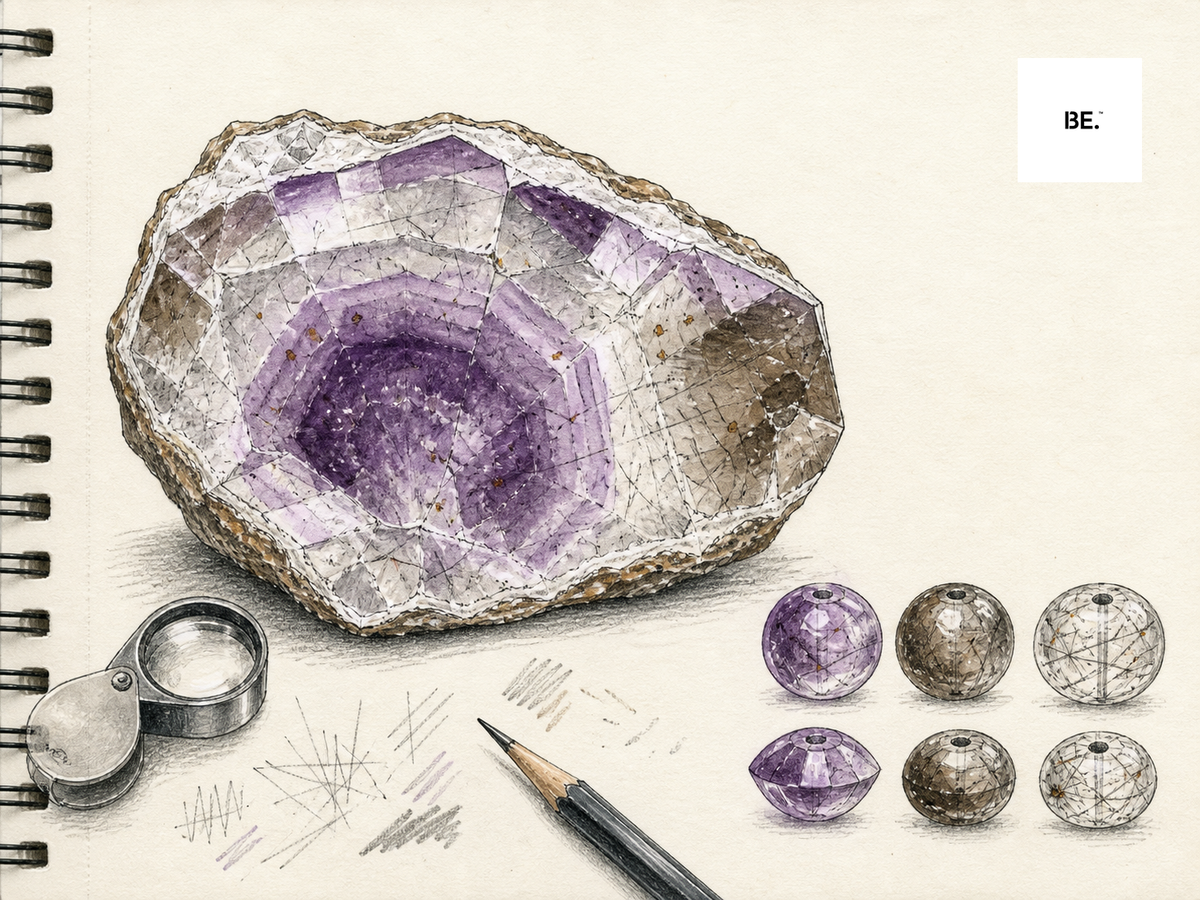
What Super Seven actually means
A commercial name, not a mineral species
Mineral species are defined by characteristic chemistry and crystal structure. Super Seven has no single formula or crystal structure of its own. Mindat records the term as a synonym used in the trade for “Melody’s Stone”, while the material sold under the name is generally described through a quartz host plus colour zones and inclusions.
This distinction matters because a commercial name can cover specimens with visibly different internal structures. One bead may be mostly colourless quartz with needles. Another may show violet zoning, smoky areas and iron-rich-looking clouds. The shared label does not make those internal features identical.
“Seven” is not a specimen guarantee
A common market list names clear quartz, amethyst, smoky quartz, rutile, goethite, cacoxenite and lepidocrocite. That list is a description used around the trade name, not proof that every rough piece, cut stone or bead contains all seven. It also counts colourless quartz, amethyst and smoky quartz separately even though all three belong to the quartz species.
The responsible wording is specimen-specific: “the seller identifies rutile”, “the lot documentation names amethyst zoning”, or “needle-like inclusions are visible”. “Every bead contains seven minerals” requires evidence that the name alone cannot supply.
The three identity layers inside a specimen
1. The host: quartz
The host is the continuous crystal body that contains the other visible features. For most material sold as Super Seven, that host is described as macrocrystalline quartz, silicon dioxide. Establishing the host is the first task because every later observation sits inside it.
Basic gemmological observations can support a quartz identification: optical behaviour, refractive index, specific gravity and response under a polariscope. These tests address the host. They do not automatically identify every microscopic phase trapped within it.
2. Colour zones: expressions within quartz
Violet zones may be described as amethyst, brown-to-grey zones as smoky quartz and colourless zones as clear quartz. These are not three separate host minerals fused together. They are colour expressions or regions within quartz, produced by trace chemistry, irradiation history and structural defects.
A bead can cross more than one growth zone, so a strand may change from pale to saturated or from colourless to smoky without changing host species. The exact colour mechanism of a particular zone may still require testing; appearance alone is not a treatment report.
3. Inclusions: separate material inside the host
Inclusions may be crystals, fluids, growth remnants or features associated with fractures. They can record interruptions in growth, changing fluids or later geological events. Their shape is useful descriptive evidence: needles, blades, flakes, plumes and granular clouds are valid observations.
Shape is not a mineral name. Several minerals can form visually similar needles or iron-coloured plates, and very small inclusions may be inaccessible to a non-destructive laser or too mixed for a clean spectrum. A name such as rutile or goethite belongs at the level supported by analysis or reliable lot documentation.
How to read the common seven-part list
| Market label | Scientific position | Safe visual wording | What needs evidence |
|---|---|---|---|
| Clear quartz | Colourless quartz, not a separate species from amethyst or smoky quartz | Colourless or near-colourless host area | Quartz host identification |
| Amethyst | Violet variety of quartz | Violet colour zone | Whether the zone is natural colour and whether treatment is present |
| Smoky quartz | Brown-to-grey variety of quartz | Smoky or brown-grey colour zone | Whether colour is natural or induced |
| Rutile | A distinct titanium-dioxide mineral | Needle-like inclusion | Specimen-level identification, commonly by Raman where accessible |
| Goethite | A distinct iron oxyhydroxide mineral | Brown, ochre or dark inclusion | Analytical distinction from other iron-bearing phases |
| Cacoxenite | A distinct hydrated iron-aluminium phosphate mineral | Radiating or fibrous-looking inclusion | Analytical confirmation; colour and habit are not enough |
| Lepidocrocite | A distinct iron oxyhydroxide mineral | Red-brown plate-like or flaky inclusion | Analytical confirmation and separation from lookalikes |
The table does not certify the common list. It shows why the first three names describe quartz itself while the remaining names would describe separate included minerals if they are confirmed. A specimen can still be visually complex without satisfying a seven-item checklist.
How zones and inclusions can enter quartz
Growth can occur in stages
Quartz grows when silica-bearing material becomes supersaturated under suitable geological conditions. Changes in chemistry, temperature, pressure, radiation exposure and available space can alter later zones. Boundaries between stages may remain visible as colour zoning or phantom-like growth lines.
That general model does not justify one universal deposit story for all Super Seven material. Without documented locality and geological context, the bead records changing growth conditions but not a named mine, a single formation temperature or a unique regional history.
Inclusions and fracture-related features
A solid inclusion may have formed before the surrounding quartz finished growing and then become enclosed. Other features can occupy or decorate fractures, and fluid inclusions can preserve tiny remnants of the growth environment. Polishing converts a three-dimensional crystal into a bead, cutting across these structures at different angles.
This is why adjacent beads from one lot can look unrelated at first glance. They may sample different parts of the same heterogeneous rough. Variation is not automatically evidence of better or worse material; it becomes meaningful only against the selection goal and disclosure.
Seeing is not the same as identifying
| Evidence level | What it can establish | What it cannot establish alone | Possible next step |
|---|---|---|---|
| Unaided eye / side light | Colour zones, transparency, fractures, surface pits, broad inclusion distribution | Mineral species, treatment, origin | Record the actual piece under controlled light |
| 10× microscopy | Habit, relief, bubbles, fracture filling, polishing residue and inclusion relationships | A definitive name for every tiny inclusion | Compare multiple fields and document uncertainty |
| RI, SG, polariscope | Evidence for the host material and optical character | Full inclusion suite or exact deposit | Use with microscopy and a trained interpretation |
| Raman / FTIR | Molecular or lattice signatures at accessible points; some treatment or filler evidence | A result from an inaccessible point or every phase in a mixed inclusion | Target multiple points where possible |
| EDS / XRD | Elemental composition or crystal-phase information | A guaranteed non-destructive answer on every finished bead | Laboratory method chosen for the question and sample |
GIA case studies show why this hierarchy matters. Raman analysis can resolve an inclusion that elemental data alone cannot distinguish, while other inclusions can remain unidentified because the laser cannot reach a clean point or the signal is mixed. “Inconclusive” is a valid laboratory outcome, not a failure to invent a name.
How to read a Super Seven bead
- Start with the host. Look for a continuous quartz body and record whether it is transparent, translucent, fractured or cloudy.
- Map the colour. Note whether violet, smoky and colourless areas form gradual zones, sharp boundaries or irregular patches. Do not infer treatment from zoning alone.
- Describe before naming. Record needles, plates, plumes or granular clouds by shape, colour and distribution before attaching a mineral identity.
- Check matrix legibility. Under one directional light, determine whether the internal structure remains readable rather than visually collapsing into an opaque mass. This is a BE. selection language, not an industry grade.
- Inspect the surface and drill holes. Pits, chips, polish drag, residue and fractures meeting the surface belong to craftsmanship and durability assessment, not inclusion identity.
- Read the strand as a lot. Natural variation is expected. The relevant question is whether the range of variation is intentional, coherent and represented by the actual product photographs.
Treatment, synthetic material and imitations
The trade name does not say whether the quartz is natural, treated, synthetic, glass, resin-filled or composite. Those are separate disclosures. Heating or irradiation can alter quartz colour; fillers and coatings can change appearance or durability; glass and resin can imitate colour and internal patterns.
FTC guidance requires gemstone representations to be truthful and material treatments or imitation status to be disclosed where omission would mislead. For a buyer, the practical request is plain: material identity, treatment status, any filler or coating, and whether the evidence is seller disclosure or an independent report.
Hardness, durability and care
Quartz is Mohs 7, which means reasonable resistance to scratching from softer materials. Mohs hardness is not a complete durability score. Toughness, fractures, exposed inclusions, drill holes, stringing material and clasp construction also determine how a finished bracelet survives impact and wear.
- Remove the strand before sport, manual work, showering, swimming or contact with household chemicals.
- Wipe with a soft, slightly damp cloth and dry it fully. Avoid ultrasonic and steam cleaning unless a qualified professional has examined the actual piece.
- Store it separately from harder gems and metal edges. Do not test identity by scratching, flame, chemicals or thermal shock.
- Inspect surface-reaching fractures, drill holes, wire or cord and the clasp periodically; construction can fail even when the quartz remains unscratched.
A buying evidence checklist
- Lot identity: what is the stated host, and which inclusions are named for this lot?
- Evidence level: seller observation, supplier document, in-house assessment or independent laboratory report?
- Treatment: heat, irradiation, dye, coating, filler or composite construction disclosed?
- Physical specification: bead diameter, count, bracelet length, weight and construction stated?
- Actual-piece view: photographs or video showing the piece under neutral light rather than only a reference specimen?
- Origin boundary: country, region or mine named only when the sourcing record supports that precision?
The current BE. lot is described on its product page as a quartz-family matrix with amethyst zoning and rutile inclusions. The page states untreated material and a steel-wire, magnetic-clasp construction for the current lot. These are first-party lot disclosures, not an independent laboratory certificate and not proof of a seven-mineral suite.
Frequently asked questions
Q1.Is Super Seven a formal mineral?
No. Super Seven is a commercial name used for visually complex quartz material. It has no single mineral formula or crystal structure of its own.
Q2.Does every piece contain seven minerals?
No. The common seven-part list belongs to the trade description. A particular specimen needs specimen-level evidence before any included mineral is named as confirmed.
Q3.Are clear quartz, smoky quartz and amethyst three different minerals?
No. They are colourless, brown-to-grey and violet expressions of quartz. Counting them separately in a market list does not turn them into three mineral species.
Q4.Can colour confirm cacoxenite or lepidocrocite?
No. Colour and shape can guide observation, but several phases can look alike at bead scale. A defensible identification needs appropriate analytical evidence from the specimen.
Q5.What is the hardness of Super Seven?
The quartz host is Mohs 7. Finished durability also depends on fractures, exposed inclusions, drilling, stringing and clasp construction, so hardness alone is not a wear guarantee.
Q6.How should included quartz be cleaned?
Use a soft, slightly damp cloth and dry the strand fully. Avoid steam, ultrasonic cleaning, harsh chemicals and destructive tests unless a qualified professional has assessed the actual piece.
References
- Mindat — Super Seven
- GIA — Amethyst mineral and gem overview
- GIA — Coloured Stones Unearthed: quartz colour varieties
- GIA — Raman Spectroscopy and X-Ray Diffraction
- GIA — Trapiche-like amethyst from Brazil
- GIA — Amethyst from Boudi, Morocco
- GIA — More than the Mohs scale: gem durability
- FTC — The Loupe: advertising diamonds, gemstones and pearls
- BE. — Current Super Seven lot disclosure
Field Notes.
One stone at a time: its geology, and how to read quality. The Stone Buying Checklist comes with your first email.
By subscribing you agree to receive emails from BE. Unsubscribe anytime.
Sent. Check your inbox.