
Shop by stone · Chalcedony
Onyx
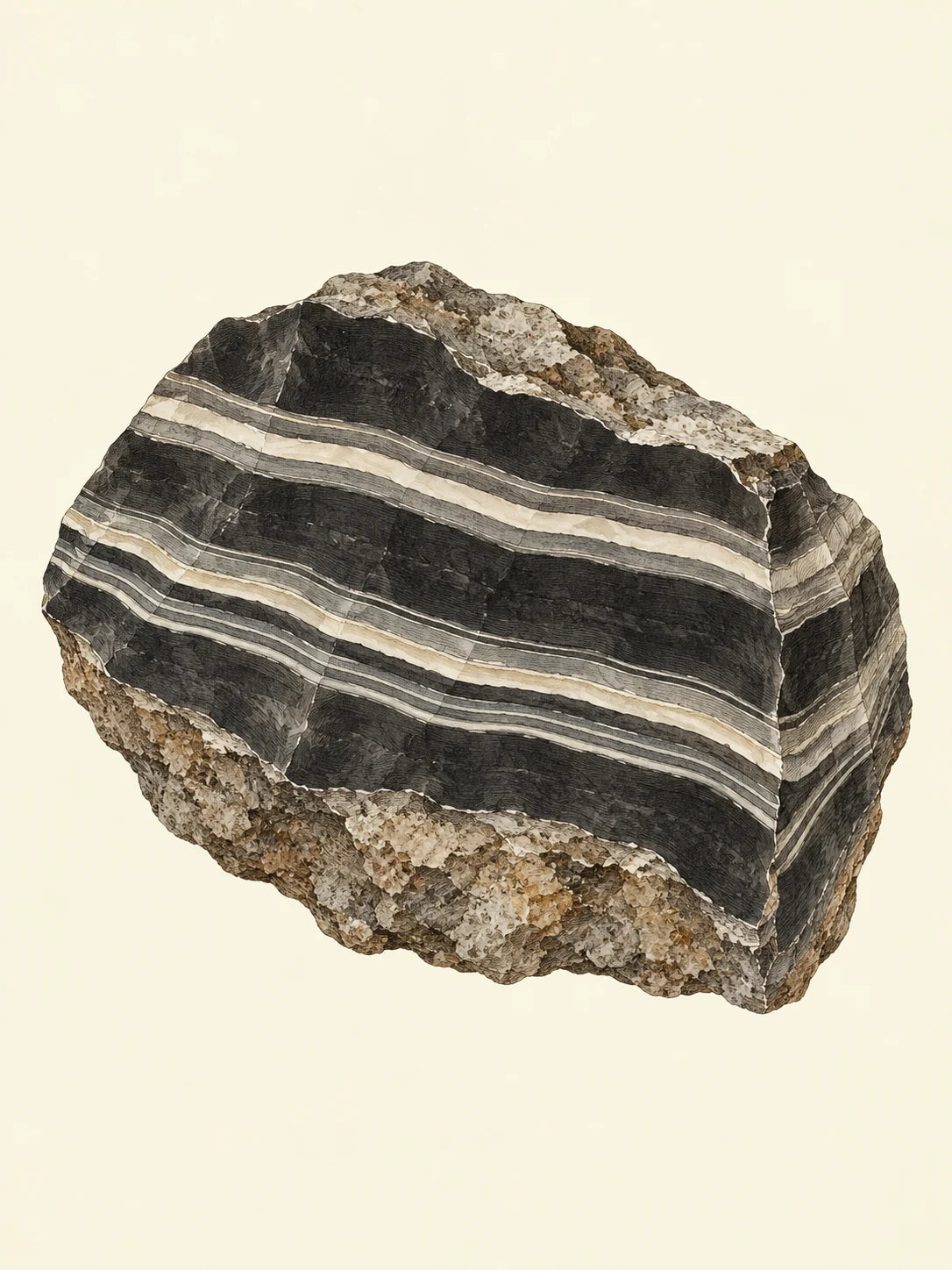
Fine-grained silica, built in layers. Onyx makes those layers visible as parallel bands.
- Material
- Onyx, a banded variety of chalcedony
- Principal component
- Silica, mainly quartz, SiO₂
- Structure
- Fibrous microcrystalline silica, mainly quartz with some moganite
- Naming
- Black onyx is also used for uniformly black chalcedony
Onyx
Pieces in this stone.
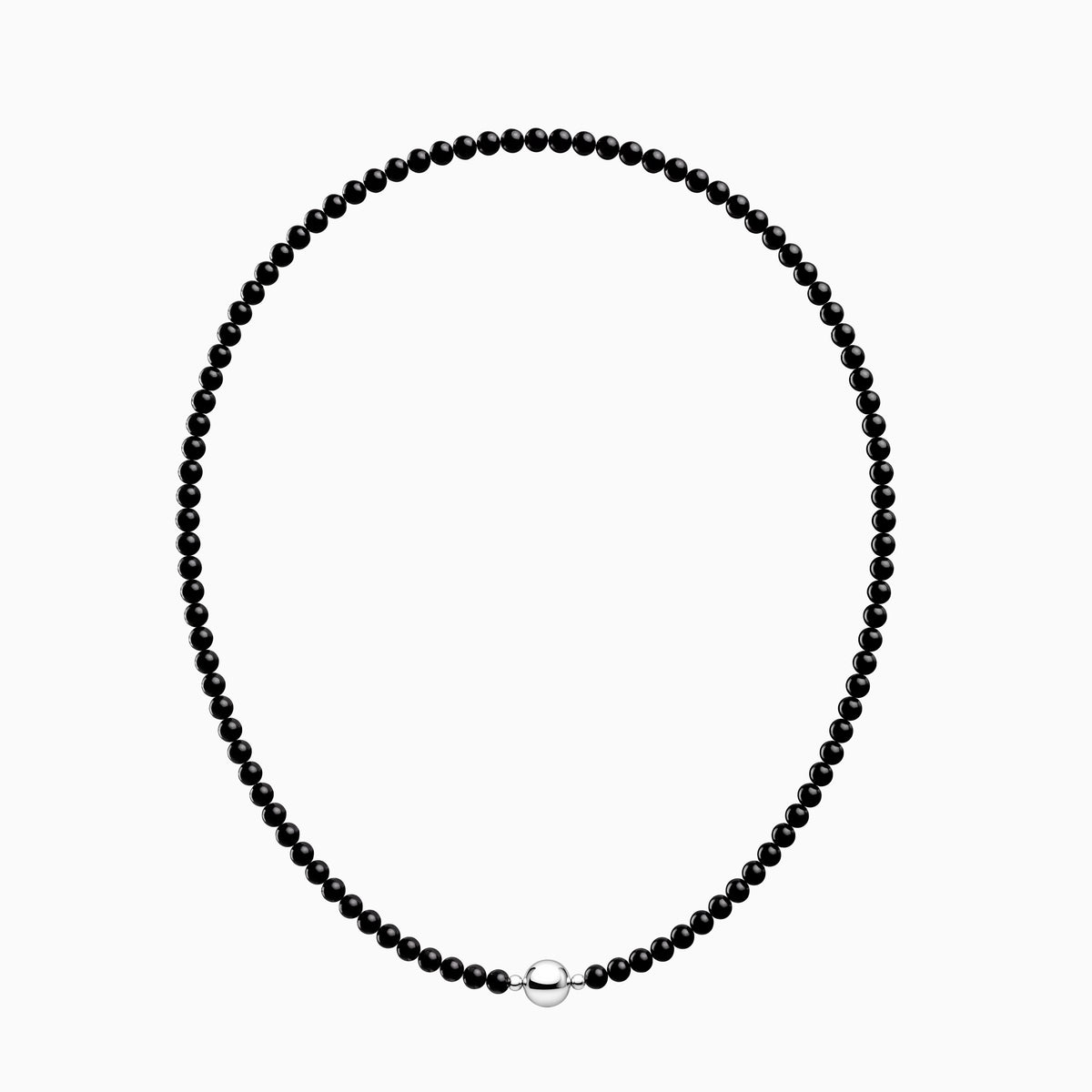
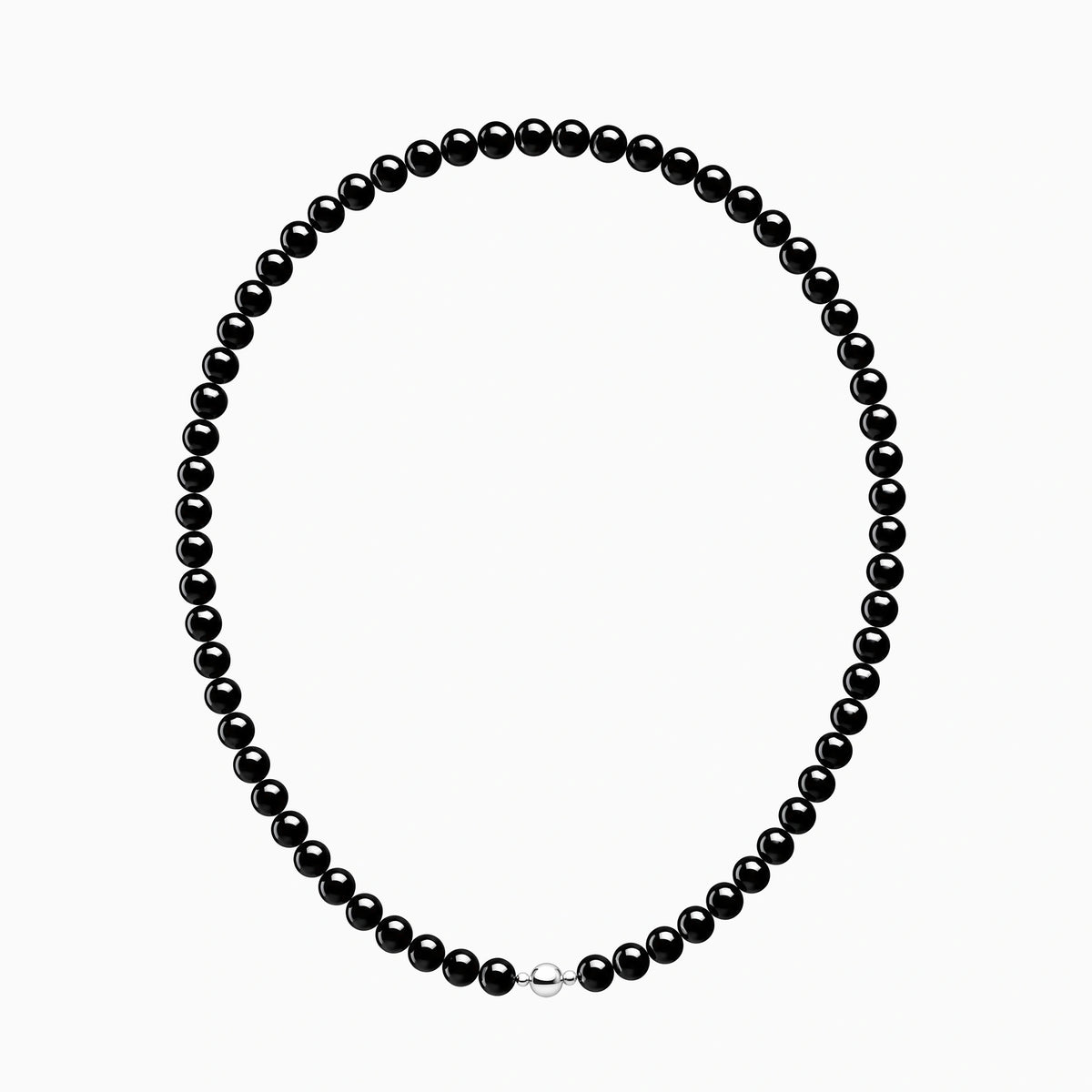
Two onyx necklaces, in 4mm and 8mm beads, from $250. The onyx is Mexican and untreated, with no heat, dye or irradiation, and every piece ships with a Stone Origin Record. At Mohs 6.5 to 7 it takes daily wear; keep perfume and cleaners off it and the clasp dry.


On this page
How it formed
Water moving through rock can carry dissolved silica into cracks and cavities. Silica accumulates there and forms extremely small crystals. Packed closely together, those crystals make chalcedony, a material whose grains are too fine to distinguish by eye.
As more material accumulates, successive layers can differ in texture, porosity and inclusions. Some deposits form bands around cavity walls; others include nearly flat layers. Onyx is the name used for chalcedony whose contrasting bands run approximately straight and parallel.
Its dark areas can contain tiny inclusions that absorb light. Several substances can contribute to brown or black colour in natural banded chalcedony, including iron or manganese oxides and carbon-bearing material. The mineral grains, the inclusions and the way light passes through them together determine the appearance.
A band marks a change in the growing material. It does not provide a calendar: several bands need not represent several years. Agate and chalcedony form in different geological settings, and researchers still investigate how particular band textures develop.
Cutting exposes a section through that internal structure. A dark layer may occupy most of one face while a pale band crosses another. Onyx carvers use the difference between adjoining layers when planning a relief.
How to look at yours
Follow a band across the face and around an exposed edge. Look at whether its width changes, where another layer meets it, and how the cut crosses the original structure. A uniformly black piece may show very little banding.
Black onyx is also a commercial name for uniformly black chalcedony. Uniform black colour alone cannot establish a natural colour or an untreated stone.
The black can come from sugar carbonised inside the pores with sulfuric acid, from dye or from a surface coating, so a finished piece needs its material identification and its treatment entry read separately. When an opaque black stone leaves several possible identities, a gemmologist uses tests beyond its surface appearance.
One way to read it
One way to read this: in banded onyx, layers of chalcedony lie close against one another. Their textures differ, so a line marks where one meets the next. Follow a band across a cut surface and you can trace its edge alongside the next. The layers form a single stone, with the boundaries between them still visible.
The name
The word comes through Latin from Greek ὀνυξ, a claw or fingernail, and one of the earliest surviving uses as a gem name is the Athenian temple inventory IG I³ 351 of 422/1 BCE. Onyx belongs to the chalcedony naming system. The banded material traditionally has contrasting parallel layers. Sardonyx includes reddish-brown sard layers alongside lighter bands.
In jewellery, black onyx can also mean uniformly black chalcedony. In decorative stone, onyx marble can mean a banded carbonate material. A material description alongside the name distinguishes these uses.
Nicolo is a historical layer-colour name for a dark ground beneath a bluish upper layer. It belongs to the history of onyx cutting and naming. Sardonyx can also be dyed, so its contrasting bands need their own treatment assessment.
Onyx: questions before you buy
Is black onyx dyed?
Much of it is. Black onyx is a trade name for evenly black chalcedony, and most of what is sold under that name has been coloured, by carbonising sugar inside the pores, by dye or by a surface coating. Ours is not. Our Mexican lot is untreated: no heat, no dye, no irradiation, as its Stone Origin Record states.
Is onyx the same as agate or obsidian?
Not obsidian, which is volcanic glass. Onyx is chalcedony: silica built of crystals too small to see, mainly quartz with some moganite. Agate is chalcedony too. Agate bands usually curve around the wall of a cavity; onyx is the name for chalcedony whose bands run roughly straight and parallel, and in jewellery also for evenly black chalcedony like ours.
Why do the beads show no bands?
Because black onyx in jewellery means evenly black chalcedony, and we select this lot for the same black from bead to bead. At 4mm the strand reads as one fine dark line. Under a small light you may still see a slightly greyer patch or a change in the polish where the grain of the stone shows.
How do I care for an onyx necklace?
Onyx is about Mohs 6.5 to 7, so it takes daily wear, but a hard knock can chip a 4mm bead. Chalcedony is slightly porous, so keep perfume, lotion and household cleaners off it and wipe it with a soft damp cloth. Keep the magnetic clasp dry and store the necklace apart from harder jewellery.
Stone Explorer
Look closely at two banded-silica specimens.
Compare · Formation · Evidence
OPEN STONE EXPLORER →From the Journal