
Red & Orange Crystals: Garnet, Hematoid & 6 More Explained
A geology-first guide to red and orange crystals — Fe³⁺ vs Mn vs Cr chromophores, mineral families and top deposits for warm-toned stones.
In this field note
Many warm-toned stones owe their colour to iron: either as an ion in the crystal lattice, absorbing light in the blue-green band so what reaches the eye reads orange, red or peach, or as tiny iron-oxide grains held inside the stone, as in hematoid quartz. Once you know what to look for, a hematoid quartz, a citrine, and a hessonite garnet stop looking similar and start looking like three very different mineral histories. For the cool counterpart of this spectrum, where iron in different oxidation states and chlorite inclusions take the colour the other way, see the companion guide on green crystals.
This guide opens up the warm half of the spectrum the way a gemmologist would: by chromophore first, mineral family second, deposit third. We list which ion produces which hue, where the major material comes out of the ground, and how to read a strand on the bench without leaning on trade-name marketing.
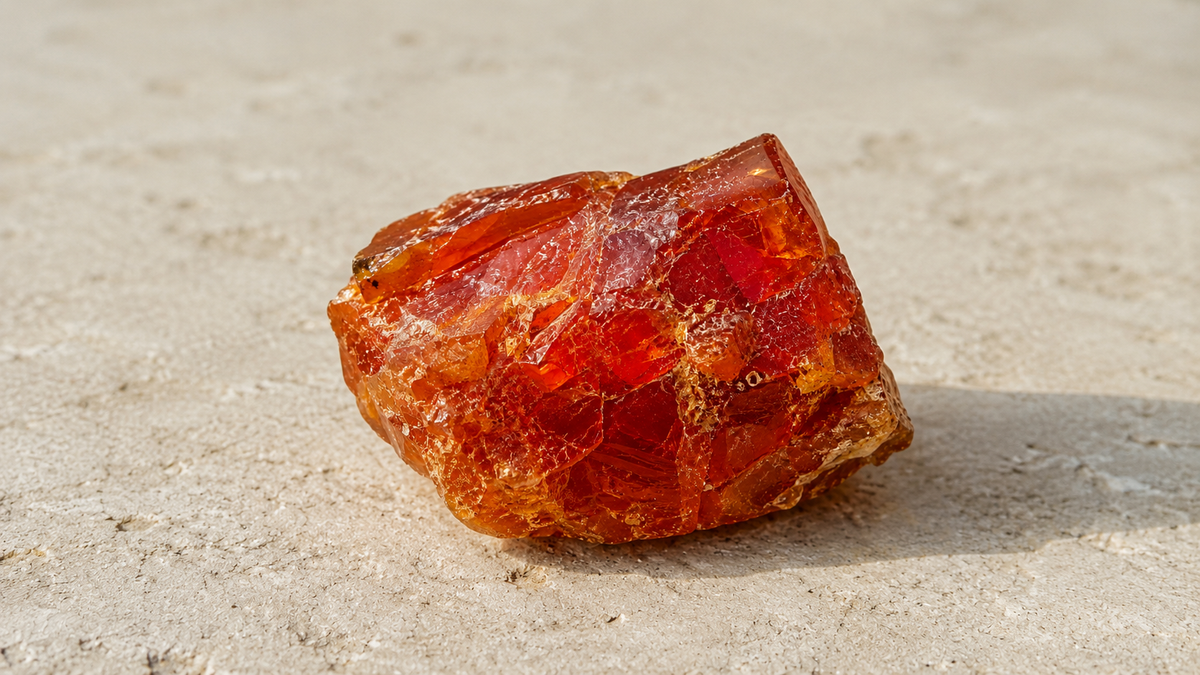
Direct answer: Carnelian is a common answer when a stone is translucent red-orange, but colour does not identify it. Opaque brick red can point toward red jasper; clear quartz with rusty plumes can enter a hematoid-quartz route; transparent orange may include spessartine or hessonite garnet, fire opal, sunstone or citrine. Ruby and red spinel sit in a harder, higher-value branch, while dyed chalcedony and glass remain disclosure candidates. Start with transparency, lustre, internal texture and any treatment claim, then use non-destructive gemmological testing when the name changes value. For the underlying absorption, defect and inclusion routes, see why crystals become red or orange.
What this colour family actually is
Red and orange cross several unrelated material systems. Iron-bearing structures or inclusions are common routes, manganese contributes to some garnets and carbonates, chromium colours ruby and red spinel, and treatment or manufactured colour can imitate the same visual range. Ion identity alone is still incomplete: valence, host lattice, defects, inclusions and treatment determine what the eye records. Colour narrows the next question; it does not prove species, origin or value.
Which red and orange crystal names match which materials?
Start with transparency, texture and the mineral family. Similar warm hues can come from lattice chemistry, inclusions, treatment or manufactured colour.
| Name | Mineral | Colour cause | Visual clue | Common confusion |
|---|---|---|---|---|
| Carnelian | Chalcedony | Iron oxides | Translucent orange-red to brown-red body colour | Sard, dyed chalcedony, glass |
| Sard | Chalcedony | Iron oxides | Darker brownish-red translucent to opaque material | Carnelian; the trade boundary varies |
| Red jasper | Silica-rich opaque material | Iron oxides | Opaque brick, rust or oxide red with veins or patches | Dyed chalcedony, reconstructed material |
| Hematoid quartz | Quartz with iron-rich inclusions | Hematite, goethite or related iron-rich material | Clear to translucent quartz with red plumes, clouds or platelets | Strawberry quartz, coated quartz |
| Almandine | Garnet group | Iron | Wine red to brownish red; transparent to opaque | Pyrope, red glass |
| Spessartine | Garnet group | Manganese | Transparent mandarin orange to orange-red | Hessonite, orange glass |
| Hessonite | Grossular garnet | Iron-related absorption | Cinnamon to orange-brown with a granular internal look | Spessartine, glass |
| Ruby | Corundum | Chromium | Transparent to opaque red, sometimes with silk or zoning | Red spinel, synthetic ruby, glass |
| Red spinel | Spinel | Chromium, sometimes modified by iron | Bright red to crimson with vitreous lustre | Ruby, synthetic spinel, glass |
| Sunstone | Feldspar | Copper or iron-rich platelets | Peach to orange-red body with flashes on rotation | Aventurescent glass, other feldspar |
| Fire opal | Opal | Iron-related body colour | Transparent to translucent yellow-orange or red-orange; play-of-colour may be absent | Common opal, glass |
| Citrine | Quartz | Trace elements and defects; the cause varies between specimens | Transparent yellow-orange to brown-orange, sometimes zoned | Heated amethyst, glass |
Continue through the colour naming series: black, blue, purple, pink, white and clear, yellow and gold, and brown.
Red and orange crystal identification matrix
Use this as a triage directory, not an identification chart. Mohs figures are typical reference values, never instructions to scratch jewellery.
| Hue | Transparency | Texture / inclusions | Mohs | Candidate material | Treatment or name trap | When a lab matters |
|---|---|---|---|---|---|---|
| Orange-red to brown-red | Translucent | Often even or softly cloudy chalcedony | 6.5–7 | Carnelian | Heat and dye disclosure; colour is not proof of carnelian | When natural-colour or treatment claims affect price |
| Brownish red to deep red | Translucent to opaque | Chalcedony, commonly more sombre than carnelian | 6.5–7 | Sard | Sard/carnelian boundary is colour-based and trade use varies | When the material or treatment label is disputed |
| Brick to oxide red | Opaque | Granular or massive; veins may occur | 6.5–7 | Red jasper | Dyed chalcedony or reconstructed material can imitate colour | When dye or composite construction is suspected |
| Strawberry to rust red | Transparent to translucent host | Plumes, clouds, platelets or iron-oxide inclusions in quartz | 7 | Hematoid quartz | Fire/strawberry/harlequin labels do not identify the included phase | When inclusion identity is claimed |
| Wine to brownish red | Transparent to opaque | Often granular inclusions; no single visual tell | 7–7.5 | Almandine garnet | “Garnet” is a group; colour does not prove species | Species, origin or treatment-sensitive value claims |
| Mandarin orange to orange-red | Transparent to translucent | Inclusions vary; strong brilliance when faceted | 7–7.5 | Spessartine garnet | “Mandarin” is a trade descriptor, not a separate species | Species/origin claims or high-value stones |
| Cinnamon to orange-brown | Transparent to translucent | Internal texture may look granular or “treacly” | 6.5–7.5 | Hessonite grossular | Hessonite is a grossular variety name; glass can mimic colour | When garnet species or imitation is uncertain |
| Red to purplish red | Transparent to opaque | Silk, fissures or zoning may occur | 9 | Ruby | Heat, diffusion, fracture filling and synthetic origin require disclosure | Always for consequential ruby identity/origin/treatment claims |
| Pink-red to crimson | Transparent to opaque | Inclusions vary; no cleavage | 8 | Red spinel | Synthetic spinel and glass are possible imitations | High-value identity/origin or synthetic-vs-natural claims |
| Peach to orange-red | Transparent to opaque | Platelet-like aventurescence may flash on rotation | 6–6.5 | Sunstone feldspar | Aventurescent glass and other feldspars can share the look | When species, origin or inclusion composition is claimed |
| Orange to red-orange | Transparent to translucent | Play-of-colour may be absent | 5.5–6.5 | Fire opal | “Fire” can mean bodycolour here, not necessarily play-of-colour | For opal identity, treatment or stability-sensitive purchase |
| Yellow-orange to brown-orange | Transparent to translucent | Quartz zoning may occur | 7 | Citrine | Some commercial citrine is heated amethyst; treatment must be disclosed | When natural-colour or origin claims affect value |
| Pale to vivid orange | Transparent to translucent | Cleavage or cloudy bands may be visible | 3 | Orange calcite | Dye can intensify colour; soft material is easily damaged | When dye, coating or another carbonate is suspected |
| Very even red/orange | Transparent to opaque | Flow, moulding traces or round bubbles may occur, but absence proves nothing | Variable, often about 5–6 | Glass / manufactured material | Colour names such as “crystal” do not make glass a mineral crystal | Whenever sold as a natural gem |
Treatment and disclosure gate
- Dyed chalcedony or agate: concentrated colour in fractures, drill holes or porous zones can raise a dye question; none is proof by itself. Ask for disclosure and testing [1].
- Heated material sold as citrine: heating amethyst to produce citrine colour is established treatment practice. “Natural citrine colour” requires evidence, not a visual confidence score [2].
- Coating, filling or composite construction: surface films, filled fissures and assembled materials can change appearance and care. Ruby claims especially require treatment-specific laboratory reporting [1][3].
Do not use scratch, heat, acid or destructive home tests. Escalate identity, origin and treatment claims when they change value.
For the garnet branch, continue to the garnet guide.
Origin claims need their own evidence
Red or orange colour does not establish a mine, country or geological source. Locality claims should come from traceable supplier records and, where value depends on them, laboratory evidence. Regional colour stereotypes are not an origin test.
Reading a red or orange strand
- Record hue and modifier. Note red, orange-red, brownish red or pink-red without assigning a chromophore.
- Record transparency and lustre. Transparent, translucent, opaque, vitreous, waxy and metallic observations narrow different candidate branches.
- Record internal texture. Note plumes, particles, platelets, banding, zoning, bubbles or flow without treating any single feature as proof.
- Use properties safely. Published hardness and optical data guide professional testing and wear; never scratch a finished piece.
- Escalate disclosure claims. Request a laboratory report when species, natural colour, origin, treatment or synthetic status changes value.
Names that require context
- Carnelian and sard are chalcedony colour terms with a gradual trade boundary; the label does not disclose treatment.
- Fire quartz and hematoid quartz are trade/material descriptions for iron-coloured or iron-included quartz; the exact included phase remains specimen-specific.
- Mandarin garnet describes a saturated orange appearance in spessartine trade use; it is not a separate garnet species or an origin proof.
- Fire opal can refer to warm bodycolour and does not promise play-of-colour.
- Citrine names yellow-to-orange quartz; natural-colour and heated-material claims require explicit evidence [2].
Caring for warm-toned stones
Care follows species, fractures and treatment, not warm colour. Quartz-family material and garnet are relatively hard, while opal, calcite, rhodochrosite and some assembled or filled pieces require different handling. Use a soft dry cloth as the uncertain-material default; avoid heat, soaking, steam, ultrasonic cleaning and chemicals until identity and treatment are known. Store pieces away from harder jewellery.
How BE. grades red and orange stones
Crystal 4T records Transparency, Tone, Texture and Treasure as observations and evidence states. Stone Origin Record locality, chromophore and treatment fields are populated only when the supplier record or laboratory evidence supports them; otherwise they remain undisclosed or unassigned. Two visually similar stones must not be separated into origin claims by photography alone.
Frequently asked questions
Q1. What is a common translucent red-orange crystal?
Carnelian is a common answer, but colour and translucency alone do not identify it. Sard, dyed chalcedony and glass remain possible without further evidence.
Q2. Can colour identify a red stone?
No. Garnet, ruby, spinel, chalcedony, quartz with inclusions, opal and glass can overlap in hue.
Q3. How do carnelian and red jasper differ?
Both are quartz-family materials. Carnelian is commonly translucent chalcedony, while jasper is opaque and fine-grained; treatment still needs separate disclosure.
Q4. How does hematoid quartz differ from red jasper?
Hematoid quartz usually presents a transparent-to-translucent quartz host with red internal material; red jasper presents an opaque fine-grained body. Inclusion identity is not proven by a photograph.
Q5. Is commercial citrine heated?
Heated amethyst is a recognised source of commercial citrine colour. A seller should disclose treatment; appearance alone cannot prove natural colour [2].
Q6. Can appearance separate ruby from red spinel?
No. Their colours overlap. Refractive, spectroscopic and other gemmological evidence are used for a consequential identification.
Q7. What does “Mandarin garnet” mean?
It is a trade descriptor used for saturated orange spessartine, not a separate species and not proof of origin.
Q8. When should I request a laboratory report?
Request one when identity, natural colour, origin, treatment, filling or synthetic status materially affects value.
References
- [1] GIA: Gem treatment: treatment and disclosure boundary.
- [2] GIA: Is citrine treated?: heated-amethyst context.
- [3] GIA: Ruby: identity and treatment context.
- [4] GIA: Garnet description: garnet-group identity.
- [5] GIA Gems & Gemology: Hematite in quartz: inclusion evidence.
- [6] Handbook of Mineralogy: Hematite.
- [7] Handbook of Mineralogy: Quartz.
- [8] GIA: Garnet description: garnet-group species and colour range.
Field Notes.
One stone at a time: its geology, and how to read quality. The Stone Buying Checklist comes with your first email.
By subscribing you agree to receive emails from BE. Unsubscribe anytime.
Sent. Check your inbox.