
Brown Crystals: Names, Materials and Visual Clues
Brown describes an appearance, not one material. Compare Smoky Quartz, Tiger's-eye, Dravite, Hessonite, Jasper, Obsidian and Amber by structure, light behaviour, wear limits and evidence.
In this field note
Search results for brown crystals tend to offer long name lists. They are useful for discovery, but they often place minerals, rocks, volcanic glass and fossil resin in one undifferentiated category. That is where a colour guide stops helping: two objects can both look “chocolate brown” while differing in structure, durability, optical behaviour and the evidence needed to identify them.
This guide keeps the broad search language but sorts the objects by what they actually are. Use it as a route map, not a photo-identification test. For the physics behind brown, violet, green and other crystal colours, begin with How Crystal Colours Form.
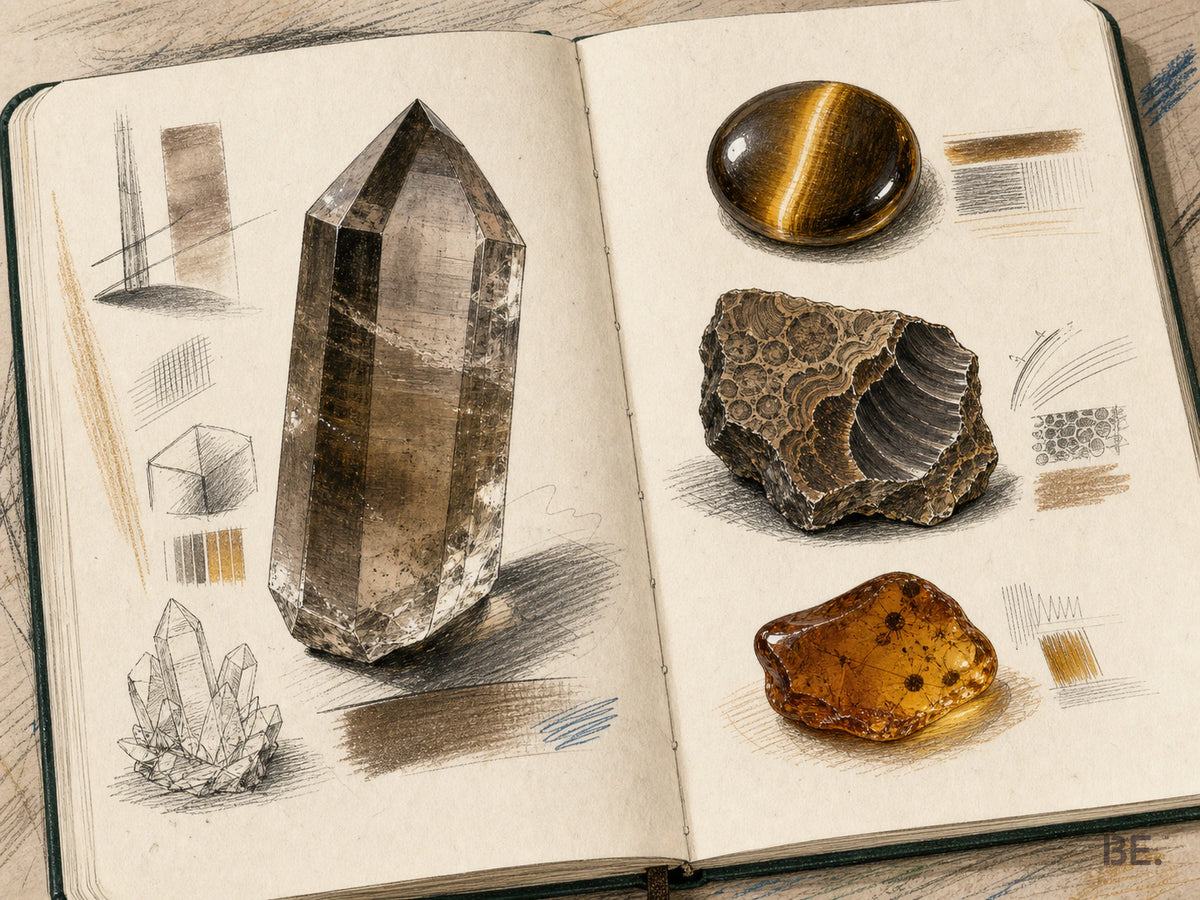
Brown crystal names, organised by material
| Name | Material identity | Useful visual clue | What colour cannot prove |
|---|---|---|---|
| Smoky Quartz | Crystalline Quartz | Transparent to translucent grey-brown body colour, sometimes zoned | Natural versus laboratory irradiation, origin or treatment history |
| Tiger's-eye | Chatoyant, fibrous Quartz material | A narrow silky band that moves across a polished surface | Identity from one static photograph or the absence of imitation fibre glass |
| Dravite | Tourmaline-group mineral | Brown to very dark prismatic material; rough crystals may show lengthwise striation | Tourmaline species from colour alone |
| Hessonite | Grossular Garnet variety | Cinnamon, honey-orange or reddish-brown transparent material; inclusions may be visible | Garnet variety, origin or quality grade from hue alone |
| Andalusite | Aluminium silicate mineral | Brownish pink, green and yellow-brown may appear as the viewing direction changes | Identity without checking its strong directional colour behaviour and other properties |
| Sphalerite | Zinc sulphide mineral | Yellow, orange, red-brown or dark material with unusually strong brilliance in suitable cuts | Suitability for daily wear; it is soft, brittle and has perfect cleavage |
| Brown Zircon, Topaz or Diamond | Three unrelated crystalline materials | Transparent faceted brown is only a starting appearance | Which species it is; laboratory testing may be needed |
| Brown Jasper / Picture Jasper | Opaque silica-rich ornamental material | Earth-brown fields, spots, bands or landscape-like patterning | A standardised trade variety, origin or natural colour from a retail name |
| Fire Agate | Iridescent Chalcedony | Brown botryoidal structure with reflected green-to-orange iridescence | That crackled or dyed “dragon vein” Chalcedony is natural Fire Agate |
| Mahogany Obsidian | Volcanic glass, not a crystal | Opaque black-brown to reddish-brown patches and glassy curved fracture | Crystalline identity; Obsidian lacks a crystal lattice |
| Petrified Wood | Mineral-replaced biological structure | Wood-like grain, growth pattern or cellular structure preserved in silica | Wood species, locality or authenticity from a decorative pattern alone |
| Amber | Fossilised organic resin, not a mineral | Honey to cognac transparency, flow structures, bubbles or organic inclusions | Natural amber versus copal, reconstructed material or plastic from colour alone |
Four visual routes that narrow the field
1. Transparent grey-brown
Smoky Quartz is the first useful comparison when a brown object remains visibly transparent. Its colour is tied to aluminium-related defects activated by irradiation; natural exposure over geological time can produce the smoky colour, and commercial material can also be irradiated. Transparency, a Quartz-like crystal form and internal zoning can support a shortlist, but they cannot disclose treatment by themselves. The dedicated Smoky Quartz colour guide explains the colour-centre mechanism in detail.
Transparent brown also occurs in Dravite, Hessonite, Andalusite, Zircon, Topaz, Diamond and Sphalerite. Their shared colour does not make them interchangeable. Andalusite can show conspicuously different brownish-pink and yellowish-green directions; Sphalerite can look exceptionally brilliant but is a poor everyday-wear assumption because of softness, brittleness and cleavage.
2. A moving band or coloured flash
Tiger's-eye is identified visually by a silky band of light that moves as the object rotates. GIA's recent review attributes the effect to oriented fibrous inclusions in a columnar Quartz material; the familiar golden-brown colour relates to weathered iron-rich amphibole. A still image can flatten the effect, so inspect motion under one light source rather than judging a bright stripe in a seller's photograph.
Fire Agate follows a different route. It is Chalcedony with a predominantly brown body and reflected iridescence over botryoidal layers. Its “fire” is not the same optical structure as Tiger's-eye chatoyancy. A crackled, dyed Chalcedony bead marketed with a fire-related trade name is not automatically Fire Agate.
3. Opaque, patterned brown
Jasper, patterned Chalcedony, Petrified Wood and Mahogany Obsidian can all sit in this lane. Look first at structure: Jasper and Chalcedony belong to silica-rich crystalline or microcrystalline routes; Petrified Wood preserves biological architecture after mineral replacement; Obsidian is rapidly cooled volcanic glass. USGS describes Obsidian as glassy volcanic material with conchoidal fracture and notes that iron oxidation states can tint it red or brown.
This is also why a Smoky Quartz versus Obsidian comparison matters. Both can become dark brown to near-black, but one is crystalline Quartz coloured by lattice defects and the other is non-crystalline volcanic glass.
4. Organic brown
Amber is included because shoppers routinely search for it alongside brown crystals, but the material boundary must stay visible. Amber is fossilised tree resin. It may be transparent, translucent or opaque, and brown is one of several possible colours. Its organic origin, lower heat tolerance and imitation risks require a different evidence route from a mineral crystal.
How to read a brown stone without damaging it
- Rotate it under one neutral light. Note whether the colour stays fixed, changes by direction, forms a moving band or appears as surface iridescence.
- Compare transmission. Record transparent, translucent or opaque rather than using “light brown” and “dark brown” as identity claims.
- Look at structure. Prism striation, Quartz zoning, fibrous banding, botryoidal layers, biological grain and conchoidal fracture point to different material routes.
- Inspect repetition. Identical bubbles, mould seams or perfectly repeated fibres can be warning signs, but they are screening clues rather than final diagnoses.
- Ask for exact disclosure. Request the mineral or material name, treatment, composite construction and whether a laboratory report belongs to that exact object.
- Avoid scratch and burn tests. Destructive home tests can damage a finished object and still fail to separate close-looking materials.
Which brown materials suit jewellery?
Material identity comes before a blanket durability claim. Quartz routes such as Smoky Quartz and Tiger's-eye provide a practical scratch-resistance baseline, while a finished bead can still fail at a fracture or thin drill wall. Tourmaline and Garnet are common jewellery materials, but inclusions, cut, setting and impact exposure still matter.
At the other end, Sphalerite is best treated as a collector or protected-setting material: GIA records Mohs 3.5–4, brittleness and perfect cleavage. Amber also needs its own care logic because it is organic rather than crystalline. The safe buying question is not “Which brown crystal is strongest?” but “What is this exact material, how is it constructed, and what kind of wear will it receive?”
Where to go next
Use the BE. Stone Library when the identity is still open and you need a wider material comparison. Use the Stone Finder when the goal is a wearable strand selected by colour and hardness. If the object is specifically transparent brown Quartz, continue to the Smoky Quartz colour guide rather than repeating that science here.
Frequently asked questions
Q1.What are the most common brown crystals?
Smoky Quartz, Tiger's-eye, brown Tourmaline such as Dravite, Hessonite Garnet, Andalusite and brown Jasper are useful starting names. They are not one material family, so compare transparency, structure and optical behaviour before deciding what an object is.
Q2.Is Tiger's-eye a brown crystal?
It belongs in a brown-colour guide, but it is more precisely a chatoyant Quartz material with oriented fibrous inclusions. Its diagnostic clue is a silky band that moves under the light, not brown colour alone.
Q3.Is Smoky Quartz naturally brown?
Natural irradiation acting on aluminium-bearing Quartz can create the smoky colour over geological time. Commercial irradiation can also create or deepen the effect, so appearance alone cannot prove an untreated history.
Q4.Is Mahogany Obsidian a crystal?
No. Obsidian is volcanic glass and lacks the ordered lattice of a crystal. It can still be a natural geological material used in jewellery, but it should not be described as a crystalline mineral.
Q5.Is Amber a brown crystal?
No. Amber is fossilised organic resin. It appears in brown gemstone searches because of its honey-to-cognac colour, but its origin, care and identification route differ from mineral crystals.
Q6.Can a photograph identify a brown stone?
Usually not with confidence. A photograph can hide transparency, directional colour, a moving band, cleavage or fracture. Use it to create a shortlist, then check multiple properties and request exact disclosure or laboratory evidence when value depends on identity.
References
- GIA: Colour centres and the origin of smoky colour in Quartz
- Gems & Gemology: Structures behind Tiger's-eye and Fire Agate optical effects
- Mindat: Dravite mineral information and references
- GIA: Cinnamon-coloured Hessonite Garnet under magnification
- Gems & Gemology: Gem-quality Andalusite and pleochroism
- Gems & Gemology: Sphalerite colour, dispersion and durability limits
- USGS: Obsidian as volcanic glass, colour and conchoidal fracture
- Gems & Gemology: Amber as fossilised organic resin
- Gems & Gemology: Petrified plant structure compared with Tiger's-eye
Field Notes.
One stone at a time: its geology, and how to read quality. The Stone Buying Checklist comes with your first email.
By subscribing you agree to receive emails from BE. Unsubscribe anytime.
Sent. Check your inbox.