
Clear Quartz Price and Value: What Makes One Piece Worth More?
Clear quartz price by object: rough, points, clusters, beads and bracelets. What raises the value of each and how to compare two prices like for like.
In this field note
“How much is clear quartz?” sounds like one question, but it covers several different markets. A rough fragment, an intact natural point, a cabinet cluster, a matched bead strand and a finished bracelet do not share the same unit of value. Treating them as interchangeable produces the low price anchors and false bargains that make careful work look inexplicably expensive.
This guide gives you a repeatable way to decide whether a specific clear-quartz price is supported by the object in front of you.
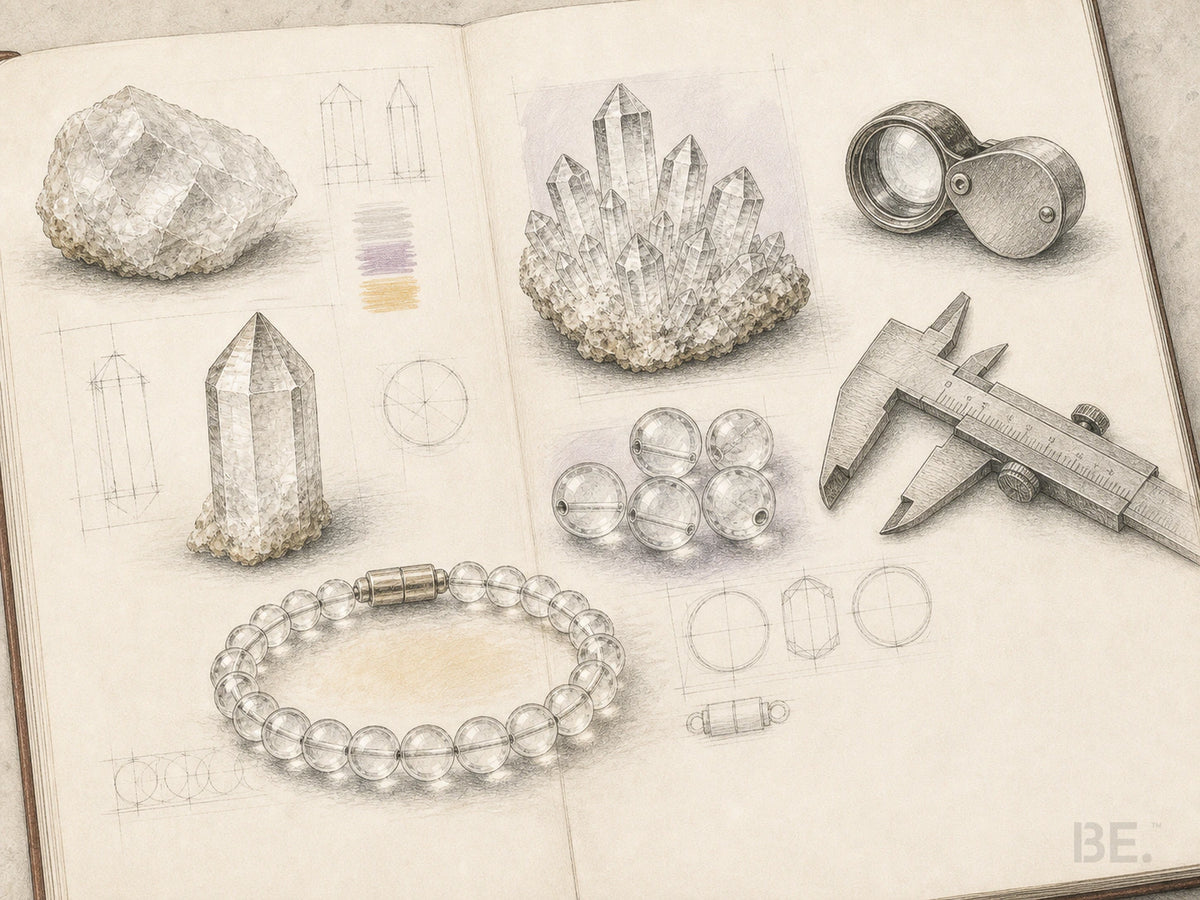
Why there is no single clear-quartz price
Quartz is abundant as a mineral, but abundance alone does not price a finished object. The relevant question is how much suitable material survived selection and transformation into the form being offered. A large rough piece can be inexpensive to obtain yet yield few clean, well-matched beads. An intact natural cluster may lose value through repaired terminations even when its total weight is impressive. A bracelet includes sorting, drilling, polish, clasp engineering, assembly, inspection and service that raw weight cannot measure.
| Object category | Primary value unit | Evidence to request |
|---|---|---|
| Rough or massive quartz | Usable material, not weight alone | Material identity, fractures, coatings, intended use and realistic yield |
| Natural point | Habit, termination and condition | Natural versus polished faces, repairs, contact damage and locality wording |
| Crystal cluster | Composition, completeness and display quality | Broken or restored points, matrix stability, dimensions and provenance |
| Calibrated beads or strand | Matching, usable clarity and lapidary finish | Diameter tolerance, drill edges, polish, internal stability and bead-to-bead coherence |
| Finished jewellery | Material plus design and construction | Exact materials, clasp, stringing, repair route and maker responsibility |
The value factors that survive scrutiny
1. Material identity and disclosure
“Crystal” is not a sufficient material name. The first premium must rest on a clear disclosure: natural quartz, hydrothermal synthetic quartz, glass, resin or a composite. Natural and synthetic quartz share many properties, while glass is an imitation material. If natural origin materially changes the price, the evidence has to show where the quartz formed, which is a separate question from whether it is quartz. The real-versus-fake Clear Quartz guide explains that two-stage distinction.
2. Usable clarity, not a fantasy of perfection
Clarity matters differently by object. In a bead, a clean viewing window and coherent internal texture may support brilliance; unstable fractures near a drill hole may shorten service life. In a collector specimen, an inclusion can add geological interest rather than reduce value. “Flawless” is not automatically natural, rare or better, and a photograph cannot prove growth origin.
3. Natural form, condition and provenance
For points and clusters, intact terminations, balanced composition, stable matrix and disclosed repairs matter. A locality can support value only when it is documented at an appropriate level. A seller should not infer a famous mine from colour, habit or a supplier’s informal label.
4. Matching, cut and polish
A premium strand should look intentionally composed. Compare bead diameter, transparency, undertone, internal texture, roundness, polish and drill alignment across the whole strand. Matching consumes labour and reduces yield; it is a different value proposition from a mixed commercial strand. Use the broader high-quality crystal jewellery checklist when assessing construction across materials.
5. Construction, service and documentation
In finished jewellery, clasp choice, stringing, finishing, inspection, repairability, sizing support, packaging and documentation all carry cost. They also carry responsibility: the maker remains answerable after the sale.
A like-for-like price check
- Name the object category. Do not compare a loose point with a finished bracelet.
- Confirm the claim. Separate material identity, natural/synthetic origin, treatment, construction and locality.
- Normalize dimensions. Record bead diameter, strand length, cluster dimensions or calibrated weight as appropriate.
- Read condition. Look for repairs, chips, unstable fractures, rough drill edges, coatings and glue.
- Compare workmanship. Assess matching, polish, alignment, clasp, stringing and finishing.
- Price the service layer. Include documentation, sizing, repair route and seller accountability.
If one offer is far cheaper, ask which evidence or service line is absent. If one is far higher, ask which observable factor justifies the difference. “AAA”, “museum grade” and “master healer” do not answer either question because they are not universal quartz grades.
What makes a Clear Quartz bracelet expensive?
In a high-price bracelet, the credible premium should be distributed across the whole object: a consistent material disclosure; strong but believable transparency; controlled internal texture; matched bead scale; clean drilling and polish; a deliberate clasp and stringing solution; documented review; and support after purchase. The Clear Quartz material guide shows how to read the stone itself, while the bracelet sizing guide covers fit.
Price red flags
- A natural-origin premium supported only by the word “crystal”.
- A universal price-per-gram claim applied across rough, clusters, beads and jewellery.
- “AAA” or “optical grade” with no defined inspection method.
- A famous locality inferred from appearance without traceable documentation.
- Perfectly retouched photographs with no drill-hole, clasp, profile or condition views.
- A high price that cannot be connected to material, workmanship, documentation or service.
Frequently asked questions
Q1.How much is Clear Quartz worth?
There is no defensible universal number. First identify whether the object is rough, a natural point, cluster, calibrated bead strand or finished jewellery; then compare identity, dimensions, condition, clarity, workmanship, documentation and service within that category.
Q2.Is Clear Quartz priced per gram or carat?
Weight can describe an object, but it does not create a universal valuation method. Natural form and condition dominate many specimens; calibrated dimensions, matching and finish matter more for beads; design and construction matter for jewellery.
Q3.Does clearer quartz always cost more?
No. Clarity can raise value within a genuinely comparable category, but natural form, condition, inclusions, provenance, cut, matching and workmanship can outweigh it. Extreme clarity also does not prove natural origin.
Q4.What makes a Clear Quartz bracelet expensive?
A supported premium can come from selective material yield, bead-to-bead matching, careful drilling and polish, robust construction, a considered clasp, documentation, inspection, repairability and after-sale service. The stone’s raw weight is only one part of it.
Q5.Does AAA Clear Quartz mean high quality?
Not by itself. There is no universal cross-market AAA standard for clear quartz. BE. grades each strand under Crystal 4T™ instead, and the Stone Origin Record gives a written reading for Transparency, Tone, Texture and Treasure.
Q6.How can I tell whether a Clear Quartz price is fair?
Compare the same object category and dimensions, then check disclosure, condition, clarity, workmanship, documentation and repair route. A fair premium should map to evidence you can inspect.
References
Field Notes.
One stone at a time: its geology, and how to read quality. The Stone Buying Checklist comes with your first email.
By subscribing you agree to receive emails from BE. Unsubscribe anytime.
Sent. Check your inbox.