
Blue Crystals: A Material-First Naming Guide
A visual navigation hub for blue material names, separating mineral species, varieties, rocks, archive labels and manufactured glass before routing each question to its owner guide.
In this field note
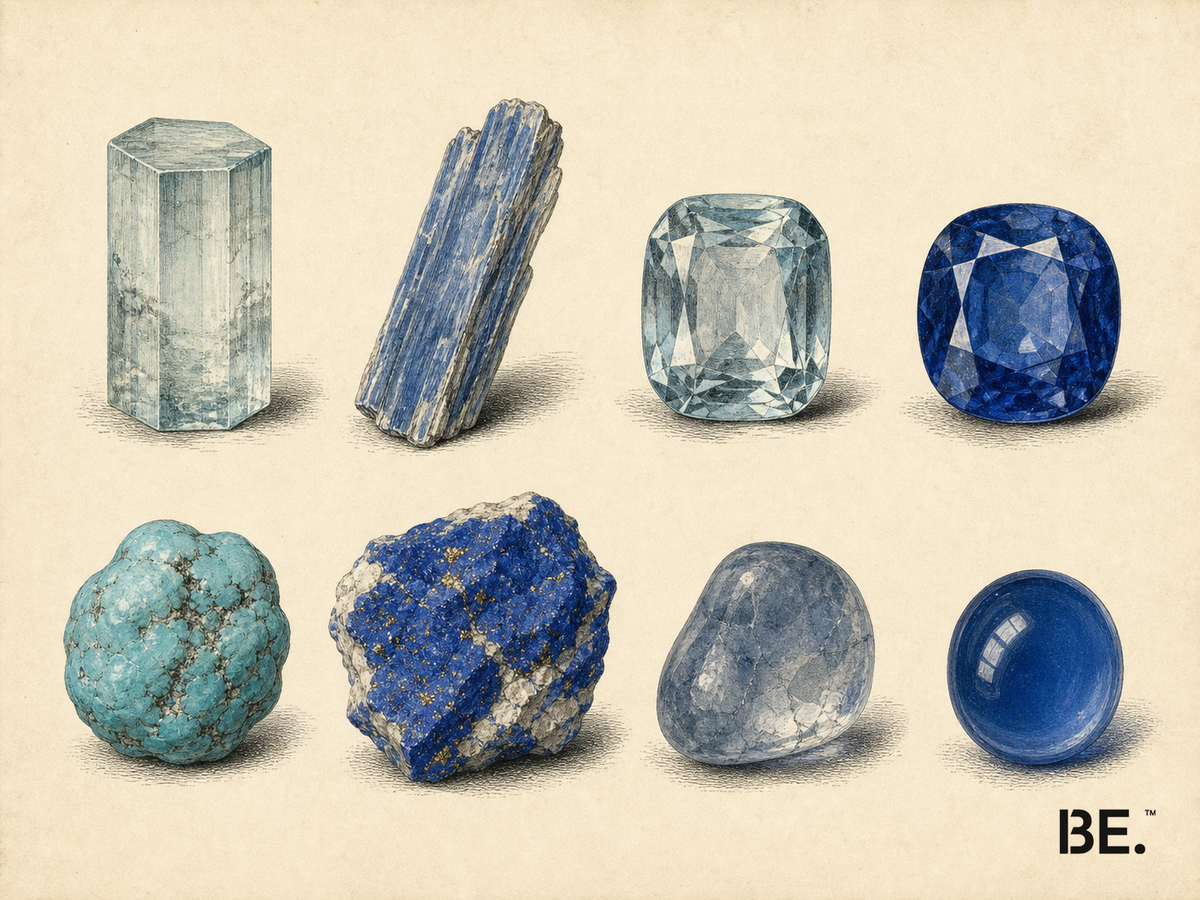
Blue is a useful way to browse jewellery, but a poor place to stop. This page covers blue gem and jewellery materials. Screen colour codes, paint names and craft-colour matching are outside its scope. Pale greenish blue can occur in beryl, while stronger blue can appear in treated topaz, sapphire, glass and other materials. Opaque blue may point towards turquoise, lapis lazuli, ceramic imitation or dyed material. Lighting, background, material thickness and image processing can shift all of them, so a responsible naming hub starts with classification.
Quick jumps: Common blue names · Transparent or faceted · Opaque or matrix-bearing · Bladed or directional · Blue within quartz · Manufactured material · FAQ
Start with the level of the name
Mineral species
A mineral species is defined by its chemistry and crystal structure. Topaz, kyanite and turquoise are examples of species used in blue jewellery. The word “blue” may describe a specimen, but it does not change the species. Kyanite also has direction-dependent hardness, which is one reason a colour-only care rule is inadequate.
Mineral variety
A variety name sits within a mineral species. Aquamarine is the greenish-blue to blue variety of beryl. Blue sapphire belongs to corundum; “sapphire” also covers non-red corundum in other colours, so sapphire is not a synonym for blue. Variety conventions can depend on colour and gemmological usage, and do not require a wholly different crystal structure.
Rock or aggregate
Lapis lazuli is a rock, an aggregate of several minerals, and not a single blue mineral crystal. GIA describes its principal components as lazurite, calcite and pyrite, with other minerals possible. The proportions and texture can vary across the same object. Calling every blue granular stone “lazurite” erases that rock-level identity.
Trade, collection or archive label
A commercial or archive label may describe colour, appearance, a collection record or a house classification. It is not automatically a mineral species, treatment conclusion or colour-mechanism claim. BE. currently records Blue Smoky Quartz as a material/archive name while leaving the mechanism behind its blue appearance unassigned. That boundary is more accurate than repeating an attractive but unconfirmed scattering explanation.
Manufactured material
Blue glass is manufactured and can imitate many transparent or opaque gems. Plastic “crystals” may be sold beside it while belonging to a different material category. Their composition and properties vary. “Synthetic” and “imitation” are not interchangeable: a synthetic counterpart has essentially the same material properties as the natural gem but grows in a laboratory; an imitation only resembles another gem and may be chemically unrelated. Accurate disclosure names the category.
A compact blue-material name map
| Name encountered | Classification | Appearance you may record | Next owner question |
|---|---|---|---|
| Aquamarine | Blue to greenish-blue beryl variety | Often transparent, commonly light in tone | Is the material beryl, and what treatment or quality claim is being made? |
| Blue topaz | Topaz species with a colour descriptor | Transparent; pale to strongly saturated commercial blue | Does testing fit topaz, and is irradiation/heat disclosed? |
| Blue sapphire | Blue corundum | Transparent to opaque; blue can vary in tone and modifier | Does testing fit corundum, and what origin or treatment claim needs evidence? |
| Kyanite | Mineral species | Commonly blue; bladed form may occur | Does the material fit kyanite, and how do directional hardness and cleavage affect use? |
| Turquoise | Mineral species | Semitranslucent to opaque blue/green; matrix may occur | Is it turquoise, treated turquoise, reconstructed material or an imitation? |
| Lapis lazuli | Multi-mineral rock | Usually semitranslucent to opaque; calcite or pyrite may be visible | Does the aggregate and mineral evidence fit lapis, and is dye or impregnation present? |
| Blue Smoky Quartz | BE. archive/material label | Blue-grey appearance within a quartz record | What does the specimen record establish, and which mechanism remains unassigned? |
| Blue glass | Manufactured material | Transparent to opaque; bubbles, flow or moulding traces may occur | Is it accurately disclosed as glass or being used as an imitation? |
This table is a decision directory, not a complete list of blue stones. None of its appearance phrases is an identification criterion. A faceted blue stone may sit in several rows; an opaque blue bead may still require instruments to separate mineral, rock, ceramic and glass candidates. Names outside the compact map still need the same species, variety, rock, trade-label or manufactured-material classification before comparison.
Common blue names: a material directory
Use these names to route a material question, not to identify a stone. Each row carries a source key.
| Retail name | Material class | Visible clue | Owner or lab question |
|---|---|---|---|
| Blue Lace Agate / chalcedony | Banded chalcedony; quartz variety [9] | Pale blue-and-white bands; translucent to opaque | Chalcedony? Natural colour or dye? |
| Sodalite | Feldspathoid mineral [10] | Opaque blue; white veining may occur | Sodalite, lapis lazuli, glass or dye? |
| Azurite | Copper carbonate mineral [11] | Deep blue; malachite may occur | Azurite, another copper mineral, composite or coating? |
| Chrysocolla | Copper-silicate material; intergrowths occur [12] | Opaque blue-green; texture can be uneven | Which phases? Stabilised, dyed or assembled? |
| Amazonite | Blue-green microcline feldspar [13] | Opaque to translucent; pale streaks or cleavage | Microcline? Variety and treatment accurate? |
| Blue apatite | Apatite-group label; fluorapatite is one member [14] | Transparent to opaque blue or blue-green | Which group member? Treatment or origin? |
| Celestite / celestine | Celestine mineral; “celestite” is a common name [15] | Pale blue; transparent to translucent | Celestine? Coated or dyed? |
| Larimar | Blue pectolite variety and trade name [16] | Opaque to translucent blue; white patterning | Pectolite? Origin and treatment evidence? |
| Blue calcite | Blue calcite variety [17] | Pale to mid blue; cleavage may show | Calcite or another carbonate? Dye or coating? |
| Dumortierite-bearing quartz | Quartz with dumortierite [18] | Blue fibres, needles or clouds in quartz | Is the included phase established? |
| Iolite | Gem-quality cordierite [19] | Blue-violet; strong pleochroism | Does testing fit cordierite? |
| Tanzanite | Blue-to-violet zoisite [20] | Transparent; direction changes the face-up colour | Zoisite? Heat treatment disclosed? |
| Blue fluorite | Blue fluorite variety [21] | Transparent to translucent; zoning or cleavage | Fluorite? Treatment or colour evidence? |
Appearance does not identify any row. Escalate material, origin or treatment claims when they are consequential.
Why unrelated materials can look blue
Blue is not one material mechanism. Copper-bearing minerals such as azurite and chrysocolla, feldspar sold as amazonite, pleochroic iolite and tanzanite, included quartz, treated gem material and manufactured glass can occupy a similar visual range for different reasons. Those categories are not interchangeable, and a photograph cannot determine which route applies. Start with the taxonomy already used here (species, variety, rock or aggregate, trade or archive label, and manufactured material), then continue to how blue colour can form in crystals for the broader absorption, defect, inclusion and physical-optics framework.
Navigate by what you can record
Transparent or faceted
Record colour modifier, tone, transparency, cut and visible internal features. Aquamarine, topaz, sapphire and glass can all enter the initial list. Move next to the Aquamarine Guide for beryl context, Aquamarine vs Blue Topaz vs Blue Glass for the three-way material framework, or Real vs Fake Aquamarine for disclosure and laboratory escalation.
Do not let saturation choose the name. Aquamarine is often light, but unusually strong blue examples exist. Colourless topaz is plentiful and is often treated to produce blue; irradiation is one documented route, and treated blue topaz can be pale or intense. Sapphire spans modifiers and tones, while glass can be manufactured in virtually any colour. Treatment history needs disclosure, because colour cannot supply it.
Opaque, granular or matrix-bearing
Record whether the blue body is uniform, granular or crossed by a contrasting matrix. Turquoise commonly appears semitranslucent to opaque and may retain host-rock matrix. Lapis lazuli is an aggregate and can show white calcite or metallic-looking pyrite, but it can also be relatively uniform. Ceramic, glass, dyed and reconstructed imitations can reproduce familiar patterns. Matrix is a texture observation, not a natural-origin certificate.
Bladed or strongly directional
A bladed habit can raise kyanite as a candidate. Kyanite's hardness varies with crystallographic direction, so the familiar idea of giving every gem one fixed Mohs number becomes incomplete. Continue with Why Kyanite Has Two Hardness Values for the owner explanation. Habit alone still does not prove that a polished bead is kyanite.
Blue areas or needles within quartz
Quartz can host coloured zones, particles, fibres or needle-like inclusions, and commercial names may emphasise the visible feature. A photograph does not establish the included phase or the optical mechanism. Use the Blue Smoky Quartz Guide for the current material record, with its blue mechanism left unassigned, and the Blue Needle Quartz and Dumortierite Guide for that separate owner question.
“Needle”, “smoky” and “blue” remain descriptive until mineralogical evidence supports more. An attractive visual analogy is not a phase identification.
Uniform manufactured appearance
Very even colour, mould repetition, curved flow or several round bubbles can raise glass as a candidate. Absence of those features does not remove glass. Surface coatings, adhesive and wear around drill holes can add other candidates. A loupe helps document the pattern; gemmological instruments confirm the material.
Read a blue-material label in order
- Colour word: blue, teal, aqua, navy or blue-grey describes appearance only.
- Material name: beryl, topaz, corundum, kyanite, turquoise, lapis lazuli, quartz or glass states the proposed identity.
- Growth or manufacture: natural, laboratory-grown, reconstructed, composite or manufactured answers a different question.
- Treatment: heat, irradiation, dye, impregnation, filling or coating should be disclosed when known and relevant.
- Scope: establish whether the statement applies to one focal stone, every bead or only the design colour.
- Evidence: a report should identify the tested object, methods and conclusions; a generic certificate image is not parcel-level proof.
This order prevents a colour label from acquiring claims it never made and prevents a specific material claim from escaping verification. For jewellery, finish the check with setting or drill condition, care limits, report identifiers and return terms tied to the exact object.
Choose the next owner, not a colour verdict
Use this hub to route the question. Beryl identity and quality belong to the Aquamarine Guide. The aquamarine/topaz/glass separation belongs to the three-way comparison. Natural, treated, laboratory-grown and imitation language belongs to Real vs Fake Aquamarine. Kyanite, Blue Smoky Quartz and Blue Needle Quartz each retain their own material records.
No single blue hub can replace those material guides. Its job is to preserve the cross-material map, not to absorb specimen-specific identification, mechanism, care or price conclusions.
Frequently asked questions
Q1.Is every “blue crystal” a mineral crystal?
No. Aquamarine, topaz, sapphire, kyanite and turquoise are mineral names or varieties, while lapis lazuli is a rock made from several minerals and blue glass is manufactured. “Crystal” is often used loosely in retail naming.
Q2.Can colour identify a blue gemstone?
No. Different minerals, rocks, treatments and manufactured materials can overlap in hue, tone and transparency. Colour is useful for describing and routing a question, not for confirming identity.
Q3.How do I separate aquamarine, blue topaz and blue glass?
Begin with disclosure and non-destructive observation, then use measured properties such as refractive index, specific gravity, optic character and microscopy. The three-way comparison explains why bubbles, heft and colour are screening clues only.
Q4.Does a bladed blue crystal prove kyanite?
No. A bladed habit can raise kyanite as a candidate, but identity needs a coherent mineralogical result. Kyanite's direction-dependent hardness also requires more care than one headline Mohs number suggests.
Q5.What causes the blue in BE. Blue Smoky Quartz?
The current BE. Geological Codex leaves that blue-appearance mechanism unassigned. The material/archive label should not be expanded into a Tyndall, Rayleigh or other scattering claim without specimen-specific evidence.
Q6.Is synthetic blue material the same as blue glass?
Not necessarily. A synthetic gem counterpart has essentially the same chemical, physical and optical properties as the natural material but grows in a laboratory. Glass is a different manufactured material and may be used as an imitation.
Q7.What should I ask before buying a blue stone?
Ask for the material identity, natural or laboratory-grown status, known treatments, whether the claim covers every component, and what evidence supports it. Keep the invoice, report details and return terms tied to the exact object.
Q8.Is “crystal blue” one fixed colour?
No. It is not a mineral species, a gemmological identity or one universal colour value. Record hue modifier, tone, saturation, transparency and lighting, then identify the material separately.
References
- GIA: Aquamarine
- GIA: Sapphire Description
- GIA: Topaz
- GIA: Turquoise
- GIA: Lapis Lazuli Description
- GIA: A Case of Mistaken Identity?
- Handbook of Mineralogy: Kyanite
- BE. Geological Codex
- [9] CIBJO: The Gemstone Book: chalcedony and agate naming.
- [10] Handbook of Mineralogy: Sodalite.
- [11] Handbook of Mineralogy: Azurite.
- [12] Handbook of Mineralogy: Chrysocolla.
- [13] Handbook of Mineralogy: Microcline.
- [14] Handbook of Mineralogy: Fluorapatite.
- [15] Handbook of Mineralogy: Celestine.
- [16] Handbook of Mineralogy: Pectolite.
- [17] Handbook of Mineralogy: Calcite.
- [18] GIA Gems & Gemology: Dumortierite in Rock Crystal Quartz.
- [19] GIA: Iolite Description.
- [20] GIA: Tanzanite Description.
- [21] Handbook of Mineralogy: Fluorite.
Field Notes.
One stone at a time: its geology, and how to read quality. The Stone Buying Checklist comes with your first email.
By subscribing you agree to receive emails from BE. Unsubscribe anytime.
Sent. Check your inbox.