
Aquamarine vs Blue Topaz vs Blue Glass: A Material-First Comparison
A material-first comparison of aquamarine, blue topaz and blue glass, covering measurable differences, safe screening limits, jewellery durability and when laboratory testing is justified.
In this field note
A blue bead or faceted stone arrives as an appearance, not an identification. Three objects may share the same photograph-friendly colour while differing in crystal structure, density, treatment history and response to impact. Start with the material name, then ask what evidence supports it. For aquamarine’s full beryl identity, colour, treatment, quality and care context, use the Aquamarine Guide; this comparison keeps to the narrower question of separation from topaz and glass.
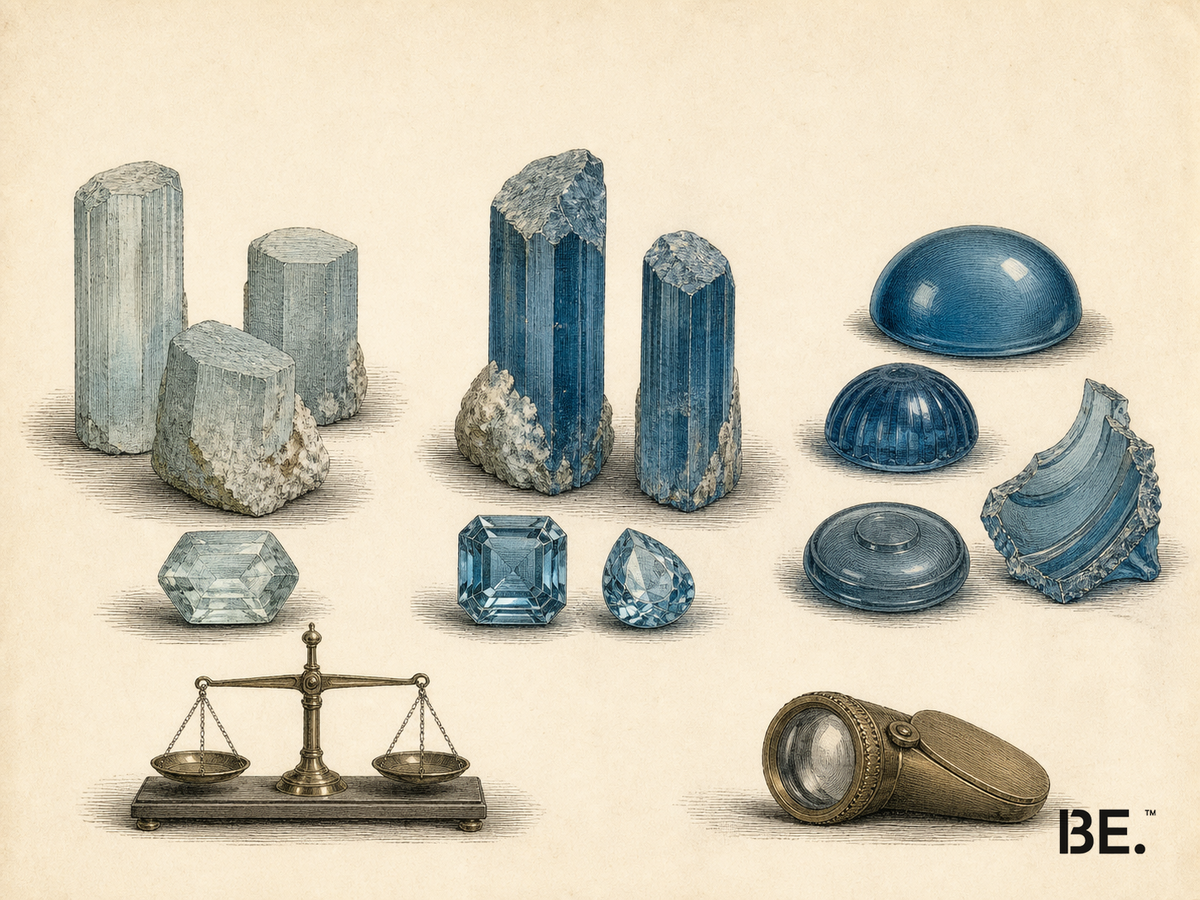
Three blue appearances, three material stories
Aquamarine is beryl
Aquamarine is the greenish-blue to blue variety of the mineral beryl. GIA lists a refractive-index range of 1.577–1.583, specific gravity around 2.72 and Mohs hardness of 7.5–8. Faceted material is often highly transparent, so an eye-clean appearance is normal rather than suspicious. Its colour is commonly light, and heat treatment can reduce a green component to give a bluer appearance.
Those facts define a material family; they do not create a visual home test. A mounted stone cannot be assigned an RI or specific gravity by looking at it. Natural aquamarine can also contain fluid, multiphase, mineral or growth-related features. “It has an inclusion” is therefore no more complete than “it looks clean”.
Blue topaz is topaz
Topaz is a different mineral species. GIA gives topaz a refractive-index range of 1.619–1.627, specific gravity around 3.53 and Mohs hardness of 8. Pronounced blue can be created or enhanced by irradiation followed by heat, and treated blue topaz has been widely available for decades. Treatment does not turn topaz into glass or aquamarine; it remains topaz, but the treatment should be represented accurately.
Hardness must not be confused with resistance to every kind of damage. Topaz has perfect basal cleavage, a structural direction along which it can split. A well-set topaz may wear successfully, but edge exposure and hard knocks deserve attention even though its Mohs number is high.
Blue glass is manufactured
Blue glass is manufactured, so its properties depend on its composition, colourants and production. Its colour and optical behaviour depend on composition, colourants, manufacturing and any later coating or assembly. Artificial glass used as a gem imitation may show rounded bubbles, curved flow structures, comparatively weak lustre or moulding marks. These are useful observations when present.
They are not a compulsory checklist. Well-made glass can lack obvious bubbles, and a bubble-shaped feature seen through a loupe can be misread. Conversely, natural beryl may contain angular fluid cavities and multiphase inclusions. The shape, distribution and context of a feature matter more than the word “bubble”.
Aquamarine, blue topaz and blue glass compared
| Question | Aquamarine | Blue topaz | Blue glass |
|---|---|---|---|
| Material family | Beryl variety | Topaz mineral species | Manufactured amorphous material |
| Common blue context | Natural beryl colour; heating commonly reduces green | Strong commercial blue commonly produced by irradiation and heat | Colour introduced through glass composition or later surface/assembly processes |
| Typical reference density | SG about 2.72 | SG about 3.53 | Variable; no universal value |
| Hardness context | Mohs 7.5–8 | Mohs 8, with perfect cleavage | Variable and generally not represented by one number |
| Possible magnified clues | Natural growth, mineral or fluid-related features; often eye-clean | Natural inclusions may occur; treated blue colour is common | Rounded bubbles, curved flow and moulding traces may occur |
| What appearance can prove | Nothing by itself | Nothing by itself | Nothing by itself |
The table is a map of candidates, not a set of pass marks. Published constants belong to materials measured under controlled conditions. They cannot be transferred automatically to a bead strand whose holes, coatings, settings or internal construction are unknown.
What you can screen safely
Record colour before interpreting it
Compare the object under diffuse daylight-equivalent illumination and a warmer indoor source, against a neutral background. Record whether the blue is pale, greenish, greyish or highly saturated and whether colour is even across the object. This makes descriptions more reproducible. It does not decide between aquamarine, topaz and glass, because all three can be cut or manufactured to overlap in visible colour.
Do not convert ordinary lighting differences into a claimed colour-change phenomenon. Camera white balance, screen profiles, reflected surroundings and the thickness of the stone can all shift the recorded blue.
Use magnification to build candidates
A clean loupe and transmitted plus reflected light can reveal surface wear, drill-hole condition, facet junctions and internal features. Several round bubbles or sweeping curved flow lines would raise glass as a candidate. Angular cavities, oriented growth features or mineral inclusions may support a natural-mineral candidate when interpreted by someone trained to recognise them.
One feature is rarely decisive. Glass need not show bubbles; aquamarine can contain fluid inclusions; topaz can contain two-phase or needle-like inclusions. Dirt, adhesive and polishing residue can also sit above rather than inside the material. Record location and pattern before assigning meaning.
Treat heft as a controlled comparison, not a verdict
Topaz is roughly 30 per cent denser than aquamarine on the reference values above, so truly equal volumes of solid material would not weigh the same. The phrase “equal volumes” is the entire condition. A deeper pavilion, hollow bead, larger drill hole, metal setting or mixed strand changes volume and mass. Hand-held heft between unrelated pieces is too imprecise to identify them.
Specific-gravity measurement can be useful on a suitable loose stone, but it is a measured test with technique and uncertainty—not a sensation. Porosity, attached metal, fillers and surface tension can distort the result.
Leave destructive shortcuts out
A scratch test damages a finished surface and still may not provide a unique answer. A hot needle can injure coatings, adhesives, stringing or glass and creates no responsible route for testing an unknown piece of jewellery. UV fluorescence is variable within and between materials; an inert or fluorescent response is a data point, not an identity. “Cold to the touch” depends on thermal mass, room conditions and handling. None deserves a real/fake label.
What a gemmological examination adds
The first useful question for a loose transparent stone is often whether its measured properties fit beryl, topaz or glass. Refractive index can separate the typical aquamarine and topaz ranges. Specific gravity provides another independent line. Polariscope observations and optic character help distinguish crystalline material from singly refractive glass, while microscopy tests whether observed features form a coherent pattern.
More complex questions need more than standard measurements. Raman spectroscopy can confirm a mineral phase; infrared spectroscopy can reveal some fillers or structural features; UV-Vis-NIR spectroscopy and trace-element chemistry may help investigate colour origin or separate natural from laboratory-grown blue beryl. A laboratory chooses methods for the object and question. No single instrument is a magic authenticity button.
Seek a qualified gemmologist or independent report when the price, insurance value, resale representation or treatment claim materially depends on identity. The report applies to the submitted object, not every similar-looking bead in a parcel.
Choosing between them for jewellery
Choose from disclosed identity and construction, not from a hierarchy built on colour alone. Aquamarine’s 7.5–8 hardness supports jewellery use, while ordinary care still means avoiding abrasion and hard knocks. Topaz is hard but its cleavage makes protective design and impact avoidance relevant. Glass can be entirely appropriate as designed jewellery when sold as glass, but its wear behaviour depends on formulation, coatings, edges and setting.
For any bracelet or necklace, the stone is only one part of durability. Drill holes, bead-to-bead contact, stringing, knots, clasps and adjacent materials may fail before the blue material does. Warm soapy water is the conservative route for known, uncomplicated aquamarine, but mixed or unknown pieces should follow the limits of their most vulnerable component.
A disclosure-first buying checklist
- Ask for the specific material name: aquamarine, blue topaz or glass—not simply “ocean blue crystal”.
- Ask whether the material is natural, laboratory-grown, an imitation or a manufactured product.
- Ask for known treatment disclosure. Commercial blue topaz is commonly treated; aquamarine may be heated and is rarely filled.
- Check whether the description applies to every component or only a focal stone.
- Keep invoices, laboratory reports and return terms tied to the exact object.
- Treat an unsupported mine, “untreated” or “certified” claim as a question to verify, not a detail to repeat.
Continue by material
If the candidate is beryl, continue with the Aquamarine Guide for colour, treatment, quality and care. The purpose of this comparison is to reach the correct owner question—not to replace a full material record with a three-column shortcut.
Frequently asked questions
Q1.Is blue topaz the same as aquamarine?
No. Aquamarine is a greenish-blue to blue variety of beryl, while blue topaz is the mineral topaz. Their colour can overlap, but their structure, refractive index and density differ.
Q2.Is commercial blue topaz usually treated?
Yes. Pronounced commercial blue topaz is commonly produced by irradiating colourless or pale topaz and applying heat. It remains topaz; accurate treatment disclosure is the relevant issue.
Q3.Do bubbles prove that a blue stone is glass?
No. Multiple rounded bubbles and curved flow structures can support a glass candidate, but glass may have no obvious bubbles and natural aquamarine may contain fluid or multiphase inclusions. Feature shape, pattern and other tests must agree.
Q4.Can I identify topaz because it feels heavier?
Not reliably by hand. Topaz is denser than aquamarine, but a fair comparison requires equal material volume and no setting, drill-hole or construction differences. Measured specific gravity is evidence; casual heft is only a prompt for further testing.
Q5.Which is more durable, aquamarine or blue topaz?
Neither is categorically more durable. Topaz is harder at Mohs 8 but has perfect cleavage, while aquamarine is Mohs 7.5–8 and still needs protection from abrasion and hard knocks. Hardness alone does not settle durability. Cut, inclusions, setting and the complete jewellery construction also matter.
Q6.What is the safest way to confirm the material?
Use a qualified gemmologist or independent laboratory when the conclusion matters. Refractive index, specific gravity, optic character and microscopy can separate many cases, with spectroscopy or chemistry added for treatment or origin questions.
References
Field Notes.
One stone at a time: its geology, and how to read quality. The Stone Buying Checklist comes with your first email.
By subscribing you agree to receive emails from BE. Unsubscribe anytime.
Sent. Check your inbox.