
Real vs Fake Aquamarine: Safe Checks and Laboratory Evidence
A disclosure-first guide to natural, treated, laboratory-grown and imitation aquamarine, with safe observation limits and the evidence an independent laboratory can add.
In this field note
The word “fake” feels decisive but hides several different material states. A seller may have the mineral name wrong, omit a treatment, confuse laboratory growth with natural origin, or use a vague colour label that never promises aquamarine at all. A useful check therefore starts with exact language and a candidate list, not a single home trick. For the full beryl record, read the Aquamarine Guide. For the narrower three-way material comparison, use Aquamarine vs Blue Topaz vs Blue Glass.
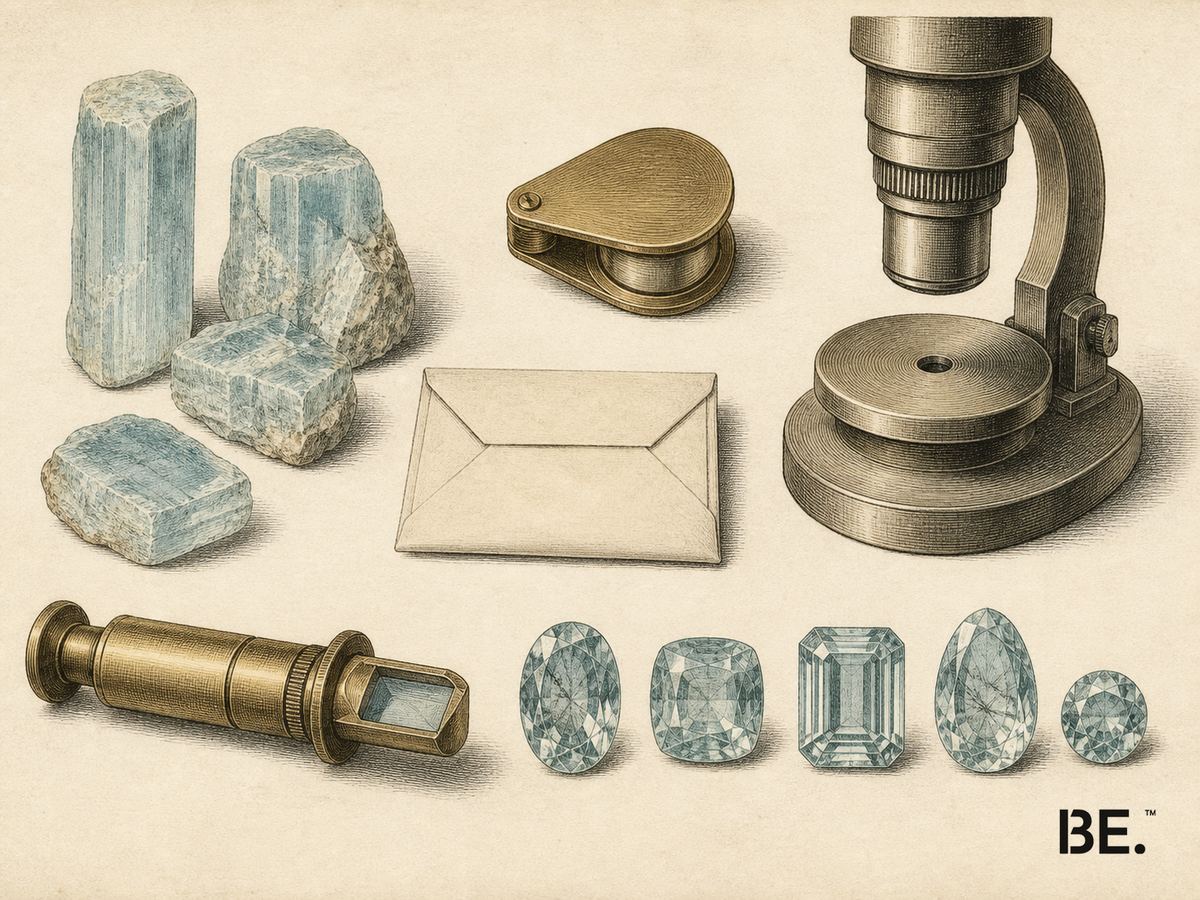
What “fake aquamarine” can mean
The material may not be beryl
Aquamarine is the greenish-blue to blue variety of beryl. Blue glass, blue topaz and other blue materials can imitate its appearance. If one of them is sold as aquamarine, the problem is material identity. Similar colour is not a shared mineral species.
The material may be laboratory grown
Synthetic or laboratory-grown material has essentially the same chemical, physical and optical characteristics as its natural counterpart, but it is made in a laboratory. Hydrothermal synthetic blue beryl has been documented and can overlap natural aquamarine in standard properties. Correctly disclosed laboratory-grown beryl is not glass and should not be described as a natural mined stone.
The stone may be natural but treated
Heat is commonly used to reduce the green component of natural aquamarine, producing a bluer appearance. The stone remains natural beryl with a treatment history. Polymer filling of fractures has also been documented in aquamarine; that treatment can affect disclosure and care. “Natural” should therefore never be expanded silently into “natural and untreated”.
Some blue beryl belongs to a different colour-origin category, including Maxixe-type material. Its naming, spectroscopy and light-stability questions are not resolved by an aquamarine-looking photograph. A laboratory may need to determine which blue beryl category fits.
The description may be the failure
A listing may say only “aqua”, “sea blue”, “aquamarine colour” or “crystal”. These phrases can describe appearance without promising mineral aquamarine. In contrast, “natural untreated aquamarine” makes specific identity, origin and treatment claims. The first screening step is to copy the exact wording, not upgrade it mentally.
A candidate map, not a pass-or-fail test
| Candidate | Material identity | Natural or laboratory grown | Treatment/disclosure question |
|---|---|---|---|
| Natural aquamarine, no detected treatment | Beryl, aquamarine variety | Natural | Whether evidence supports the no-treatment wording |
| Heated natural aquamarine | Beryl, aquamarine variety | Natural | Heat history should be represented accurately |
| Filled natural aquamarine | Beryl, aquamarine variety | Natural | Filling and care implications require disclosure |
| Laboratory-grown blue beryl | Beryl | Laboratory grown | Must not be represented as natural |
| Maxixe-type or another blue beryl category | Beryl | Depends on the specimen | Colour-origin category and stability may need spectroscopy |
| Blue topaz, glass or another substitute | Different material | Natural, synthetic or manufactured depending on candidate | Selling it as aquamarine is inaccurate |
This map prevents two common errors. First, it does not place every treated natural stone in a “fake” box. Second, it does not call every non-natural material glass. Identity, growth environment and treatment are separate fields.
A safe home-screening workflow
Preserve the claim and object
Save the listing, invoice, report number and photographs. Note whether the claim covers a focal stone, every bead or only the colour. Record dimensions, mass where practical, setting metal, drill holes, chips and repairs. A report for one stone does not certify an untested parcel, and a photograph of one bead does not establish a whole strand.
Record colour under controlled light
Use a neutral background and compare diffuse daylight-equivalent light with a warmer indoor source. Record tone, saturation, green or grey components and zoning. This produces a better description, but not an origin result. Aquamarine, treated blue topaz and manufactured glass can occupy overlapping colour ranges; camera processing can move them closer still.
Ordinary lighting differences should not be promoted into a colour-change claim. White balance, screen calibration, stone thickness and reflected surroundings can all alter the image.
Inspect rather than diagnose with a loupe
At 10× magnification, look for surface-reaching fractures, drill-hole coatings, chips, adhesive, curved flow structures, rounded bubbles, angular fluid cavities, growth features and mineral inclusions. Record where each feature sits and whether it repeats across the piece.
Interpretation needs restraint. Multiple round bubbles and curved flow may support glass, but well-made glass can be visually clean. Natural aquamarine is often eye-clean, while some natural specimens contain fluid or multiphase inclusions. Synthetic growth features can also require training to recognise. Neither “perfectly clear” nor “full of inclusions” proves origin.
Check construction and consistency
Compare bead diameter, drill-hole shape, facet style, surface wear and colour distribution across the entire object. A mixed strand or repaired setting may contain more than one material. Coatings can concentrate at drill holes or worn edges, but their absence does not establish an untreated stone. Construction evidence helps define what needs testing; it does not name the mineral by itself.
Stop before damage
Do not scratch a polished surface, use a hot needle or apply household chemicals. Hardness is resistance to scratching, not a unique identity code, and Mohs intervals are not evenly spaced. A thermal “cold stone” impression depends on mass, room temperature and handling. UV fluorescence is variable, and a binary glow/no-glow chart cannot settle natural origin or treatment. These shortcuts can damage the piece while leaving the core question unanswered.
Why popular authenticity shortcuts fail
“It is too clear to be natural” fails because aquamarine commonly forms large, transparent, eye-clean material. “It has inclusions, so it is natural” fails because manufactured and laboratory-grown materials can contain internal-looking features, and filled fractures can add their own visual signals. “It was inexpensive, so it is glass” fails because price also reflects colour, size, cut, supply, brand, treatment, condition and seller behaviour.
Likewise, bubbles are a candidate clue rather than a verdict; weight requires equal volume and controlled measurement; UV response varies; and a phone photograph discards optical information. Each may justify a better next question. None completes the identification.
What laboratory evidence can establish
A gemmologist may begin with refractive index, specific gravity, optic character, pleochroism and microscopy. These can separate many glass and topaz imitations from beryl. Yet natural aquamarine and hydrothermal synthetic blue beryl can overlap in standard properties, so a beryl result does not always answer growth origin.
The next methods depend on the remaining candidates. Raman spectroscopy can confirm mineral phases. FTIR may detect diagnostic polymer features in filled material. UV-Vis-NIR spectroscopy helps examine colour-related absorptions, while trace-element chemistry and microscopic growth evidence can help separate natural, treated and laboratory-grown blue beryl. The strength lies in agreement between independent observations, not in an isolated machine result.
Ask the laboratory what its report will state: material identity, natural or laboratory-grown origin, detectable treatment, colour variety, or only some of these. “Tested” is incomplete without the scope and result.
A disclosure-first buying checklist
- Require a material name, not only a colour phrase.
- Separate “natural” from “untreated”; ask both questions when both matter.
- Ask whether laboratory-grown or imitation material is present.
- Ask which treatments are known, undetected or not tested for.
- Check whether any report number verifies on the issuing laboratory's own system and matches the object.
- Keep the return policy available until independent testing is complete.
- Treat a mine or geographic-origin claim as a separate claim requiring its own evidence.
When to seek an independent report
Independent testing is proportionate when price, insurance, resale, a natural-origin premium, an untreated claim or a seller dispute depends on the answer. It is also sensible when observations conflict—for example, a beryl-like RI paired with features that do not fit the stated origin. The conclusion should stay attached to the tested object and the methods used.
For a low-value fashion piece accurately sold as glass, further testing may add little. The objective is not to make every blue object pass through a laboratory; it is to match the confidence level to the claim and consequence.
Aquamarine strands are listed in the BE. collection, and every strand ships with a Stone Origin Record that states its lot, its four Crystal 4T™ readings and what those readings do not claim.
Frequently asked questions
Q1.Is heat-treated aquamarine fake?
No. Heated aquamarine is natural beryl whose colour has been altered, commonly by reducing a green component. It remains aquamarine, but “natural” should not be used as if it automatically meant “untreated”.
Q2.Is laboratory-grown aquamarine the same as glass?
No. Laboratory-grown blue beryl has essentially the same material properties as beryl but grows in a laboratory. Glass is a different manufactured material. Laboratory-grown beryl must still be disclosed as non-natural.
Q3.Does an eye-clean stone mean it is fake?
No. Faceted aquamarine is often highly transparent and eye-clean. Clarity alone cannot decide natural origin, treatment or whether the material is beryl.
Q4.Do inclusions prove natural aquamarine?
No. Correctly interpreted growth, mineral and fluid features may support a natural-origin conclusion, but imitations, filled stones and laboratory-grown material can also show internal features. The complete evidence pattern must agree.
Q5.Can a UV torch identify real aquamarine?
No. Fluorescence can vary, and similar responses can occur in different materials. UV is one recorded observation in a controlled examination, not a stand-alone real/fake test.
Q6.Can a refractometer prove that aquamarine is natural?
It can help establish whether properties fit beryl and separate many imitations, but natural and laboratory-grown blue beryl can overlap. Natural-origin and treatment questions may require microscopy, spectroscopy and chemistry.
Q7.What should an aquamarine report say?
Check for the tested object's identity, natural or laboratory-grown conclusion, detectable treatments, measurements, report number and laboratory name. Geographic origin or “untreated” status should appear only when the laboratory actually tested and concluded it.
References
- GIA — Aquamarine
- Gems & Gemology — Aquamarine, Maxixe-Type Beryl and Synthetic Blue Beryl: Analysis and Identification
- Gems & Gemology — Polymer-Filled Aquamarine
- GIA — An Introduction to Imitation Diamonds & Other Gems
- Gems & Gemology — Analysis of Gemstones at GIA Laboratories
- CIBJO — The Gemstone Book (Gem-A-hosted official standard)
Field Notes.
One stone at a time: its geology, and how to read quality. The Stone Buying Checklist comes with your first email.
By subscribing you agree to receive emails from BE. Unsubscribe anytime.
Sent. Check your inbox.