
Yellow & Gold Crystals: A Material-First Naming Guide
A material-first map of yellow and gold gem names, separating body colour, rutile inclusions, metallic minerals, organic amber and manufactured glass without confusing gold-toned appearance with elemental gold.
In this field note
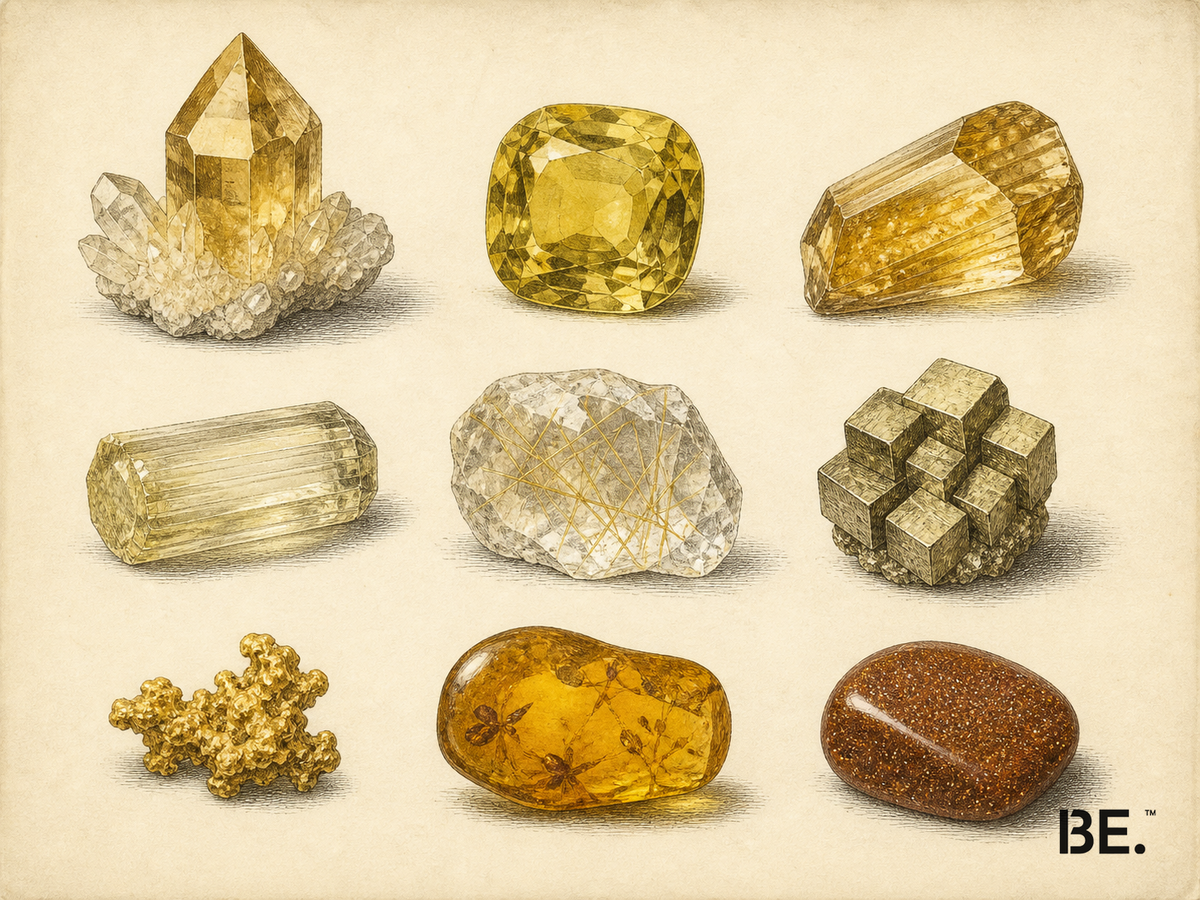
Yellow and gold describe different optical effects
A transparent gem may be yellow because its body selectively absorbs visible light. A colourless host can look golden because it contains reflective needles. An opaque mineral may appear gold because it has metallic lustre. A resinous organic material can occupy an amber-yellow palette, while manufactured glass can sparkle through deliberately added particles. For a useful name, separate four lanes: yellow body-colour gemstones and minerals; gold-coloured inclusions or metallic effects; native-gold mineral specimens; and manufactured materials or decorative components, including goldstone and other glass or plastic products.
These lanes should not be collapsed into one list of “gold minerals”. Within each lane, record three separate fields:
- Material: quartz, corundum, topaz, beryl, pyrite, native gold, organic amber or glass.
- Appearance: yellow, orange-yellow, greenish-yellow, brassy metallic, needle-included or glittering.
- Origin and modification: natural, synthetic, heated, irradiated, coated, assembled or manufactured, where supported.
The first field says what it is. The second describes what is visible. The third records what happened to it.
A material map of common yellow and gold names
Yellow body colour: citrine, sapphire, topaz and heliodor
Citrine is the yellow to orange variety of quartz. Natural-colour citrine exists, but much commercial citrine is produced by heating amethyst or other quartz material. Heat treatment does not make the material glass or synthetic quartz; it remains quartz, and known treatment should be disclosed. Colour alone cannot establish whether a particular citrine is natural-colour or heated.
Yellow sapphire is yellow corundum. Natural, treated and laboratory-grown yellow corundum all occur, and their disclosure states are separate from the species name. A transparent yellow stone cannot be called sapphire from hue, hardness folklore or a photograph.
Yellow or golden topaz is the mineral topaz in a yellow-to-orange part of its range. Trade names may imply particular colour or market categories, but they are not substitutes for a material identification and treatment statement. Topaz also has perfect cleavage, so a high Mohs number does not mean it is immune to knocks; this hub leaves detailed wear guidance to material-specific resources.
Heliodor is a name used for yellow to greenish-yellow beryl. It shares the beryl species with aquamarine and morganite, not with quartz or topaz. The boundary between “heliodor” and “golden beryl” is used differently across parts of the trade, making beryl plus a precise colour description more transparent than a name alone.
Golden inclusions: rutilated quartz
Golden rutilated quartz is quartz containing visible rutile inclusions. Rutile is titanium dioxide, and its needles may appear yellow, coppery, brown or gold-toned as light reflects from them. “Golden” describes the visual effect; it does not mean the inclusions are elemental gold.
Needle-like inclusions are not automatically rutile. Other minerals, growth features, fractures, coatings and manufactured effects can create lines. Identifying the host and inclusion may require microscopy, spectroscopy or chemical analysis. A dense, attractive needle pattern is also not a universal quality grade.
Metallic materials: pyrite and native gold
Pyrite is iron sulphide, FeS₂. Its pale brass-yellow colour and metallic lustre explain the familiar “fool’s gold” comparison, but it is not a type of gold. Crystal form, streak, hardness and density can help a trained examiner, while weathering, coatings and small mounted pieces complicate casual tests.
Native gold is elemental gold, Au. It differs from pyrite in composition and physical behaviour. The phrase “gold crystal” may refer to crystallised native gold in a mineral collection, but in jewellery search it often means only a golden colour. A seller using “gold” should state whether it is elemental gold, a gold alloy, plating, a gold-coloured mineral or a decorative name. In a craft listing, “gold crystal” may instead be a colour or component label rather than a mineral identification; the exact object and material still need to be stated.
Avoid improvised streak, filing, acid or bending tests on a specimen or finished piece. They can damage the object, and safe interpretation depends on context.
Organic amber and manufactured goldstone or glass
Amber is fossilised organic resin, not a mineral crystal. It can range through yellow, orange and brown, and may contain internal features or inclusions. Appearance alone cannot establish natural amber; pressed, reconstructed, treated and imitation materials require separate evaluation.
Goldstone is a manufactured glass with abundant reflective particles that create an even, glittering field. Despite its name, it is not a natural stone and does not contain geological gold crystals. The traditional brown-orange version often owes its sparkle to copper-bearing particles; other colours and manufactured compositions exist.
Yellow glass may imitate transparent gems or amber. Rounded bubbles, flow features and mould marks can support a glass candidate. Their absence does not rule glass out, and natural materials can show rounded-looking inclusions. A complete evidence pattern matters more than one feature. Manufactured glass or plastic components remain artificial products even when faceted and marketed by colour; any coating or assembly should be disclosed separately when known.
Visual navigation without identification
| Visual route | Candidates to keep | Boundary |
|---|---|---|
| Transparent yellow to orange body colour | Citrine, sapphire, topaz, beryl, glass or synthetic gem | Hue cannot establish species, origin or treatment |
| Transparent host with discrete golden needles | Rutilated quartz and other included or manufactured candidates | Lines do not prove rutile or gold |
| Brassy, opaque metallic surface | Pyrite, native gold, coated or manufactured material | Metallic colour does not establish composition |
| Resinous yellow to brown, relatively light | Amber, plastics, glass and composites | Touch, static or flotation folklore is not conclusive authentication |
| Uniform glitter throughout brown-orange glassy material | Goldstone is plausible | Sparkle does not indicate native gold or natural origin |
| Bubbles, mould features or flow textures | Manufactured glass remains plausible | Absence of bubbles does not exclude glass |
Photograph transparent materials against white, grey and transmitted-light backgrounds. Record the change; do not treat a camera-induced shift as a colour mechanism or treatment diagnosis.
Naming and treatment disclosure
Natural, synthetic, treated and imitation are not points on a single quality ladder.
- Natural-colour citrine and heated natural quartz are both quartz, but their treatment histories differ.
- Natural yellow sapphire and synthetic yellow sapphire are both corundum, but their origins differ.
- Yellow glass resembles a gem while being a different material, so it is an imitation when sold as that gem.
- Goldstone is manufactured glass and should be named as such, not presented as a mineral.
- Rutilated quartz contains a quartz host plus inclusions; the inclusion name should be supported rather than guessed from colour.
Ask for the material identity, natural or laboratory origin, known treatment and exact scope of any report. A colour photograph or “AAA” label cannot replace those fields. If the item is jewellery, also ask whether “gold” describes native gold, an alloy, plating, a gold-coloured material or only the design palette, then check setting, drill work, return terms and care.
A safe screening sequence
- Save the seller’s exact name, treatment statement, dimensions, weight and report identifiers.
- Decide which appearance route is present: body colour, inclusions, metallic lustre, organic appearance or manufactured sparkle.
- Observe under neutral diffused and transmitted light. Record transparency, zoning, needles, surface coating and internal features.
- Inspect at about 10× for fractures, growth features, bubbles, flow structures, seams and concentrated colour. Keep multiple candidates.
- Compare dimensions with measured weight rather than relying on “heavy” or “light” by hand.
- Avoid scratches, heat, acid, filing and improvised ultraviolet verdicts. They may damage the object or produce ambiguous results.
- Use a qualified gemmologist or laboratory when identity, origin, treatment or inclusion composition affects the decision.
Where the owner guides take over
For quartz identity and the wider material background, continue to the Citrine Complete Guide. For the treatment question, use Natural vs Heated Citrine.
If the choice is yellow quartz body colour versus a quartz host with visible needles, use Citrine vs Golden Rutilated Quartz. The Golden Rutilated Quartz Price and Quality Guide owns pattern, evidence and market-quality depth.
A separate wealth-search owner page handles the cultural and shopping vocabulary used by that question. This material guide does not treat prosperity as a geological property or make an efficacy claim. It also does not replace the citrine and golden-rutilated-quartz owner guides.
Frequently asked questions
Q1.Are all yellow crystals citrine?
No. Citrine is yellow to orange quartz. Yellow sapphire, topaz, heliodor, fluorite, glass and synthetic gems can overlap in colour while belonging to different material categories.
Q2.Is heat-treated citrine fake?
No. Much commercial citrine is natural quartz whose colour was modified by heating, commonly from amethyst material. It remains quartz; known treatment should be disclosed. Colour alone cannot prove treatment history.
Q3.Is golden rutilated quartz real gold?
Golden rutilated quartz is quartz containing rutile, a titanium-dioxide mineral. The needles can look gold-toned, but they are not elemental gold. Inclusion identity should not be assigned from colour alone.
Q4.Is pyrite a type of gold?
No. Pyrite is iron sulphide, FeS₂, while native gold is elemental Au. Their metallic colours can look related, but their composition and properties are different.
Q5.Is goldstone natural?
No. Goldstone is manufactured glass containing reflective particles. Its sparkle is intentionally produced, and the name should not be read as evidence of geological stone or native gold.
Q6.Is amber a crystal?
No. Amber is fossilised organic resin. It is a recognised gem material, but it is not a mineral and does not have a mineral crystal structure.
Q7.Can colour identify a yellow gemstone?
No. Colour can organise candidates, but it cannot reliably establish species, natural or synthetic origin, treatment or value. Use gemmological testing when the distinction matters.
References
Field Notes.
One stone at a time: its geology, and how to read quality. The Stone Buying Checklist comes with your first email.
By subscribing you agree to receive emails from BE. Unsubscribe anytime.
Sent. Check your inbox.