
Can I Wear Crystal Jewellery in the Shower? A Stone-by-Stone Guide
Remove crystal jewellery before showering or swimming. Care depends on the whole piece — stone, treatment, fractures, elastic cord or stainless-steel wire, terminals and clasp — so follow the current product specification rather than a mineral-family rule.
In this field note
Remove the finished piece before showering. The care decision depends on more than the mineral name: consider the stone and any treatment, existing fractures, the stringing material, and the terminals or clasp. Warm soapy water suitable for cleaning a bare stone is not the same exposure as wearing assembled jewellery through repeated showers.
Quartz-family stones are often suitable for brief cleaning with warm soapy water, but the strictest component governs care for the assembled bracelet. This guide therefore separates bare-stone cleaning from shower wear, distinguishes elastic cord from stainless-steel wire and magnetic clasps, and treats light exposure as a separate issue from water exposure.
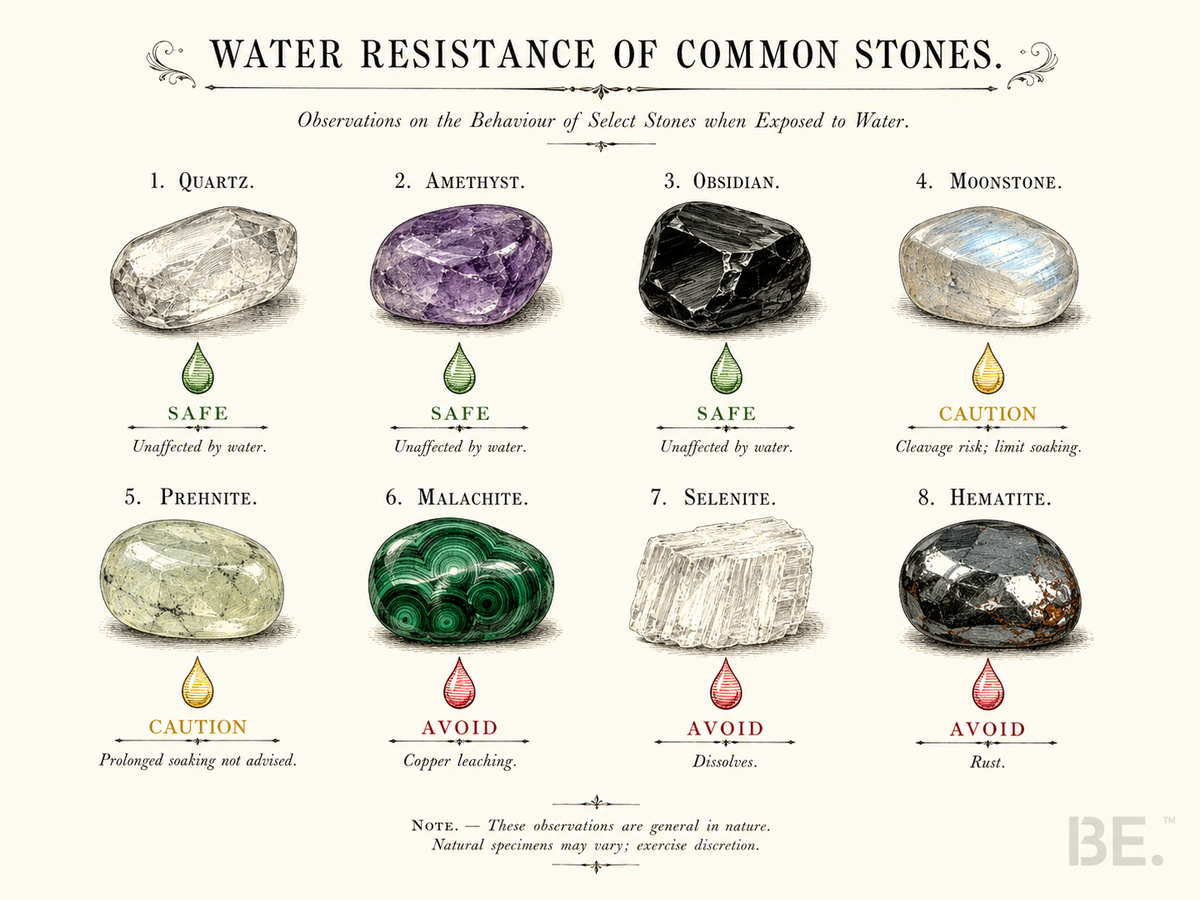
Stone-by-stone shower screening: material is only one component
| Stone | Mohs | Porosity | Bare stone: cleaning only | Notes |
|---|---|---|---|---|
| Clear quartz | 7 | None | Warm soapy cleaning | Generally stable for brief cleaning with warm soapy water; assess treatments, fractures and the rest of the piece separately. |
| Amethyst | 7 | None | Warm soapy cleaning | Warm soapy water is generally suitable; prolonged intense light can fade some colour independently of whether the stone is wet. |
| Rose quartz | 7 | None | Warm soapy cleaning | Pink pigment can pale under prolonged UV, not water. |
| Citrine | 7 | None | Warm soapy cleaning | Warm soapy cleaning is generally suitable; treatment status does not create blanket shower permission for the finished piece. |
| Smoky quartz | 7 | None | Warm soapy cleaning | Colour is associated with irradiation-related centres in quartz; use warm soapy water for cleaning and avoid prolonged heat or intense light. |
| Rutilated quartz | 7 (quartz) / 6-6.5 (rutile needles) | None | Warm soapy cleaning if intact | Enclosed rutile needles are shielded by the quartz host; assess surface-reaching fractures and the bracelet construction separately. |
| Hematoid quartz | 7 | None | Warm soapy cleaning if intact | Enclosed iron-oxide inclusions are shielded by the quartz host; assess exposed material or surface-reaching fractures separately. |
| Garnet | 6.5-7.5 | None | Warm soapy cleaning | Warm soapy cleaning is generally suitable; rinse residue away and assess the stringing and fittings separately. |
| Obsidian | 5-5.5 | None | Brief gentle cleaning | Volcanic glass is softer than quartz; use gentle cleaning, avoid abrasion and assess the whole bracelet construction. |
| Aquamarine | 7.5-8 | None | Warm soapy cleaning | Warm soapy cleaning is generally suitable; fracture-filled stones and the bracelet fittings require separate care. |
| Moonstone | 6-6.5 | Low-moderate | Warm soapy cleaning only | Cleavage planes; repeated thermal shock can promote cracking along them. |
| Opal | 5.5-6.5 | 3-21% water | Warm soapy cleaning only | Warm soapy water is the recommended cleaning method; high heat or sudden temperature change can cause fracture or crazing. |
| Turquoise | 5-6 | High (porous) | Warm soapy cleaning with care | Chemicals, cosmetics, skin oils and high heat can discolour turquoise; use warm soapy water only for controlled cleaning. |
| Lapis lazuli | 5-5.5 | Moderate | Warm soapy cleaning with care | Warm soapy water is the safest cleaning method; test first because dyes, waxes or oils may be unstable. |
| Malachite | 3.5-4 | Low | Avoid routine water exposure | Copper carbonate. Soft, and dust from polishing is mildly toxic — keep out of water and away from skin if damaged. |
For the Obsidian row, Obsidian surface care and handling separates glass-surface cleaning, storage and impact risk from bracelet-construction care.
What hot water actually does to quartz
Quartz (SiO2) is commonly cleaned with warm soapy water, but this does not make every finished quartz bracelet shower-safe. Sudden temperature changes can fracture quartz varieties such as amethyst, and treatments, existing fractures, stringing and fittings need their own care assessment. The alpha-to-beta inversion temperature does not establish a practical shower threshold for jewellery.
Abrupt temperature changes can fracture amethyst and some other gems, particularly when an existing fracture or inclusion reduces toughness. A domestic shower does not justify predicting a cycle count or calling failure rare; the practical rule is to avoid sudden temperature shifts and remove finished jewellery before showering.
The amethyst-in-sunlight exception
Amethyst colour comes from trace iron (Fe3+ or Fe4+) in defect sites in the quartz lattice, activated by natural background radiation over geological time. Some amethyst can fade after prolonged exposure to intense light, and abrupt temperature changes can cause fracture. Warm soapy water is generally suitable for cleaning, but water has not been shown here to intensify light-driven colour loss. Dry the bracelet with a soft cloth and keep it away from prolonged intense light.
Construction matters: elastic cord, steel wire and fittings
Elastic cord is one construction used in crystal bracelets, but it is not universal. Current BE. products include both elastic-cord designs and stainless-steel-wire designs with magnetic clasps. For elastic cord, water, products and repeated tension are relevant care factors; for a wire-and-clasp bracelet, inspect the wire, terminals and clasp instead.
- Heat. Heat can affect elastomer performance, but this article has no verified test record that quantifies the effect of a 40 °C shower on service life. Remove elastic-cord jewellery before showering rather than relying on a temperature threshold.
- Oil and surfactant. Shampoo, conditioner and body wash can leave residue on cord, knots, wire terminals and clasp seams. Remove the piece before showering and follow the current product specification for cleaning.
- Repeated tension cycles. Repeated stretching is normal wear for elastic cord. Water exposure can add handling and product residue; service life still depends on the specific cord, construction and wear pattern.
No verified BE. studio record establishes a universal calendar interval for stretch cord. Inspect it rather than relying on a month range. Loss of recovery, thinning at the knot or visible fraying are reasons to stop wearing and restring. Removing a bracelet before water reduces avoidable exposure to soap, heat, salt and tension. Service timing depends on the specific cord, construction and wear pattern.
BE. recommendation
Current BE. Strand construction varies by product. Some designs use stainless-steel wire with a magnetic clasp; others use elastic cord. The safest recommendation for the finished piece is the same regardless of stone:
- Take it off for showers and swimming. A stone may tolerate brief cleaning, but the finished piece also includes stringing, terminals and fittings. Removal reduces avoidable exposure without claiming a fixed lifespan multiplier.
- Rinse cool, dry in shade. After incidental exposure, follow the current product specification. Where rinsing is permitted, use lukewarm water, remove residue, dry with a soft cloth and do not soak clasp seams or terminals.
- Inspect the construction. For elastic cord, stop at visible thinning, fraying or loss of recovery. For steel wire, stop at a kink, exposed strand, displaced terminal or unreliable clasp.
The pieces described here are listed in the BE. collection, and every strand ships with a Stone Origin Record that states its lot, its four Crystal 4T™ readings and what those readings do not claim.
Frequently asked questions
Q1.Can I shower with a quartz bracelet every day?
Remove the finished bracelet before showering. Quartz may be suitable for brief cleaning with warm soapy water, but treatments, fractures, elastic cord, steel wire, terminals and clasps can set a stricter limit. Cord service life varies with material, construction and wear.
Q2.What about swimming in chlorinated or salt water?
Remove the whole piece before swimming. Chlorinated or salt water can leave residue on cord, wire terminals and clasp seams, and stone treatments or existing fractures may require stricter care. Rinse only where the current product specification permits it, then dry fully.
Q3.Why do some bracelets warn against water specifically?
Because care is set by the most sensitive part of the finished piece: stone toughness, treatment, surface-reaching fractures, elastic cord, steel wire, adhesives, terminals or clasp. Mohs hardness and mineral family alone do not decide shower wear.
Q4.Does soap damage crystal beads?
Warm water with mild soap is a standard cleaning method for many untreated gems, including quartz, garnet and aquamarine. Treatments, existing fractures and the assembled bracelet can require stricter care. Avoid harsh chemicals, steam or ultrasonic cleaning unless the material and treatment are known to permit them.
Q5.How do I dry a bracelet that has been in water?
Pat the piece with a soft, lint-free cloth and dry it fully away from prolonged intense light or direct heat. Prolonged intense light can affect some colours, but a wet stone is not assumed to fade faster. Check elastic cord for loss of recovery and steel wire, terminals and clasps for damage or trapped residue.
Q6.How often should a stretch-cord bracelet be restrung?
Restring on condition, not on a calendar. Stop wearing and restring when elastic cord shows visible thinning, fraying or loss of recovery. A steel-wire bracelet follows different signs: kinks, exposed strands, displaced terminals or an unreliable clasp.
References
- Mindat — Quartz mineral data
- GIA — Rose quartz care and cleaning
- Wikipedia — Mohs scale of mineral hardness
- BE. — Crystal 4T grading system
- BE. — Geological Codex
- Webster, R. (2002). Gems: Their Sources, Descriptions and Identification, 5th ed. Butterworth-Heinemann.
- Schumann, W. (2009). Gemstones of the World, 4th ed. Sterling.
Field Notes.
One stone at a time: its geology, and how to read quality. The Stone Buying Checklist comes with your first email.
By subscribing you agree to receive emails from BE. Unsubscribe anytime.
Sent. Check your inbox.