
AAA, AA, A Crystal Grading Explained (And Why BE. Uses Crystal 4T)
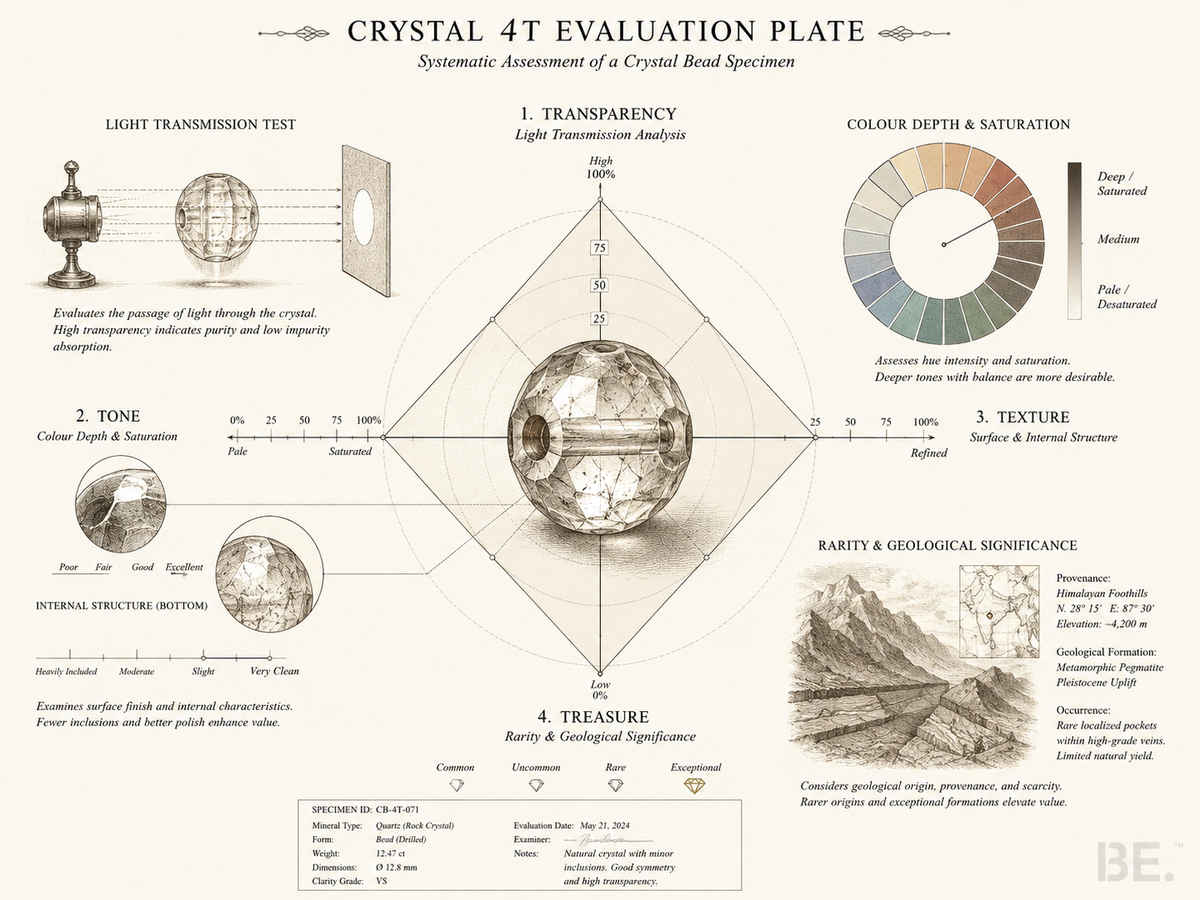
AAA crystal grading is not standardised. BE. uses Crystal 4T (Transparency, Tone, Texture, Treasure) on a 1-5 scale with Studio, Signature, Heritage tiers.
In this field note
The crystal jewellery trade runs on a grading language nobody owns. Walk through any wholesale market or scroll any marketplace and you will see the same stone labelled A, AA, AAA, AAAA, AAAAA, sometimes "5A premium" or "6A collector". The letters look authoritative. They are, in practice, copywriting.
This guide explains why crystal grading was never standardised, how the A-letter system tends to drift in shops that use it, what BE. uses instead (the 4T framework — Transparency, Tone, Texture, Treasure on a 1-5 scale), and how to read either system as a buyer.
Why crystal grading was never standardised
Diamonds have the GIA 4C — Carat, Cut, Clarity, Colour — established 1953, with published rubrics, calibrated master stones, and certified graders. Diamonds are colourless, monocrystalline, near-uniform, and trade at high enough price per gram that the cost of certification is small relative to the stone.
Coloured stones — and crystal beads specifically — are the opposite. Each species (amethyst, rose quartz, citrine, rutilated quartz) has different optical signatures, different inclusion vocabularies, different colour ranges. A grading system that worked for diamond clarity would not capture what makes one rutilated quartz strand a museum object and the next one mediocre — needle density, needle colour, the geometry of the inclusion array.
GIA does grade some coloured stones individually (sapphire, ruby, emerald) but the grades are descriptive paragraphs, not letter tiers. There is no standardised letter grade for amethyst or rose quartz beads as a category.
The buying checklist puts this in one line: ask whether the seller publishes a standard, not what letter they use. See the BE. Stone Buying Checklist, section 6.
What is AAA quality — and why grade inflation happens
| Claim | What it usually means in shop A | What it usually means in shop B | Red flags |
|---|---|---|---|
| A grade | Lowest tier sold | Bottom 60% of all material | Often heavily included, dull polish |
| AA | Middle | Top 50% | Inconsistent inclusion sorting |
| AAA | Top tier sold | Top 30% | "AAA" is shop A's ceiling but shop B's middle |
| AAAA / 4A | Above the previous ceiling | Top 10% | Letter added when shop introduces a higher tier |
| AAAAA / 5A / "premium" | Marketing language | Top 3% | No external reference; entirely shop-defined |
The drift is structural rather than dishonest. When a shop wants to introduce a higher tier, it adds an A. When a competitor's "AAA" looks similar to its own "AA", it relabels. The letter ladder always inflates upward because the ceiling is open. Without a third party to anchor what "AAA amethyst" actually means in measurable terms, the grade is whatever the shop decides it is.
None of this means a shop using AAA is mislabelling — within that shop, the grade may be internally consistent. The problem is cross-shop comparison. Two stones marked AAA from two sources cannot be reliably compared on the letter alone.
Crystal 4T — the BE. framework
BE. uses a four-axis observable framework called Crystal 4T. Each axis is independently scored 1-5 based on what can be observed under standard daylight and 10x loupe:
- Transparency. How much light passes through the stone. Fully translucent or transparent (5) to fully opaque (1). For quartz family, transparency reads as depth.
- Tone. Saturation and consistency of colour across the bead. A 5 is even, fully saturated, no zoning. A 1 is patchy, washed out, or zoned.
- Texture. Surface and internal character — polish quality, inclusion sorting, freedom from fracture. A 5 is mirror polish, well-sorted inclusions, no surface chip. A 1 is dull polish, mixed inclusions, visible surface flaws.
- Treasure. How difficult the material is to obtain at this quality, in this bead size and this colour. A 5 depends on a particular find and cannot be replaced at the same standard; a 3 is readily available at this quality.
| Tier | Rule | Description |
|---|---|---|
| Studio | Transparency, Tone and Texture >= 3; at least one below 4 | Clean, well-finished daily wear. The everyday standard. |
| Signature | Transparency, Tone and Texture >= 4; at least one below 5 | Studio output where every axis is strong; the visual character is composed across all four. |
| Heritage | Transparency, Tone and Texture = 5, and Treasure = 5 | Collector grade. Each strand is a finished object; supply is limited by what the material itself provides. |
| Rejected | Transparency, Tone or Texture <= 2 | Returned to supplier. Also rejected: dyed, heated (except declared natural-citrine heat conversion with disclosure), post-irradiated, chemically enhanced. |
The structural rule is weakest-link governs. A stone at 5 on Transparency and Tone but 3 on Texture is Studio, not Signature; Treasure does not lower the tier, it is the extra condition for Heritage. This is the opposite of letter grading, where a single strong characteristic often pulls the whole grade up. 4T forces the weakest axis to be visible.
How to use 4T as a buyer
You do not need BE. to use the framework. When evaluating any crystal bracelet, ask the four questions yourself:
- Transparency. Hold the strand against a soft light. Does light pass through evenly, or do some beads block it while others are clear?
- Tone. Look across the strand in daylight. Is the colour even bead-to-bead, or does it shift toward grey, brown, or washed-out zones?
- Texture. Run a finger over the beads. Does the polish read uniform? Are inclusions sorted (similar character per bead) or mixed (every bead looks like a different stone)?
- Treasure. How hard would it be to find another strand of this stone at this quality, size and colour? Ask the seller how often material like this comes in, and whether a sold-out lot can be replaced.
A strand strong on all four axes is rare and priced accordingly. A strand strong on three and weak on one is what most well-sorted commercial material looks like. A strand weak on more than one axis is overpriced at any tier label.
What 4T does not try to be
4T is not an industry standard. It is a transparent in-house framework. It does not certify provenance — that is the role of the Stone Origin Record, where BE. records country and region of origin per strand. It does not measure rarity at the species level — a Heritage rose quartz and a Heritage hematoid quartz are not equivalent objects, only equivalently graded within their species. And it does not claim to predict resale value, which depends on market dynamics outside of any grading rubric.
What it does do is name the four observable variables and force the buyer's attention onto each one separately. The letter-grade system collapses everything into one number; 4T keeps the components visible so the buyer can decide which axis matters most for the piece in hand.
Frequently asked questions
Q1.What does AAA mean for crystals?
AAA usually means a seller's higher tier for crystals or beads. It is not a regulated cross-shop grade: each seller defines the threshold, so two AAA labels are not directly comparable. Treat the label as a claim to examine, not as a certificate.
Q2.How is Crystal 4T different from AAA grading?
4T has four independent axes (Transparency, Tone, Texture, Treasure) each scored 1-5, with a published rubric and a weakest-link rule that prevents one strong axis from masking a weak one. A-grade systems collapse everything into a single letter, with no published rubric and no independent score per axis.
Q3.What does "weakest-link governs" actually mean in practice?
If a stone scores 5 on Transparency and Tone but 3 on Texture, its tier is Studio (not Signature), because the weakest material axis is 3. The framework refuses to average. A genuinely Signature strand must clear 4 or above on Transparency, Tone and Texture; a Heritage strand must clear 5 on all three and 5 on Treasure. This makes the lower tiers harder to inflate.
Q4.Is AA grade or AAA grade crystal better?
Within one seller's own scale, AAA is usually placed above AA. Across sellers, the letters alone do not establish which crystal is better because the thresholds are not shared. Compare the material, bead-to-bead consistency, finish, and treatment or origin disclosure.
Q5.Why doesn't GIA grade crystal beads like diamonds?
GIA's 4C system was built for transparent, near-uniform monocrystalline diamond. Coloured stones each have their own optical character and inclusion language; GIA grades some species individually (sapphire, ruby, emerald) but uses descriptive paragraphs, not letter tiers. Crystal beads as a category have no equivalent system because the variation across species is too wide for a single rubric.
Q6.Can I verify a 4T grade independently?
The four axes are observable in daylight with a 10x loupe — Transparency, Tone, Texture, and Treasure all assess visible properties. A buyer can score the four axes themselves and compare to the BE. tier rule. The framework is published and reproducible, which is what differentiates it from a closed letter grade.
Q7.AAA vs AAAA: does another A mean better quality?
Only within the same seller's defined scale, and only if that seller publishes a real distinction. There is no uniform institution that makes AAAA objectively better than AAA across shops; AAAAA extends the same open-ended ladder rather than adding independent evidence.
References
- GIA — Colored stone grading
- Mindat — Quartz
- Wikipedia — Gemstone grading
- BE. — Crystal 4T grading system
- BE. — Geological Codex
- BE. — Our Story
- Read, P. (2008). Gemmology, 3rd ed. Butterworth-Heinemann.
- Webster, R. (2002). Gems: Their Sources, Descriptions and Identification, 5th ed. Butterworth-Heinemann.
Field Notes.
One stone at a time: its geology, and how to read quality. The Stone Buying Checklist comes with your first email.
By subscribing you agree to receive emails from BE. Unsubscribe anytime.
Sent. Check your inbox.