
Do Crystals Fade in Sunlight? Which Stones Change — and Why It Isn't a Flaw
Which crystals fade in sunlight and which don't, why colour-centre stones like amethyst pale while included stones hold, and how to slow it, or let it be.
In this field note
A handful of stones really do lose colour in sunlight over time. Most don't. The difference comes down to where each stone's colour is stored.
The table below sorts every BE. stone into fades or holds and gives the reason for each. For water and showering, see the shower guide.
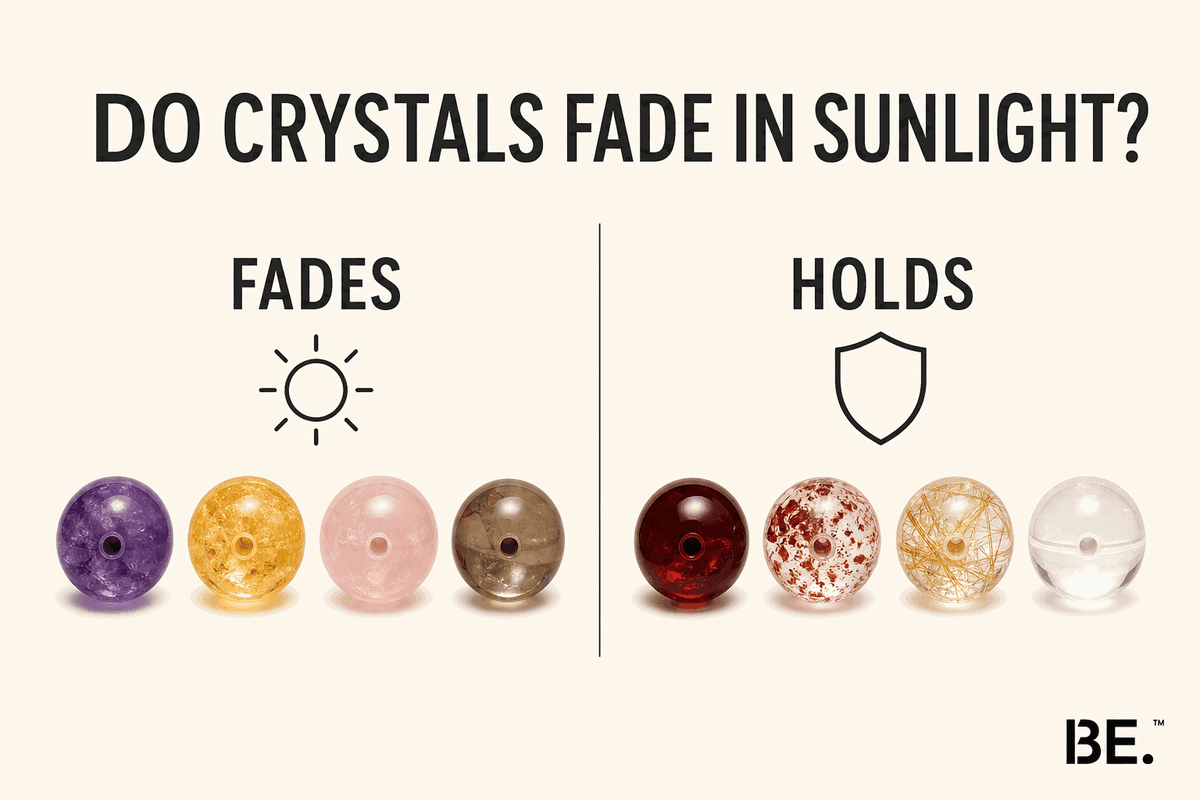
Which crystals fade in sunlight, and which don't?
Read the table by the last two columns. Stones marked Yes can pale after long, direct sun, so keep them in a drawer or pouch between wears. Stones marked No keep their colour in daylight.
| Stone | Series | Where the colour comes from | Fades in sun? |
|---|---|---|---|
| Amethyst | Void | Iron colour centre + natural irradiation | Yes, slowly |
| Citrine | Prism | Colour centres; the cause varies between specimens | Some can pale after long, direct sun |
| Rose quartz | Flow | Tiny pink mineral fibres inside the quartz | Yes, after long, direct sun |
| Smoky quartz | Anchor | Radiation-induced colour centre in aluminium-bearing quartz | Yes, slowly, after long UV exposure |
| Blue smoky quartz | Void | Tiny particle inclusions inside the quartz that scatter light blue | No |
| Super Seven | Void | May include amethyst and smoky zones | Prolonged strong light can pale some amethyst zones |
| Garnet | Anchor | Iron in a stable crystal framework | No |
| Hematoid quartz | Prism | Iron-oxide inclusions inside quartz | No |
| Rutilated / green rutilated quartz | Prism | Rutile needle inclusions; green needles can be actinolite or another mineral | No |
| Green phantom quartz | Prism | Chlorite mineral inclusions | No |
| Phantom quartz | Flow | Included growth boundaries | No |
| Clear quartz | Flow | No colour centre; colourless | No |
| Aquamarine | Flow | Iron in beryl | Largely stable; avoid intense prolonged heat |
| Moonstone | Flow | Adularescence, an optical effect | No (handle for softness, not light) |
| Prehnite | Flow | Iron in the silicate | Mostly stable; can pale a little |
| Kyanite | Void | Trace elements in a stable structure | No |
| Gold sheen obsidian | Anchor | Optical sheen from tiny inclusions in glass | No |
For water and cleaning next to light, stone by stone, see the full care chart.
Why do some crystals fade?
Amethyst, citrine and smoky quartz take their colour from colour centres: a trace of iron or aluminium inside the quartz that absorbs part of the light. In amethyst and smoky quartz, natural radiation over geological time switched those sites on. Long, strong sunlight can switch some of them off again, and the colour pales. Rose quartz is coloured by tiny pink fibres, yet it can also soften after long, direct sun.
How fast this happens differs from stone to stone. For smoky quartz, one GIA light and heat study reported no significant fading in the material tested, while Mindat reports paling after prolonged UV; see Smoky Quartz and natural radiation.
Stones that hold their colour store it differently. Hematoid quartz is red because it has iron-oxide minerals trapped inside the silica; rutilated quartz shows gold needles of rutile; green phantom quartz has chlorite sealed in layers. They are solid minerals sealed inside the quartz, and sunlight does not change them. The blue in blue smoky quartz comes from tiny particles inside the quartz that scatter light, so it holds too. Garnet's iron sits in a dense, stable crystal framework, which is why a garnet holds its deep red through decades of wear.
Is a faded crystal ruined?
No. The bead is just as hard and just as polished as before; only the colour is lighter.
Raw denim starts out dark and stiff and, over a couple of years, fades exactly where the body creases it: the knees, the seat, the line where a wallet sits. Nobody calls that damage. It is the reason people buy raw denim in the first place. Leather does the same. A good pair of boots or a plain leather watch strap darkens and softens with use, and people prize that patina.
A colour-centre stone worn in daylight for years changes in the same way: the violet softens or the brown lightens. If you would rather keep the colour as it arrived, keep the bracelet out of long, direct sun.
How to slow it down, if you want to
It comes down to where the bracelet sits when you are not wearing it. Ordinary wear is a shorter, cooler exposure than a summer on a windowsill.
- Don't store it in the light. The effect adds up over time, so where a bracelet spends its off hours matters more than the hour it is worn. A drawer, a pouch or a box keeps the clock stopped. See how to store crystal bracelets.
- Skip the sunlit ledge. Leaving a colour-centre stone on a sunny windowsill is an easy way to fade amethyst without meaning to.
- Dry in shade. If a bracelet has been in water, dry it on a cloth out of direct sun.
How BE. records it
Every BE. strand ships with a Stone Origin Record that names the stone, its treatment and its colour source, so you know from the start whether the colour sits in a colour centre or an inclusion, and whether to keep it out of long sun. Crystal 4T™ reads Transparency, Tone, Texture and Treasure. Tone covers how deep and even the colour is in each bead and how well it matches along the strand; a stone that can pale in sun and one that holds can both read Exceptional.
Frequently asked questions
Q1.Does amethyst fade in sunlight?
Yes, slowly. Amethyst's violet comes from an iron colour centre that ultraviolet light can reverse over long spells of direct sun, drifting the colour toward grey or pale. Kept out of long, direct sunlight, it stays as it was.
Q2.Which crystals fade in the sun?
Amethyst, citrine, smoky quartz and rose quartz can pale after long, direct sun, and so can the amethyst zones in Super Seven. Garnet, hematoid quartz, rutilated quartz, phantom quartz, blue smoky quartz and clear quartz hold their colour.
Q3.Does rose quartz lose its colour?
It can pale under prolonged UV. Water and normal wear don't affect it; long stretches on a sunny windowsill do. Store it out of direct light and the pink holds.
Q4.Can a faded crystal get its colour back?
Not at home. The change is a shift in the stone's colour centres, and reversing it needs conditions you can't recreate on a wrist. The practical answer is prevention: keep the fade-group stones out of long, direct sun.
Q5.Is it bad to wear a crystal that fades?
Not at all. A slight softening of colour over years is a record of wear, like the fade in raw denim or the patina on leather. You can prevent it with shade and storage, but a stone that drifts isn't damaged; it is the same stone with a lighter colour.
Q6.How do I stop my crystal bracelet fading?
Store it out of the light when you're not wearing it, avoid leaving it on sunlit windowsills, and dry it in shade after water. Everyday daylight is fine; it's sustained, direct exposure that adds up.
Q7.Does agate fade in sunlight?
Agate is chalcedony, and its light stability depends on what creates the colour and whether it has been dyed. GIA notes that chalcedony is commonly dyed and that some dyes can fade under prolonged sunlight. Keep a dyed agate strand off sunny windowsills.
Q8.Does morganite fade in sunlight?
According to GIA, morganite's colour is stable under light exposure and is not expected to fade in ordinary wear. Avoid high heat, and follow any separate care instructions if a coating or other treatment is disclosed.
References
- Mindat: Quartz mineral data
- GIA Gem Encyclopedia: Quartz
- Wikipedia: Colour centre (F-centre)
- Nassau, K. (2001). The Physics and Chemistry of Colour, 2nd ed. Wiley.
- Rossman, G. R. Mineral Spectroscopy (Caltech), colour-centre references.
Field Notes.
One stone at a time: its geology, and how to read quality. The Stone Buying Checklist comes with your first email.
By subscribing you agree to receive emails from BE. Unsubscribe anytime.
Sent. Check your inbox.