
How Amethyst Turns Violet: Transformations in the Dark
Amethyst is violet quartz formed through trace iron, natural radiation and time. A geology-first note on colour centres, care, safety and amethyst jewellery.
In this field note
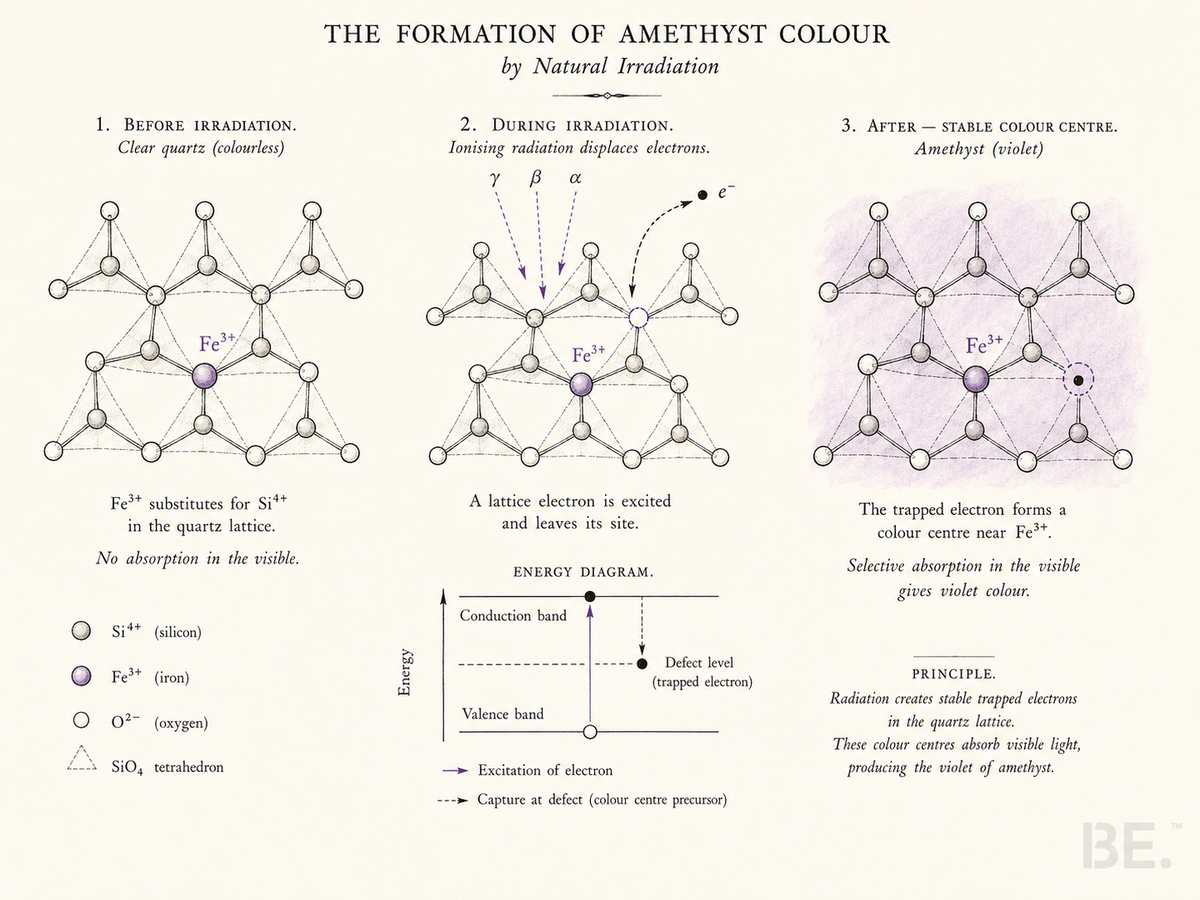
The mechanism is not mystical. It is a precise convergence of iron, quartz structure, background radiation and time. None of those conditions alone produces amethyst. Together, they turn ordinary quartz into violet quartz.
Why is amethyst purple? Three conditions behind violet
The first condition is trace iron. Very small amounts of Fe3+ must enter the silicon dioxide lattice during crystal growth, substituting at specific sites in the structure. The concentration can be tiny, measured at levels that would be invisible without the later colour effect.
The second condition is natural radiation. In many amethyst-bearing environments, gamma radiation comes from the decay of potassium-40, uranium and thorium in surrounding rock. This is background geological radiation, not reactor radiation and not a stored danger in the finished stone. It changes electronic arrangements in iron-related centres inside quartz.
The third condition is time. Over long geological periods, those altered centres absorb yellow-green wavelengths and transmit violet. The colour is therefore a state produced inside the crystal structure, not pigment painted onto the surface.
Where amethyst grows
Amethyst often forms in cavities inside volcanic basalt, where agate and chalcedony line the walls and quartz crystals grow inward. The environment is closed, dark and stable, with temperatures often discussed in the broad 50-250°C hydrothermal range. Crystals grow from the cavity wall toward the centre, and their colour develops without light ever entering the space.
Important amethyst localities include the Anahí mine in Bolivia, the Artigas region of Uruguay and Rio Grande do Sul in Brazil. Anahí is not a Cretaceous basalt-flow deposit: GIA describes amethyst and ametrine in quartz veins hosted by dolomitic limestone. The mine name supports provenance only when the offered lot is documented.
Colour can be changed by heat
Amethyst colour centres are sensitive to heat. Heating can shift purple quartz toward colourless, green or yellow-to-orange results depending on the starting material and treatment conditions. This is why some commercial citrine is heat-treated amethyst, but there is no universal 400-500°C range in which every specimen makes the same transition.
For jewellery, this matters in two ways. First, amethyst should be kept away from prolonged strong sunlight and high heat, because colour can fade. Second, darker purple is not automatically better. Strong amethyst needs colour depth, but also clarity, balance, zoning and a cut that keeps the violet alive.
How BE. chooses amethyst
BE. selects amethyst for depth without muddiness. The stone should feel crystalline, not flat; saturated, not opaque. Some people prefer concentrated violet, others prefer a lighter and airier purple. Colour is one dimension of quality, not the only dimension.
For more amethyst context, see Amethyst Complete Guide.
Frequently Asked Questions
Is amethyst radioactive?
No. Natural radiation helped form the colour underground, but the finished amethyst is not a radiation hazard in ordinary jewellery wear.
Why is amethyst purple?
Trace iron in quartz is altered by natural radiation, creating colour centres that absorb yellow-green light and transmit violet.
Is darker amethyst always better?
No. Darker colour can feel more dramatic, but clarity, evenness, cut, internal life and personal preference also matter.
Can amethyst fade?
Yes. Prolonged intense sunlight or high heat can weaken colour, so careful storage away from harsh light is recommended.
References
- GIA 4Cs: Amethyst, a Variety of Quartz: colour-mechanism overview.
- GIA Gems & Gemology: Boudi Amethyst Notes & Techniques: deposit-level characterisation.
- NRC: Backgrounder on Irradiated Gemstones: safety framing for irradiated material.
- BE. Crystal 4T Grading System: the four observable axes used to read a strand.
- BE. Geological Codex: material-level reference for the stones in the BE. catalogue.
Field Notes.
One stone at a time: its geology, and how to read quality. The Stone Buying Checklist comes with your first email.
By subscribing you agree to receive emails from BE. Unsubscribe anytime.
Sent. Check your inbox.