
Are Crystals Ethically Sourced? Honest Supply Chain
Ethical sourcing is not a property inside a crystal. It is a scoped, continuing process that must separate verified facts, candidate claims, limited evidence and unknowns.
In this field note
A yes-or-no answer is attractive because it is simple. The supply chain is not. A crystal can move from a mine through local buyers, exporters, cutters, drillers, component suppliers and a jewellery studio. Records may be strong at one stage and absent at the next.
Honest sourcing language therefore begins with scope. It states what is known, separates supplier assertions from independent evidence, keeps unknown fields visible and describes the work still required.
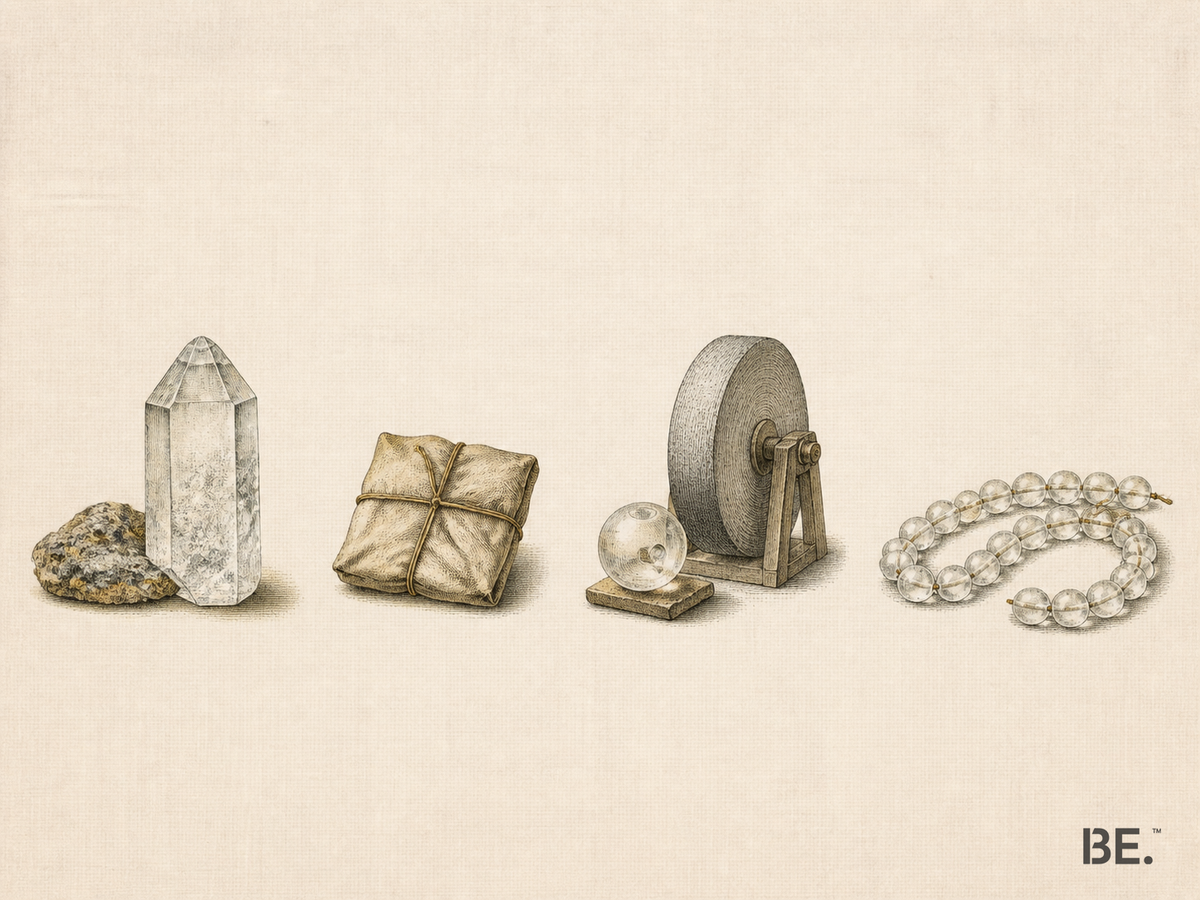
What “ethically sourced” must mean before it can be tested
| Term | What it can establish | What it does not establish |
|---|---|---|
| Origin or provenance | A documented geographic or transactional history, at the resolution the record supports. | Fair labour, safe work, environmental management or an unbroken chain. |
| Traceability | The ability to follow information through named stages or transactions. | That every traced practice was responsible. |
| Chain of custody | Rules and records for transferring material or claims between parties within a defined scope. | Issues outside that material, entity, facility, period or standard. |
| Risk-based due diligence | An ongoing process to identify, assess, prevent or mitigate, track and communicate risk. | A risk-free supply chain or a permanent pass. |
| Certification | Conformity of a named entity or activity to a named standard, scope and date. | Automatic certification of every gemstone sold by that organisation. |
The W4 Origins Map owns the distinction between occurrence, source claim, provenance and traceability. This guide begins where geography stops: origin is one evidence field, not an ethical verdict.
Why coloured-stone supply chains are difficult to verify
Coloured stones often pass through fragmented networks of small and large operators, traders and processing workshops. Parcels can be split, combined, recut or relabelled. Cutting and drilling may take place in a different country from extraction, and the chain for metal components may be separate again.
This complexity does not make every small-scale mine or trader irresponsible. Artisanal and small-scale mining can support livelihoods and local economies. It does mean that a country name or supplier relationship cannot substitute for a risk assessment. Evidence has to follow the actual route and the actual risks.
A mine-to-wrist evidence ledger
| Stage | Evidence to request | Risk areas | What the evidence cannot prove alone |
|---|---|---|---|
| Mine or extraction site | Operator and location; licence or permit where applicable; dated labour, safety, community and environmental records. | Forced or child labour, unsafe work, land or water impact, community harm, corruption. | Conditions at a cutter or later trader. |
| Local buyer, trader or exporter | Invoices, lot continuity, counterparty identity, risk screening and discrepancies. | Mixing, laundering of origin claims, bribery, broken records. | That an upstream mine met every standard. |
| Cutting, drilling and polishing | Facility identity, lot receipt, treatment disclosure, worker-safety controls and corrective records. | Silica dust, machinery, wages and hours, loss of lot identity. | Upstream extraction conditions. |
| Components and metals | Material specification, supplier and any standard-specific documentation. | Separate metal and plating risks, unsupported recycled-content claims. | Gemstone chain of custody. |
| Brand or studio | Supplier policy, risk assessment, lot record, follow-up, remediation and public boundary. | Overstated marketing, stale evidence, missing escalation. | Independent audit unless one was actually performed. |
BE.’s current open ledger: fact, candidate, limited and unknown
This is a disclosure of the evidence available to this article, not a third-party audit of BE. suppliers or products.
| Status | Current statement or field | What it supports | Boundary |
|---|---|---|---|
| Fact | BE.’s current public ethos states that some materials can be verified only to a region or supplier-documented lot, that an unsupported mine will not be named, and that unknown is a valid field. | The existence of that published disclosure boundary. | It does not prove mine-level conditions or the performance of a supplier. |
| Candidate claim | Public wording about supplier vetting, environmental responsibility, fair labour and due diligence. | A claim to evaluate against dated policy, questionnaires, risk screening, follow-up, corrective action, audits or equivalent records. | The wording itself is not an audit finding. |
| Limited evidence field | Lot ID, country or region, and natural or untreated status when recorded for an exact product. | Lot continuity, a geographic claim or treatment disclosure at the stated resolution. | These fields never automatically become labour, environmental, governance or whole-chain proof. |
| Unknown | Complete mine and operator evidence, every cutting facility, labour and occupational-safety checks, environmental permits or remediation, uninterrupted transactions, independent audit scope and grievance or remedy records for every lot. | A visible evidence gap. | Unknown means neither “nothing happened” nor “already verified.” |
The same boundary applies to a product page or Our Ethos: it can publish the brand’s record and its limit, but it cannot act as independent proof of its own claims.
Where BE. stops
BE. writes origin on the Stone Origin Record as far as the record behind the lot reaches. When a lot can be traced to a mine or a deposit, the record names it. When it can be traced to a country or a region, the record gives that. When there is no traceable record behind a lot, the origin line is left blank.
Each piece ships with a lot number and a Stone Origin Record: lot and piece ID, four Crystal 4T™ readings scored 1 to 5 with the lowest reading setting the tier, the treatment declaration, and the origin as recorded.
How responsible-sourcing progress works
OECD guidance describes a continuing process rather than a one-time label. In practical terms, a small jewellery business can:
- Set management responsibility. Define the policy, evidence owner, escalation route and record-retention system.
- Identify and assess risk. Map suppliers and routes, then prioritise the most severe and likely human-rights, labour, environmental and governance risks.
- Respond to risk. Seek missing evidence, use corrective plans, pause or disengage responsibly where necessary, and record the decision.
- Use appropriate assurance. Check the exact entity, facility, material, standard, version, date and limits of any audit or certification.
- Report progress and gaps. Communicate what changed, what remains unknown, and how a concern can be raised and remedied.
No framework makes a supply chain risk-free. The test is whether the business can show a proportionate, ongoing process and measurable response instead of a blanket promise.
Six questions buyers can ask
- Which exact lot or product does this claim cover?
- How far back does the record go: country, region, supplier, exporter, mine or operator?
- Is this the supplier’s assertion, the brand’s due-diligence record or an independent audit?
- Which labour, safety, environmental and governance risks were assessed?
- What entity, material, facility, standard and date does a certificate cover?
- What remains unknown, and what is the next evidence or remedy step?
Frequently asked questions
Q1. Can crystals ever be fully traceable?
Some lots can be documented through many stages, but traceability has a defined scope and can stop at a trader, region or supplier record. A credible claim states the last verified point, the evidence owner and the date instead of turning a partial record into a whole-chain promise.
Q2. Does country of origin prove that a crystal was ethically sourced?
No. A country or region is a geographic field. Responsible sourcing also requires risk-based evidence about operators, labour, occupational safety, environmental and community impacts, transactions, controls and response. Those conditions can vary within the same country.
Q3. Does natural or untreated mean ethical?
No. Natural describes formation, and untreated describes the absence of stated enhancement. Neither term records wages, working conditions, environmental management, community impact, governance or chain of custody.
Q4. Does RJC certification guarantee an individual gemstone?
No. Certification must be read against the named entity, standard, facility, material scope and date. The current RJC Chain of Custody 2024 standard covers gold, silver and platinum-group metals, not a blanket chain-of-custody guarantee for crystals or coloured gemstones.
Q5. Is artisanal and small-scale mining automatically unethical?
No. It can support livelihoods and local economies, and it can also present serious labour, safety, environmental or governance risks. The responsible approach is to assess the actual context and impacts, not treat mine size as the verdict.
Q6. What should a brand say when sourcing evidence stops?
It should name what is known, the resolution and source of the record, what remains unknown, and the next due-diligence or remedy step. “Supplier-documented region; mine not verified” is more useful than a blanket assurance.
References
- OECD — Responsible mineral supply chains
- OECD — Five-step due-diligence guidance
- OECD — Environmental due diligence in mineral supply chains
- OHCHR — UN Guiding Principles on Business and Human Rights
- ILO — Fundamental principles and rights at work
- CIBJO — Responsible Sourcing Toolkit
- Responsible Jewellery Council — Standards
- Responsible Jewellery Council — Code of Practices
- Responsible Jewellery Council — Assurance
- GIA — Ethical issues and solutions in coloured gemstones
Field Notes.
One stone at a time: its geology, and how to read quality. The Stone Buying Checklist comes with your first email.
By subscribing you agree to receive emails from BE. Unsubscribe anytime.
Sent. Check your inbox.