
Why Quartz Is Everywhere
Quartz is widespread because of crustal chemistry, formation across several geological settings and relative persistence through weathering and recycling—not because free quartz exists in every rock.
In this field note
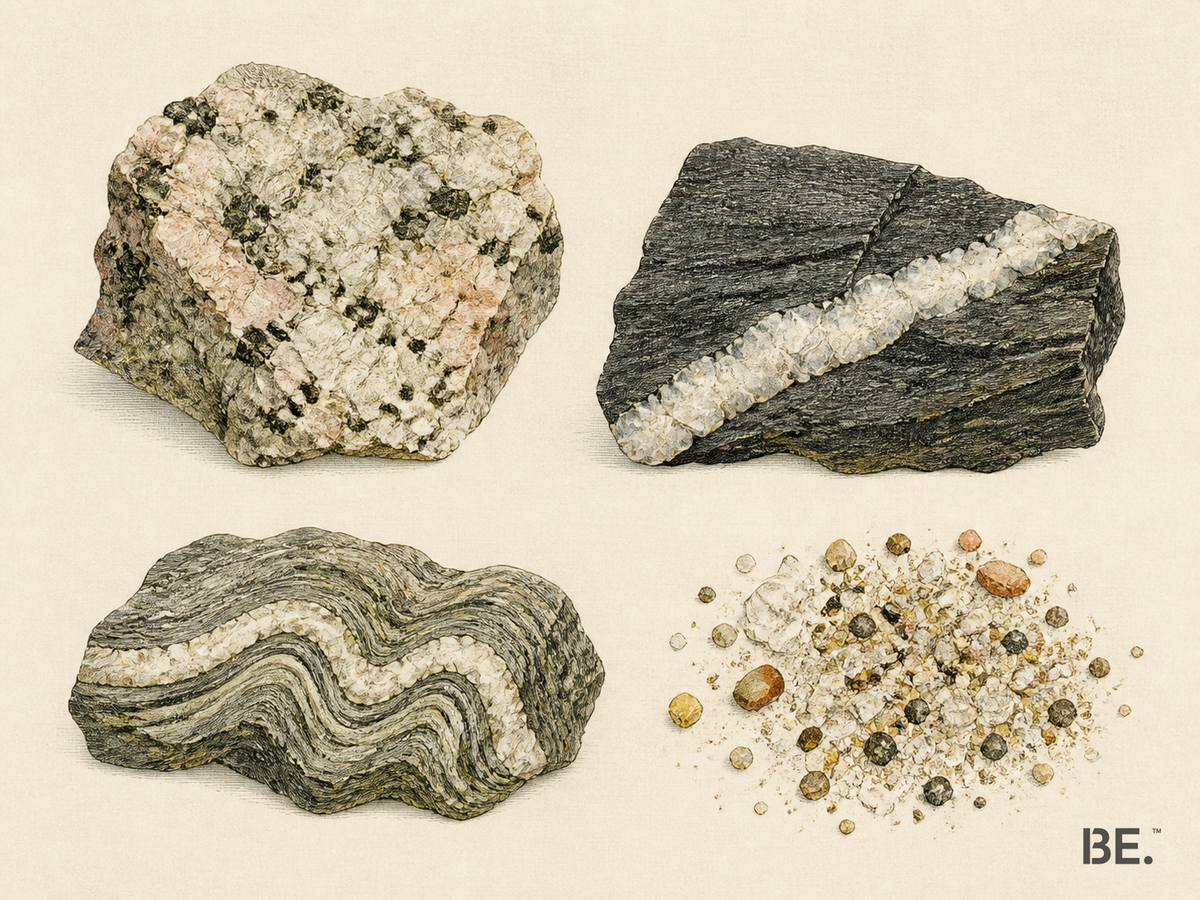
Quartz appears in granite, veins, metamorphic fabrics, sediments, soils and gemstones. That reach is not one simple abundance story. It is the combined result of crustal chemistry, crystallisation conditions and repeated survival through weathering, transport and burial.
The useful question is therefore not only “How much silicon is there?” It is “When does silicon and oxygen become quartz, where can that quartz grow, and why does it remain visible after other minerals change?”
Oxygen and silicon are only the start
A classic USGS compilation, drawing on an earlier estimate by Brian Mason, gives average crustal abundances of 46.60 weight per cent oxygen and 27.72 weight per cent silicon. These are historical whole-crust estimates, not fixed percentages for every rock, region or modern analytical model.
The figures explain why silicate minerals dominate much of the crust. Quartz is crystalline silicon dioxide, SiO2, so it draws on two exceptionally abundant elements. Yet an elemental inventory is only the starting material. It does not tell us which mineral structures those elements occupy.
Why abundant elements do not mean free quartz everywhere
Silicon and oxygen also occur in feldspars, micas, pyroxenes, amphiboles and many other silicate minerals. Which phases form depends on the complete chemistry of the system and on temperature, pressure, water activity and cooling or reaction history.
A basalt can be rich in silicate minerals and still contain little or no visible quartz. A silica-rich granite may contain obvious quartz alongside feldspar and mica. Silica can also occur as amorphous opal or as other SiO2 polymorphs before quartz becomes the stable form under later conditions. “Silica-rich” and “quartz-rich” are related, but they are not interchangeable claims.
Where quartz forms
| Geological setting | How quartz enters the record | What may be seen |
|---|---|---|
| Igneous | Quartz crystallises from sufficiently silica-rich melt as magma or lava cools. | Interlocking grains in granite, fine material in rhyolite, or late pockets and cavities. |
| Hydrothermal | Hot fluids transport dissolved silica; changes in temperature, pressure or fluid chemistry can cause it to precipitate. | Veins, cavity linings, crystal clusters and repeated growth zones. |
| Metamorphic | Existing silica-bearing material recrystallises, reacts or is mobilised during heat, pressure and deformation. | Quartz-rich layers, ribbons, veins and recrystallised mosaics. |
| Sedimentary and diagenetic | Older quartz survives erosion and transport, while dissolved silica may also form cement or overgrowths during burial. | Sand grains, sandstone frameworks, cements and recycled grains with older cores. |
These routes overlap across geological time. One grain can crystallise in an igneous rock, enter a hydrothermal fracture, survive erosion, become sand and acquire a later quartz overgrowth during burial. The Four Geological Ways Crystals Form guide owns the deeper process explanation.
Weathering persistence and geological recycling
Quartz is stable in many soil-forming environments and resistant to both chemical and physical breakdown relative to many companion minerals. Feldspars commonly alter toward clay minerals while quartz grains remain, so weathering and transport can increase the proportion of quartz in a sediment even without creating new quartz.
This is why quartz is common in many sands and sandstones. It is not why every sand is quartz. Sand is a grain-size category and can be made of gypsum, carbonate fragments, volcanic minerals, olivine or other materials depending on the source and environment. White Sands National Park, for example, is dominated by gypsum rather than quartz.
Why one formula can look so different
Pure quartz is colourless, but real crystals record their growth environment. Trace elements, lattice defects, natural irradiation, inclusions, tiny fluid or gas cavities, growth interruptions and microstructures can change colour, transparency and optical behaviour.
That is why SiO2 can appear as rock crystal, amethyst, smoky quartz, citrine, rose quartz, chalcedony and many inclusion-bearing materials. The Quartz Family Tree owns variety taxonomy; What Is a Gemstone Inclusion? owns the inclusion primer. A chemical formula identifies a framework, not the full visual history of a specimen.
Common does not mean low quality
“Common” describes frequency at a stated scale. “Quality” evaluates whether a specific specimen or finished object meets relevant criteria. Those are different axes.
- Global occurrence: quartz exists across many geological environments.
- Mineral presence: a rock or sediment contains quartz, sometimes only as small or intergrown grains.
- Gem rough: a piece has the size, integrity and visual properties needed for cutting.
- Matchable lot: enough material shares a controlled diameter, colour range, transparency and inclusion character.
- Finished jewellery: drilling, shaping, polish, assembly and disclosure meet the intended standard.
Abundance at the first step does not guarantee the later ones. A clear quartz bead can still be assessed for fractures, surface damage, polish, drilling, matching and treatment disclosure. See the Clear Quartz Gemstone Guide for the material-specific reading and Crystals Aren’t Magic—They’re Geology for BE.’s evidence boundary.
Frequently asked questions
Q1. Is quartz the most abundant mineral in Earth’s crust?
Quartz is one of the most abundant minerals in the crust, but “the most abundant mineral” is too simple without defining whether mineral groups are combined and which part of the crust is measured. Feldspar groups collectively make up a larger share in many standard descriptions.
Q2. If oxygen and silicon are abundant, why is quartz not in every rock?
Because those elements also occupy feldspars, micas, pyroxenes and many other silicate structures. Bulk chemistry, temperature, pressure, water and geological history determine which minerals form; abundant ingredients do not guarantee free quartz.
Q3. Why is quartz common in sand?
Quartz is relatively stable and resistant, so it often survives when feldspars and other minerals alter, break down or are removed during weathering and transport. Its proportion can therefore rise through recycling. Sand is a grain-size category, however, and not all sand is quartz.
Q4. Can quartz occur in all three major rock types?
Yes. It can crystallise in igneous systems, recrystallise or grow during metamorphism, and survive as detrital grains or form later cement in sedimentary rocks. The mechanism and texture differ among settings.
Q5. Does common quartz mean low quality?
No. Occurrence frequency is separate from the quality of a specimen, a matchable lot or a finished piece. Integrity, transparency or intended opacity, inclusion character, colour, cutting, drilling, polish, matching and disclosure must be assessed at the relevant scale.
Q6. Why do quartz varieties differ if they are all SiO₂?
The quartz framework can record trace elements, lattice defects, natural irradiation, inclusions, growth interruptions and microstructures. These features can change colour, transparency, texture and optical behaviour without changing the basic SiO₂ formula.
References
- USGS Professional Paper 440-D — Data of Geochemistry: Composition of the Earth’s Crust
- USGS Circular 1363 — The Life Cycle of a Mineral Deposit
- USGS — The hot and cold journey of silica
- USGS — Quartz in soils of the conterminous United States
- Smithsonian National Museum of Natural History — All Sorts of Quartz
- National Park Service — Sand
- National Park Service — Coastal Sediments: Parent Material
- National Park Service — Coastal Sediments: Sand Colors
- Mindat — Quartz mineral data
Field Notes.
One stone at a time: its geology, and how to read quality. The Stone Buying Checklist comes with your first email.
By subscribing you agree to receive emails from BE. Unsubscribe anytime.
Sent. Check your inbox.