
The Rarest Quartz Varieties—and Why No Single Ranking Works
No single global quartz rarity order is defensible. This guide separates natural-rarity wording, commercial-source concentration, treatment substitution and documented cases.
In this field note
A list of rare quartz can look precise while comparing unlike things. A natural colour may be scarce, a commercial supply may come mainly from one mine, and an inclusion pattern may be unusual in a particular report. None of those facts supplies the same denominator.
The useful answer is therefore not a podium. It is a method: name the material correctly, state which kind of scarcity is being discussed, show what the source actually documents, and leave incomparable claims side by side.
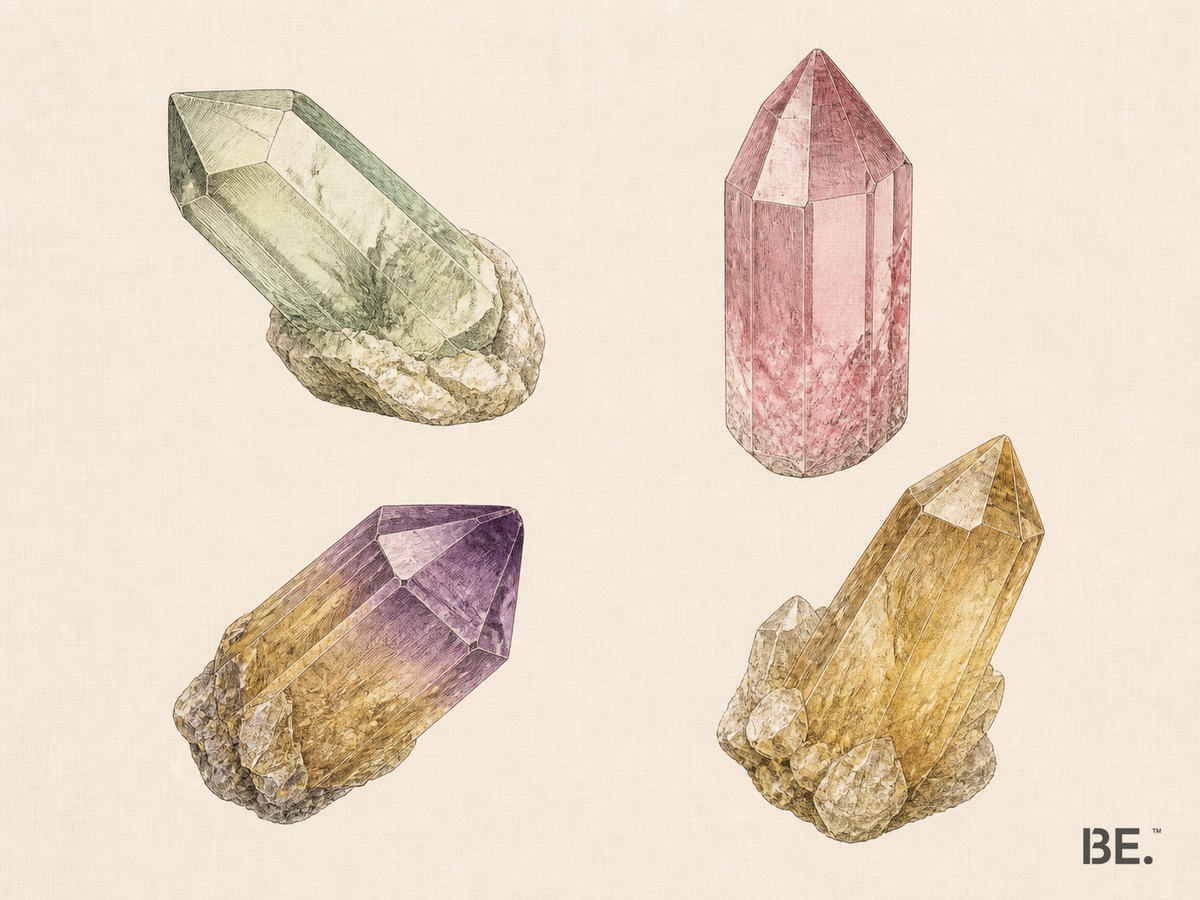
Why no single rarity ranking works
Three data problems appear immediately. First, names are not equivalent. Prasiolite is a colour variety, ametrine is a bicoloured quartz variety, and rutilated or phantom quartz describes internal material or growth structure. Second, gemstone production is fragmented and often reported without a consistent variety or quality threshold. Third, retail availability can be enlarged by treatment, accumulated stock and trade concentration.
The authoritative sources reviewed here do not provide a unified global dataset that resolves those problems. That is a search finding, not proof that no private or future dataset can exist. It means only that a precise global ordering is not supportable from the evidence used for this article.
The companion W4 explanation of why quartz is widespread supplies the opposite side of the same boundary: global abundance is not a specimen-quality grade. That concept remains plain text here until the companion article passes an ordinary Main, no-preview live check.
Five different questions hidden inside “rare”
| Evidence lane | What it measures | What it cannot prove |
|---|---|---|
| Natural-rarity wording | An authoritative source explicitly describes a naturally occurring material or form as rare. | Its exact position against a different material measured another way. |
| Commercial-source concentration | How narrowly present commercial supply is concentrated in a documented source. | Total natural abundance or future production. |
| Treatment substitution | How much market availability may come from treated material rather than the natural colour. | That treated material is inferior, deceptive or uncommon when disclosed. |
| Documented case | A verified occurrence of a specific inclusion, colour or structure. | Global frequency from one report. |
| Data confidence | Whether naming, locality, method and time period are clear enough to compare. | Missing production numbers. |
Four parallel evidence categories
Natural-rarity wording: prasiolite and euhedral pink quartz
Natural green quartz described as prasiolite is documented as very rare, while much green quartz in the market is produced through treatment. That supports a claim about natural colour occurrence and treatment substitution. It does not establish a universal position above every other quartz form.
GIA also distinguishes common massive rose quartz from transparent, euhedral pink quartz crystals, which are exceptionally rare as that specific crystal form. The adjective belongs to the transparent euhedral form, not to every bead sold as rose or pink quartz.
Commercial-source concentration: natural ametrine
GIA identifies Bolivia’s Anahí mine as the only commercial source of natural ametrine, while noting small non-commercial deposits elsewhere. This is strong evidence of commercial-source concentration. It does not show that ametrine is naturally less abundant than every material described as rare on another evidence lane.
Treatment substitution: natural citrine
Natural yellow quartz colours are rare, while much citrine in the market is heat-treated amethyst. That explains how a naturally scarce colour can remain easy to find in shops. Treatment is not the same as synthesis, and a disclosed heated citrine is still quartz; the relevant issue is whether the colour history is stated clearly. The dedicated guide explains why natural citrine is rarer than amethyst.
Documented cases: useful, but not rankable
GIA has documented Raman-confirmed prismatic dumortierite inclusions in rock crystal reported from Bahia. The report establishes identity for those examined samples. It does not provide a global occurrence rate. The material therefore belongs in a documented-case category, with the deeper inclusion discussion left to the Blue Needle Quartz guide.
Names that do not fit one list
| Name | Best treated as | Safe rarity language |
|---|---|---|
| Rutilated quartz | Quartz containing visible rutile inclusions; appearance and replaceability vary by lot. | Describe the inclusion pattern and lot, not a universal variety position. |
| Phantom quartz | A growth structure that preserves an earlier crystal surface or growth stage. | Describe the recorded structure; do not equate every phantom with rarity. |
| Blue Smoke Quartz | A market or descriptive name for an uncommon optical form of quartz whose mechanism requires sample-specific evidence. | “Uncommon optical form” or “trade description”; no global superlative. |
| Super Seven | A trade name whose claimed component scope can vary. | List verified components for the examined material; do not infer scarcity from the name. |
The Quartz Family Tree owns the wider taxonomy. This article owns only the evidence rules for rarity language.
Rarity, quality and value are separate
Rarity is not a quality grade. A more frequent material can still show exceptional transparency, colour distribution, inclusion legibility, polish and matching. A naturally scarce colour can occur in fractured, poorly cut or weakly disclosed material. Value adds further variables: size, condition, treatment, demand, provenance confidence, workmanship and the difficulty of replacing a matched lot.
Origin is also only one field. A concentrated source may matter to supply, but a country or mine name does not substitute for material identity, quality evidence or a responsible-sourcing assessment. The W4 Origins Map explains those geographic evidence levels.
How to read a rarity claim
- Check the name. Is it a recognised variety, an inclusion-bearing form, a growth structure, a locality label or a trade name?
- Ask what is scarce. Natural colour, commercial source, gem-quality yield, a specific appearance or one matched lot?
- Check the denominator. Does the source give production, documented localities or only a case report?
- Separate treatment from identity. Market abundance may reflect treated material; disclosed treatment does not erase the underlying quartz identity.
- Keep quality and value outside the shortcut. They require their own observations and evidence.
Frequently asked questions
Q1. Is there an official global list of rare quartz varieties?
No. The authoritative sources reviewed here do not supply one unified dataset with consistent names, production coverage and gem-quality thresholds. They support separate claims about natural rarity, commercial-source concentration, treatment substitution and documented cases.
Q2. Can natural prasiolite be placed above every other quartz variety?
No. Authoritative sources describe natural prasiolite as very rare, but that wording does not create a common denominator with commercial-source concentration, gem-quality yield or an isolated inclusion report. It should remain in its own evidence category.
Q3. Why is citrine common in shops if natural yellow quartz is rare?
Much market citrine is amethyst whose colour has been changed by heat. This expands supply without changing the fact that natural yellow quartz colours are rare. The treatment should be disclosed rather than treated as proof of poor quality.
Q4. Does natural ametrine occur only in Bolivia?
Bolivia’s Anahí mine is the only documented commercial source cited by GIA, but small non-commercial deposits have been reported elsewhere. “Only commercial source” is narrower than “only natural occurrence.”
Q5. Are rutilated and phantom quartz directly comparable as rare varieties?
Not without a defined material and evidence axis. Rutilated quartz is inclusion-bearing quartz, while phantom quartz describes a preserved growth structure. Their appearance and lot replaceability can be unusual, but those facts do not supply a shared global frequency.
Q6. Does rare quartz automatically have higher quality or value?
No. Quality depends on the relevant material features, condition, cutting, polish and disclosure. Value also reflects size, demand, workmanship, provenance confidence and lot replaceability. Rarity alone answers none of those questions.
References
- GIA — Ametrine History and Lore
- GIA — Is Bolivia the only commercial source of ametrine?
- GIA — Is citrine treated?
- GIA — The Quartz Formation at Green Ridge, Arizona
- GIA — Gems & Gemology, Fall 2010: natural green quartz review
- GIA — Rose Quartz Description
- GIA — Dumortierite in Rock Crystal Quartz
- CIBJO — The Blue Books
- Mindat — Quartz
- Mindat — Prasiolite
- USGS — Limits of estimating gemstone production
- GIA — Factors that interact to affect gem value
Field Notes.
One stone at a time: its geology, and how to read quality. The Stone Buying Checklist comes with your first email.
By subscribing you agree to receive emails from BE. Unsubscribe anytime.
Sent. Check your inbox.