
How to Wear a Crystal Bracelet with a Suit at the Office
A gender-neutral office styling guide that tests cuff clearance, controlled contrast and real contact points before pairing one mineral strand with a suit.
In this field note
A suit already has a structure: shoulder line, lapel, shirt cuff, watch and shoes all create a visual rhythm. A mineral strand can sit within that rhythm, but only if it works when the wearer moves. The useful question is not whether crystal jewellery is “professional” in the abstract. It is whether this particular bracelet fits this particular cuff, level of formality and working day.
Start with one strand and test the complete outfit. A workplace uniform, laboratory rule, food-safety policy or machinery restriction always overrides styling advice.
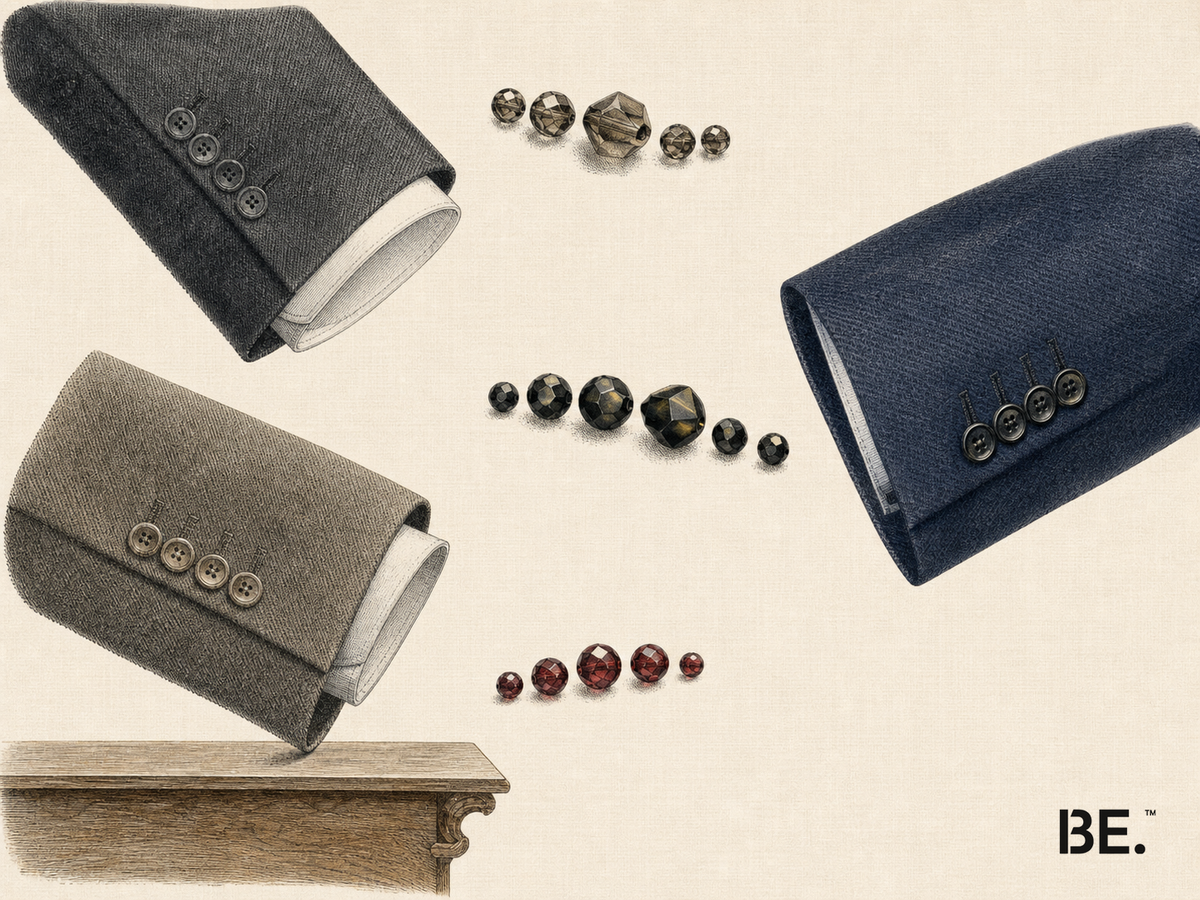
Test three office variables
Cuff clearance
Fasten the shirt cuff, place the bracelet where you intend to wear it, and perform three movements: rest both hands on a keyboard, raise the forearm as if checking the time, and reach forward as if taking a document. The cuff should close without being forced over the beads. The bracelet should not trap the fabric or slide so far that it interrupts the hand.
This is an actual-outfit test. Two shirts labelled with the same size can have different cuff openings, and a bracelet that sits cleanly under a relaxed cuff may crowd a closely cut one.
Controlled contrast
Contrast determines how much attention the bracelet claims. A stone close to the suit's value and temperature usually reads quietly; a bright, pale or strongly reflective material becomes a deliberate accent. Neither approach is inherently more professional. For a conservative office, begin near the suit's tonal range and let polish or internal structure provide the detail.
Contact with objects
Notice what the strand touches during a normal hour: watch case, metal bracelet, desk edge, laptop palm rest, mouse surface or stone countertop. Contact does not prove that damage will occur, but repeated hard contact is a reason to change wrist, create separation or remove the bracelet for that task. For detailed material and device risk, use the dedicated scratch guide and smartwatch guide.
Match the suit palette
The directions below are BE. editorial recommendations, not measured trend claims or universal office rules. Read “quiet” and “accent” as visual outcomes, not properties of the minerals.
| Suit palette | Editorial material direction | Visual result | Material caution |
|---|---|---|---|
| Charcoal or black | Smoky quartz for close tonal continuity; gold sheen obsidian for a controlled directional highlight. | Quiet from a distance; detail appears at the wrist. | Sheen changes with angle and lighting. It is not metallic gold. |
| Navy | Dark smoky brown or black volcanic glass. | Low-to-medium contrast without introducing a bright colour. | Judge the actual strand beside the fabric; photographs can shift colour temperature. |
| Brown, taupe or olive | Smoky quartz for continuity; muted gold sheen as a warmer accent. | Related earth tones with restrained reflection. | Do not describe visual warmth as a physiological effect. |
| Light grey | One dark strand as an intentional contrast. | More graphic and visible; keep the rest of the wrist simple. | A high-contrast strand will remain noticeable even at small scale. |
Let bead scale follow the tailoring
Fitted cuff
A close cuff leaves little volume for beads. Choose the lowest profile that still fits the wrist correctly, and check that the cuff can move over or stop cleanly beside the strand. If the bracelet repeatedly catches, changing the shirt, wrist or accessory is better than forcing the fabric.
Open cuff and relaxed tailoring
A wider opening can accommodate a more visible bead scale, but the desk test still matters. Extra room can also allow the strand to travel farther down the hand. Visual permission is not mechanical clearance.
Fit is not gender
Bead diameter is a question of fit, not gender. Wrist circumference, hand scale, strand length, bead diameter and cuff cut are the useful variables. Use the dedicated men's material and sizing guide or women's material-first guide when that context helps, but do not turn it into a rule.
When a watch or metal is on the same wrist
A suit often brings a watch, cufflinks or other metal into the composition. Keep this article's test simple: look for physical space, listen for repeated impact and check whether the stack moves into the hand while typing. Do not assume that a polished bead and a polished watch case are harmless to each other.
- For combination principles, use the bracelet layering guide.
- For metal colour and material pairing, use the gold and silver guide.
- For sensors, magnets and smartwatch construction, use the smartwatch guide.
- For contact and scratch mechanisms, use the device scratch guide.
If separation cannot be maintained, place the bracelet on the other wrist or wear only one object. The which-wrist guide owns the broader practical and cultural discussion.
Adapt to the working state
| Working state | Priority | Practical choice | Recheck |
|---|---|---|---|
| Desk-heavy day | Low movement and minimal surface contact. | One strand; test keyboard, mouse and desk edge for a full work block. | Noise, pressure marks, bead-to-device contact and drift into the hand. |
| Client or formal meeting | Controlled contrast and clean cuff line. | Choose the strand only after viewing it with the complete suit in ordinary room light. | Whether the sheen or colour becomes more prominent under meeting-room lighting. |
| Relaxed office | More visual freedom, same physical test. | A more visible bead scale or second piece may fit the setting. | Layering and contact rules still belong to their dedicated guides. |
This framework stops at the office. Commuting, airport security and travel storage involve different constraints and belong to their own guides.
Check the material before wearing
Natural-stone names do not all describe the same kind of material. Smoky quartz is a quartz variety; obsidian is natural volcanic glass, not black quartz. Their appearance and response to impact are therefore not interchangeable.
- Confirm identity and disclosure. Read the exact product description, treatment statement and lot-level evidence.
- Read durability correctly. Mohs hardness measures resistance to scratching, not the whole of durability. Toughness, stability, inclusions and construction also matter.
- Inspect the finished piece. Look at polish, surface-reaching features, drill holes, stringing and clasp before office wear.
- Test the actual day. Ten minutes in front of a mirror cannot reproduce hours at a keyboard. Begin with a short, low-risk wear period.
Frequently asked questions
Q1. Can you wear a crystal bracelet with a suit?
Yes, when the bracelet fits the cuff, the visual contrast suits the setting and it does not interfere with work. Begin with one low-profile strand and test the complete outfit while typing, raising the arm and fastening the cuff. Workplace policy always overrides styling advice.
Q2. What bead size fits under a shirt cuff?
No single bead size fits every shirt cuff; the answer depends on cuff opening, wrist circumference, strand length and bead profile. A closely cut cuff usually tolerates less volume than a relaxed one, but correct wrist fit remains essential.
Q3. What crystal bracelet works with navy or charcoal?
As a BE. editorial direction, smoky quartz creates close tonal continuity, while gold sheen obsidian adds a restrained directional highlight. Judge the actual strand beside the actual fabric in ordinary room light; this is styling guidance, not a universal dress-code fact.
Q4. Can I wear a crystal bracelet with a watch?
You can if the two pieces maintain space and do not repeatedly strike each other. Test the wrist through normal desk movements. For material contact, sensors and magnets, use the dedicated smartwatch and scratch guides rather than assuming compatibility.
Q5. Will a crystal bracelet scratch a laptop or watch?
Contact alone does not prove that scratching will occur, and hardness is not the only variable. Material identity, surface finish, trapped particles, force and repeated movement all matter. Use the dedicated scratch guide for the full risk assessment.
Q6. Is office styling different for men and women?
The same principles apply: fit the wrist, clear the cuff, control contrast and check contact. Wrist and hand scale, tailoring and personal style are more useful than rules such as “men wear dark stones” or “women wear small beads”.
Q7. Can I stack two bracelets with a suit?
Possibly, but establish one-strand clearance first. A second strand changes volume, movement, sound and contact points. Use the dedicated layering guide for compatibility and return to the cuff and desk tests with the full stack.
References
- Gemological Institute of America — More Than the Mohs Scale
- U.S. Geological Survey — Yellowstone's tool-making lava flows
- Gemological Institute of America — Ametrine and Smoky Quartz
- BE. Journal — Do Crystal Bracelets Scratch Watches, Phones or Screens?
- BE. Journal — Crystal Bracelets and Smartwatches
Field Notes.
One stone at a time: its geology, and how to read quality. The Stone Buying Checklist comes with your first email.
By subscribing you agree to receive emails from BE. Unsubscribe anytime.
Sent. Check your inbox.