
Summer Crystal Jewellery Guide: Travel, Airport & Care Index
A summer decision page for airport screening and secure packing, plus an index to BE.’s existing sunlight, sweat, water, sunscreen, sea and storage guides.
In this field note
Summer brings several jewellery questions into one journey: what happens at airport security, how a bracelet should be packed, and what changes when it meets sun, sweat, seawater, pool water or sunscreen. Those questions do not need one universal rule. They need the right authority for each decision.
This page adds the travel and airport layer, then points to BE.'s dedicated material-care guides. It does not recommend crystals for protection, luck or a promised travel outcome. The useful protection here is physical: secure packing, accurate rules and care matched to the material and construction.
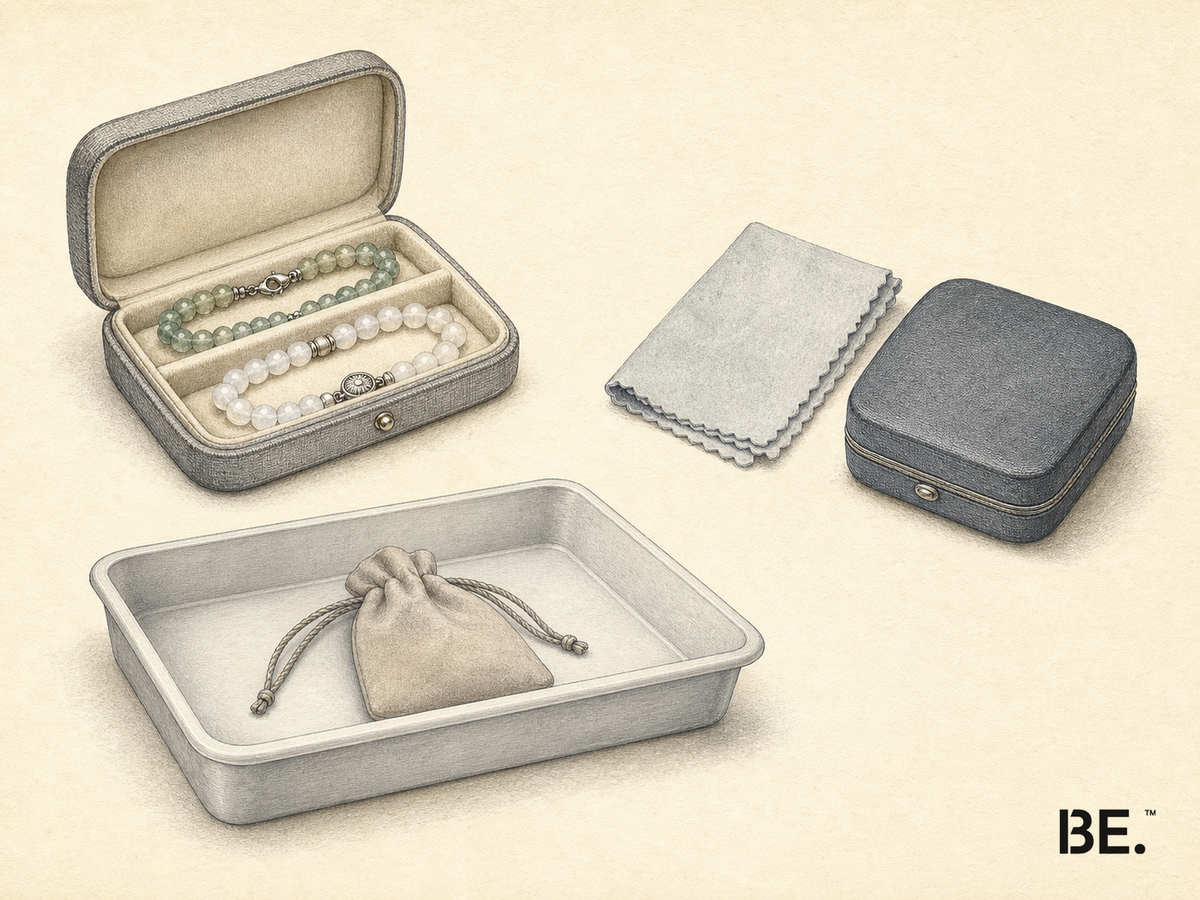
Airport security is not customs
Security screening decides whether an item and its presentation raise an aviation-security concern at the checkpoint. Customs addresses what enters a country, what must be declared and whether duties or other rules apply. Passing through a security lane does not answer a customs question.
This distinction matters most after a purchase abroad. A bracelet may be ordinary jewellery for screening and still be a purchase that must be declared on return. Check the customs authority for the country you are entering; do not use an airline security page as a declaration guide.
US, EU and UK checkpoint rules
| Jurisdiction | Official baseline checked 12 August 2026 | Practical reading |
|---|---|---|
| United States | TSA lists jewellery and rocks as permitted in carry-on and checked bags. Items may receive additional screening, and the final decision rests with the TSA officer. | Keep valuable jewellery with you, expect questions if an item alarms or obscures the view, and ask about private screening when appropriate. |
| European Union | European Commission passenger guidance tells travellers to remove metal items and notes that watches, belts and jewellery may need to go into a tray. | Prepare to remove the piece when instructed. Use a closed pouch rather than leaving it loose among tray contents. |
| United Kingdom | UK passenger guidance directs travellers to current departure-airport and airline information. | Check the airport you will actually use; do not assume a US or EU example describes every UK lane. |
| Other departures | Procedures and prohibited-item decisions are jurisdiction-specific. | Read the current airport, civil-aviation authority and airline guidance before leaving. |
No article can promise that a magnetic clasp, metal spacer or particular bead size will or will not trigger additional screening. Equipment, the complete object and local procedure vary. Follow the instruction given at the checkpoint rather than testing a universal claim.
Pack a bracelet without losing it
- Inspect before leaving. Check the cord, clasp, jump rings and bead holes. Travel is not the moment to discover an already weakened connection.
- Record the piece. A simple photograph and purchase record help identify it if a bag is opened or an item is misplaced.
- Use a closed soft case. A zipped jewellery case or closed pouch keeps beads from rubbing against keys, chargers and other jewellery.
- Keep valuables in carry-on. Put the closed case in a consistent inner pocket rather than checked baggage or a loose outer pocket.
- Prepare before the tray. If instructed to remove the bracelet, place it inside its case first. Do not leave a small piece loose under a coat or laptop.
- Count before walking away. Recheck the tray, case and wrist after screening.
For a valuable piece, TSA notes that private screening can be requested. Availability and procedure still depend on the checkpoint. Ask before placing the item into the general tray flow.
Loose stones and new purchases
TSA lists rocks as permitted in both carry-on and checked bags, subject to screening and the officer's decision. Pack loose pieces individually so they cannot strike one another, and keep them accessible if an officer needs a closer look. Other jurisdictions may classify or inspect them differently, particularly when size, shape, quantity or accompanying tools change the context.
New purchases create a second record. Keep the receipt and material description. US Customs and Border Protection, for example, requires travellers to declare articles acquired abroad on return. Allowances, duties and documentation depend on the destination or return country, so verify the current customs rule rather than assuming that “personal jewellery” always means “nothing to declare”.
Summer care index
Choose the exposure or care question below, then open the material guide for the detailed evidence and steps.
| Summer decision | Use this guide | What it covers |
|---|---|---|
| Sunlight and colour | Do crystals fade in sunlight? | Stone-specific evidence, treatment uncertainty and why one sunlight rule does not fit every material. |
| Gym, sweat, sauna and beach | Can you wear a crystal bracelet to the gym, sauna or beach? | Heat, impact, sweat, abrasion and setting-specific wear decisions. |
| Shower and water | Can I wear crystal jewellery in the shower? | Water exposure separated by material, treatment and construction. |
| Perfume, lotion and sunscreen | Do perfume, lotion and sunscreen damage crystal bracelets? | Residue, films and care around cosmetics rather than a universal chemical verdict. |
| Fast risk check | Crystal bracelet care and safety chart | A quick route when the material and exposure are already known. |
| Cleaning and daily wear | Crystal jewellery care guide | General cleaning, drying, handling and construction boundaries. |
| Storage | How to store crystal bracelets | Separation, scratch management, light and long-term storage. |
Before you leave and when you return
Before you leave
- Check the current departure-airport, civil-aviation authority and airline guidance.
- Inspect cord and clasp, photograph the piece, and place it in a closed soft case inside carry-on.
- Separate pieces so stones and metal fittings do not rub against one another.
- Save receipts and descriptions for jewellery or stones bought abroad.
When you return
- Follow the correct customs declaration route for the country you are entering.
- Inspect the cord, clasp and bead holes before the next wear.
- Use the relevant guide above for sunscreen, sweat, seawater or cleaning; do not apply one cleaning method to every stone.
- Let the piece dry fully where appropriate, then store it separately.
Frequently asked questions
Q1.Can I take crystal jewellery through airport security?
In the United States, TSA lists jewellery and rocks as permitted in carry-on and checked bags, subject to screening and the officer’s final decision. Other countries and airports may use different procedures, so check the departure authority before travel.
Q2.Should I wear a bracelet through security or put it in my bag?
Valuable jewellery is safer in a zipped pouch inside your carry-on. Bulky or metal pieces may need to be removed; follow the officer’s instructions and request private screening if appropriate.
Q3.Can loose crystals go in carry-on luggage?
TSA lists rocks as permitted, but they may still receive additional screening. Pack them securely, keep them accessible and check the rules for the country and airport you are using.
Q4.Will a magnetic clasp set off airport screening?
There is no reliable universal answer. Equipment, the amount and type of metal, and local procedures vary. Be ready to remove the piece if instructed.
Q5.Do I need to declare jewellery bought abroad?
Security and customs are separate. Declaration rules depend on where you enter and what you bought; US CBP, for example, requires travellers to declare purchases acquired abroad. Check the current customs authority for your destination or return country.
Q6.Where can I find the detailed summer care advice?
Use this article’s care index for the dedicated BE. guides on sunlight, sweat and the gym, beach and sea, showering and water, sunscreen and perfume, cleaning and storage.
References
- US Transportation Security Administration: Jewelry
- US Transportation Security Administration: Rocks
- US Transportation Security Administration: Travel Checklist
- US Transportation Security Administration: Travel Tips
- European Commission: Information for Air Travellers
- GOV.UK: Air Passenger Travel Guide
- US Customs and Border Protection: Declaring Purchases Made Abroad
- US Customs and Border Protection: Customs Duty Information
Field Notes.
One stone at a time: its geology, and how to read quality. The Stone Buying Checklist comes with your first email.
By subscribing you agree to receive emails from BE. Unsubscribe anytime.
Sent. Check your inbox.