
Matching Strands for Couples
Choose one shared visual rule, then size each bracelet separately. Matching strands need not be identical, gendered or assigned a crystal meaning.
In this field note
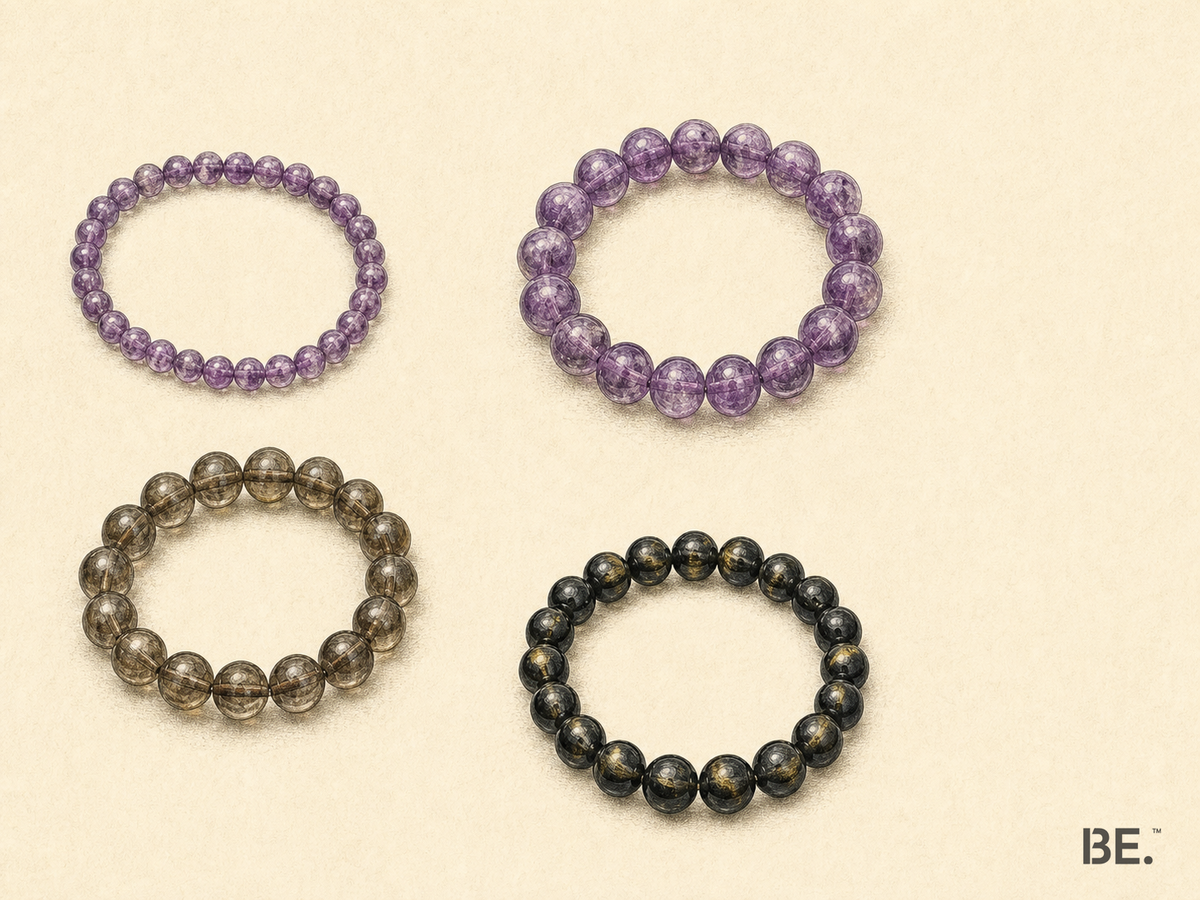
Start with two verified visual routes
A useful pair begins with one visible rule. Keeping the rule narrow makes room for two real wearers rather than forcing every detail to match.
Same material, different bead scale
The Bolivian Amethyst 6mm and 10mm Strand Bracelets keep the mineral and violet colour family consistent while changing visual rhythm. Six-millimetre beads make a finer, more continuous line around the wrist. Ten-millimetre beads create more individual bead presence and may feel heavier. Neither scale belongs to a gender, and neither is inherently more meaningful.
Treat the two product routes as separate exact items. Natural colour distribution, transparency and zoning can differ between bead selections and lots. Review current images, material and treatment disclosure, size variants and availability for both pieces rather than assuming that the bead diameter is their only difference.
Dark material contrast
Smoky quartz and gold sheen obsidian share a dark neutral field but remain different geological materials. Smoky quartz is crystalline quartz and can retain visible translucence. Obsidian is natural volcanic glass; the selected product carries a reflective gold sheen. The visual idea comes from dark depth read in two ways—light passing into quartz and light reflecting from glass.
This route works when both wearers already choose dark jewellery but do not need identical material. Judge each bracelet by its own surface, transparency, bead scale and care information. Do not assign quartz or obsidian according to gender stereotypes.
Two-route decision table
| Verified route | Shared visual rule | Each wearer decides independently | Exact product cards | Verify before ordering |
|---|---|---|---|---|
| Same material, different bead scale | Bolivian amethyst and violet quartz field | 6mm or 10mm presence, wrist size, preferred movement and exact natural variation | Bolivian Amethyst 6mm; Bolivian Amethyst 10mm | Current lot, treatment disclosure, size variant, weight, availability and returns |
| Dark material contrast | Dark neutral palette | Translucent crystalline quartz or reflective volcanic glass, wrist size and care routine | Smoky Quartz; Gold Sheen Obsidian | Current lot, bead scale, surface condition, size variant, availability and returns |
Size each bracelet for its own wearer
Do not label sizes “his” and “hers”. Measure both wrists and record each person’s preferred ease. Wrist circumference does not determine mineral or bead diameter. Use the current BE. size instructions for each exact product and choose only from the listed variants.
Comfort includes more than nominal length. A 10mm amethyst strand has greater visual mass than a 6mm strand and may feel more present during typing or beside a watch. Smoky quartz and obsidian can also differ in perceived depth, surface reflection and weight. The correct choice follows the wearer’s actual habits.
Read the material before the symbolism
Amethyst is violet quartz at Mohs 7. Colour strength, zoning, transparency, inclusions, polish and treatment disclosure are material questions; bead diameter is a design decision. Two amethyst bracelets need not show identical violet distribution to form a considered pair.
Smoky quartz is also quartz, while obsidian is volcanic glass. Their shared dark field should not erase that identity difference. Inspect smoky quartz for the transparency and internal features represented by its current lot. Inspect gold sheen obsidian for surface polish, chips and the way the sheen appears in movement. Follow the current care guidance for each product rather than assuming all dark stones behave alike.
Let natural variation remain visible
Natural-stone bracelets are related rather than mechanically duplicated. Colour zoning, transparency, inclusion density and bead-to-bead rhythm can vary between pieces. A current-lot image is more useful than an older campaign photograph when choosing a close visual relationship.
For the amethyst route, decide whether the goal is a similar violet range or a deliberate difference in depth. For the dark route, define the contrast clearly: translucent crystalline quartz against reflective volcanic glass. The relationship should be visible without claiming that the objects are exact copies.
Photograph both bracelets under the same diffuse light before judging how clearly the visual relationship reads. This controls one viewing condition, but it does not establish mineral identity, treatment, origin or exact colour equivalence.
Decide together or use a precise brief
Gift research suggests that recipients often value requested gifts and long-term usability more than givers predict. Choosing together is therefore a strong option. If the bracelets are a surprise, build the brief from observed facts: exact wrist size, jewellery already worn, preferred bead scale, daily routine and one of the two verified visual routes.
Before purchase, check both exact product pages for current variant availability, size, bead diameter, material and treatment disclosure, construction, care, delivery and returns. These are time-sensitive purchase facts.
Matching strands are listed in the BE. collection, and every strand ships with a Stone Origin Record that states its lot, its four Crystal 4T™ readings and what those readings do not claim.
Frequently asked questions
Q1. Do matching bracelets have to use the same stone?
No. The reviewed routes either repeat Bolivian amethyst at two bead scales or contrast smoky quartz with gold sheen obsidian. Both use a clear visual rule while allowing each wearer an individual piece.
Q2. What is the visual difference between 6mm and 10mm amethyst?
Six-millimetre beads create a finer, more continuous rhythm. Ten-millimetre beads give each bead more visual presence and may feel heavier. Choose by comfort and scale, not by gender.
Q3. Can a couple choose different bracelet sizes?
Yes. Measure each wrist and record each preferred fit separately. A shared material or palette does not require identical wrist measurements.
Q4. How do smoky quartz and gold sheen obsidian differ?
Smoky quartz is crystalline quartz that can remain translucent. Obsidian is natural volcanic glass, and this product shows reflective gold sheen. Their dark palette is related, while their material identity and optical behaviour remain different.
Q5. Will two natural-stone bracelets look exactly alike?
Usually not. Colour distribution, transparency, inclusions and bead-to-bead rhythm vary between pieces and lots. Review current product imagery and exact variants before purchase.
Q6. Do matching bracelets need a shared crystal meaning?
No. They can be chosen through mineral identity, colour, transparency, surface reflection, bead scale, craft and fit. No healing or relationship claim is needed.
References
Field Notes.
One stone at a time: its geology, and how to read quality. The Stone Buying Checklist comes with your first email.
By subscribing you agree to receive emails from BE. Unsubscribe anytime.
Sent. Check your inbox.