
Green Rutilated Quartz Guide: Actinolite, Rutile & the Evidence Boundary
A science-first guide to green rutilated quartz: why the trade name does not prove rutile, how actinolite/chlorite/phantom confusions differ, and what evidence a seller should show.
In this field note
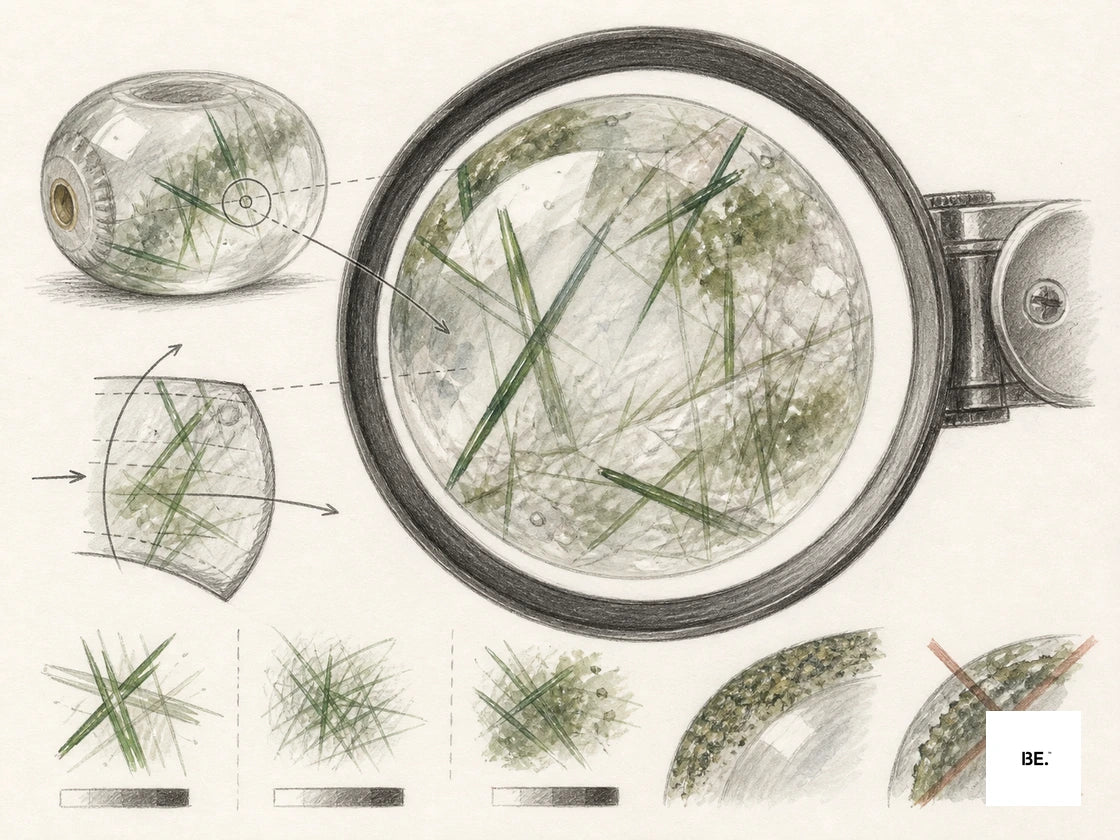
Green rutilated quartz sits in a difficult part of the jewellery trade: the name sounds precise, but the mineral identity is often less certain than the label suggests. Classic rutilated quartz means quartz with rutile needles. Green rutilated quartz is commonly used for a different visual object: transparent to translucent quartz carrying green lines, fibres, clouds or phantom-like layers.
That distinction matters. A buyer can love the material without letting the name overclaim. This guide treats green rutilated quartz as an evidence problem: what can be seen with the eye, what can be checked with a loupe, what laboratory methods can decide, and where a product card has to stop.
Quick answer
If a seller says green rutilated quartz, read it as a trade label unless they provide specimen-level testing. The reliable statement is: quartz host with green needle-like, fibrous, cloudy or phantom-style inclusions. The stronger statement, such as actinolite in quartz or rutile in quartz, needs evidence.
- Rutile is titanium dioxide, TiO2, and is the classic inclusion in rutilated quartz.
- Actinolite and ferro-actinolite are amphiboles; they can occur as green fibres or needles in quartz.
- Chlorite-bearing quartz often reads as green dusting, clouds, phantoms or coating rather than clean rigid needles.
- Dyed, coated, glass or composite material can imitate green quartz or green-included quartz and must be separated from natural included quartz.
Trade name vs mineral name
The phrase rutilated quartz has a mineral meaning when the inclusions are rutile. The phrase green rutilated quartz often has a looser market meaning: quartz with green hair-like or needle-like inclusions. Those two meanings overlap only when the green inclusions have been identified as rutile in that specimen.
This is why BE. keeps four layers separate: the commercial name, the quartz host, the visible inclusion habit, and the tested mineral identity. A bead can be honestly sold under a familiar trade name while the article explains that the needle identity is not guaranteed by colour or by name.
| Label | What it can mean | Evidence boundary |
|---|---|---|
| Rutilated quartz | Quartz with rutile needles | Strong only when the needles are identified as rutile, not merely hair-like. |
| Green rutilated quartz | Trade label for green needle or fibre inclusions in quartz | Does not prove rutile. Often needs actinolite/chlorite/epidote checks. |
| Actinolite quartz | Quartz with actinolite-family amphibole inclusions | Requires seller or lab evidence tied to the actual lot/specimen. |
| Green phantom quartz | Quartz preserving earlier green growth surfaces | Usually a growth-layer description; chlorite is common but not automatic. |
What the green needles might be
Green inclusions in quartz can come from several mineral habits. Long straight lines suggest an acicular or fibrous mineral. Softer clouds and dusted planes point toward chlorite-bearing or phantom material. A colour concentrated in cracks, drill holes or surface films points toward dye, coating or impregnation rather than a grown-in inclusion.
Rutile
Rutile is TiO2. It commonly appears as golden, red, brown, silver or dark needles in quartz. Green rutile is not impossible as a specimen-specific claim, but it is not the default conclusion from a green bead. A seller who uses the word rutile should be able to say how that identity was determined.
Actinolite and ferro-actinolite
Actinolite-family amphiboles can form green to dark-green fibres, blades and needle-like inclusions. The 2024 RSC Advances study of Huanggangliang material found Ca-Fe-rich amphiboles close to ferro-actinolite, with a few ferro-hornblende identifications. That is useful evidence for tested Inner Mongolia samples, not a licence to rename every market strand.
Chlorite-bearing quartz
Chlorite in quartz often reads as green dusting, mossy clouds, phantom layers or surface coatings. It is a separate material story from clean needle inclusions. A green phantom can be beautiful, but the word phantom describes a preserved growth stage, not automatically the mineral species.
Dyed, coated or glass material
Artificial green can enter quartz-like material through dye in fractures, coloured coating, assembled stones or glass. Red flags include identical beads, colour pooling around drill holes, surface film at edges, round bubbles, flow lines, or a colour that ignores the internal structure of the quartz.
Needle observation ladder
A good inspection moves from low-risk observation to higher-authority testing. The point is not to turn a buyer into a laboratory; it is to prevent a trade name from doing more work than it can support.
- Start with the host. Quartz should read glassy, hard and internally reflective. If the whole bead looks like coloured glass, stop before naming inclusions.
- Locate the green. Is it inside the host, on a surface, along cracks, around drill holes, or tracing an older growth plane?
- Read the habit. Straight needles, flat blades, soft clouds, flakes and coatings are different shapes and should not be collapsed into one word.
- Check bead-to-bead variation. Natural inclusion density varies. Perfect repetition across a strand is a warning sign.
- Ask for evidence. Lot notes, supplier disclosure, microscopy, Raman, FTIR or EPMA have different authority levels.
Common confusions
| Confusion | Why it happens | Safer wording |
|---|---|---|
| Green rutilated quartz vs actinolite quartz | Both can show green hair-like inclusions. | Green-included quartz unless the inclusion has been tested. |
| Green rutilated quartz vs green phantom quartz | Both are green inside quartz. | Needles/fibres for rutilated trade material; growth-layer outlines for phantom material. |
| Actinolite vs chlorite | Both are green and can occur with quartz. | Needle/blade amphibole vs cloudy, flaky, coating or phantom chlorite until tested. |
| Natural inclusion vs treatment | Dye can sit in cracks and imitate internal colour. | Describe the visible colour distribution and ask for disclosure. |
What a lab can decide
Laboratory testing can separate host and inclusion more cleanly than visual inspection. Raman spectroscopy can identify mineral phases in many accessible inclusions. FTIR can support quartz and treatment readings. EPMA can measure chemistry when a suitable surface or section is available. Microscopy still matters because the testing point must correspond to the visible green feature.
The article should not pretend that every bracelet needs destructive analysis. It should say something simpler: a seller may use a trade name, but the mineral claim becomes stronger only when the evidence is tied to the lot or specimen being sold.
Seller evidence checklist
- Minimum honest claim: natural quartz with green inclusions, if the seller can support natural host and untreated colour.
- Better claim: green included quartz with supplier disclosure of actinolite, chlorite, epidote or rutile, tied to the lot.
- Strong claim: specimen-level or lot-level lab evidence naming the inclusion mineral.
- Overclaim: saying rutile only because the product category says rutilated, or saying actinolite only because the inclusions are green.
BE.'s current first-party product record describes this lot as green rutilated quartz by trade name and discloses the green threads as actinolite rather than rutile. That disclosure is useful because it limits the claim. It does not turn every green rutilated quartz specimen in the market into actinolite, and it does not replace a specimen-specific lab report.
Frequently asked questions
Q1.Is green rutilated quartz actually rutile?
Not by name alone. Classic rutilated quartz is quartz with rutile, a titanium dioxide mineral. In much of the trade, green rutilated quartz is a visual name for quartz with green needle or fibre inclusions, often actinolite-family amphibole, chlorite, epidote or another green phase. Only testing can decide a specimen.
Q2.Can green colour prove the inclusions are actinolite?
No. Green supports an inclusion question; it does not prove actinolite and it does not exclude rutile in every specimen. The safe wording is quartz with green inclusions until the seller has specimen-level laboratory evidence.
Q3.What did the Inner Mongolia study prove?
It proved that the tested Huanggangliang samples contained Ca-Fe-rich amphibole inclusions close to ferro-actinolite, with a few ferro-hornblende identifications. That result belongs to those samples and should not be stretched to every bracelet sold as green rutilated quartz.
Q4.How can I inspect a bead before buying?
Use daylight and a 10x loupe. Look for whether the green material sits inside the quartz or only in cracks and drill holes, whether the needles vary from bead to bead, whether there are bubbles or flow lines, and whether the seller can state what evidence supports the inclusion name.
Q5.Is BE.'s Green Rutilated Quartz Bracelet described as rutile?
No. BE.'s current first-party Stone Origin Record says the green threads are actinolite, not rutile. That is a disclosure for this lot, not a laboratory upgrade for every market specimen.
Q6.Is green rutilated quartz suitable for daily wear?
The quartz host is Mohs 7, so polished beads can be worn daily with normal care. Avoid ultrasonic cleaning, hard knocks and rubbing against harder stones; exposed or surface-reaching green minerals can be more delicate than the quartz host.
References
- Zhao et al., RSC Advances — Gemological characteristics and inclusions of green rutilated quartz from Huanggangliang, Inner Mongolia
- Mindat — Quartz mineral data
- Mindat — Rutile mineral data
- Mindat — Actinolite mineral data
- Webmineral — Ferro-actinolite mineral data
- International Gem Society — Quartz value, price and jewellery information
- Rock Identifier — Chlorite on quartz identification guide
- BE. — Green Rutilated Quartz Bracelet product record
Field Notes.
One stone at a time: its geology, and how to read quality. The Stone Buying Checklist comes with your first email.
By subscribing you agree to receive emails from BE. Unsubscribe anytime.
Sent. Check your inbox.