
Green Phantom Quartz: Every Layer Is a Chapter
Green phantom quartz keeps earlier growth surfaces as visible internal layers. Learn how chlorite phantoms form and how to choose readable green phantom jewellery.
In this field note
Some phantom quartz contains one internal outline; other pieces show several nested green boundaries. This Field Note reads that visible sequence. For material definition, inclusion-identification limits, care and strand evaluation, see the green phantom quartz guide.
Chlorite, actinolite and repeated growth stages
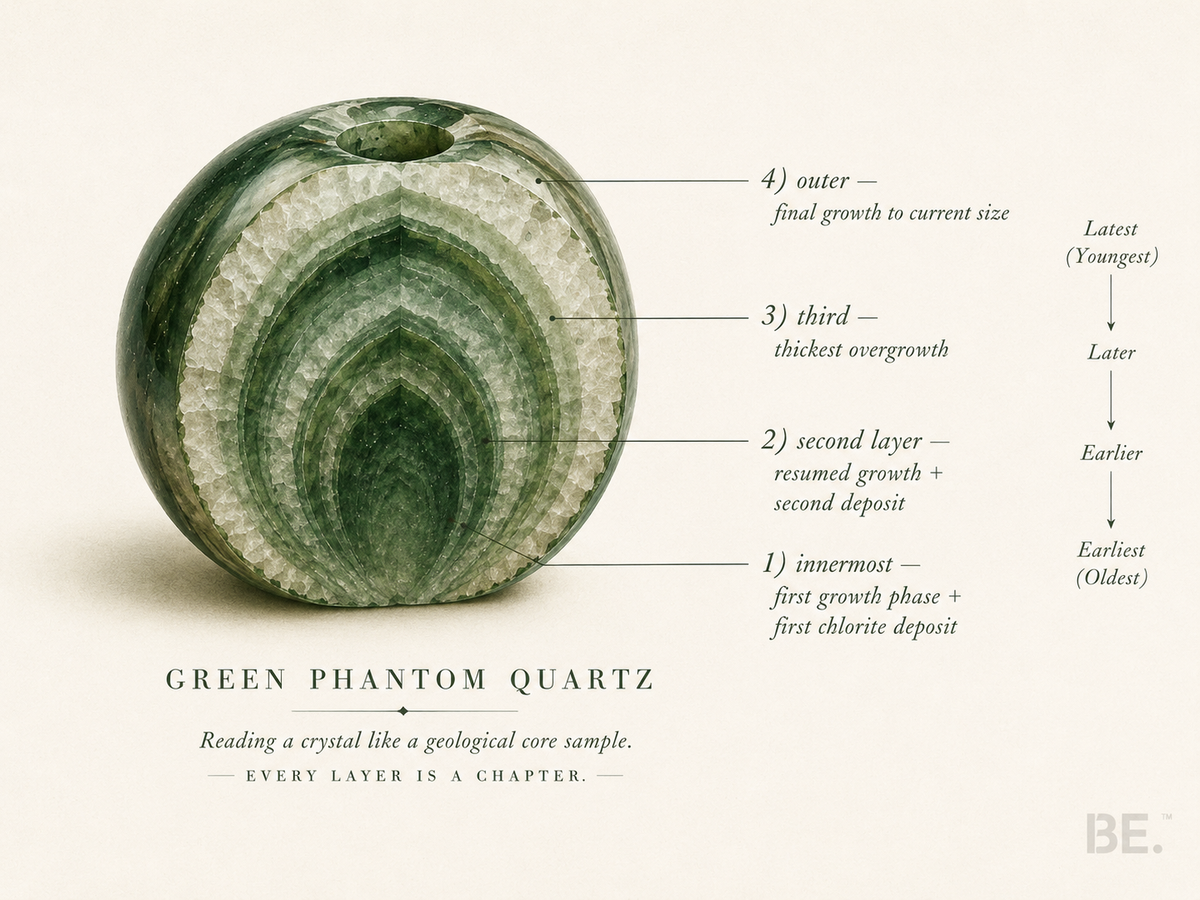
The mechanism begins with hydrothermal quartz growth. At some stage, secondary green minerals such as chlorite, an iron-magnesium phyllosilicate, or actinolite, a calcium-magnesium-iron inosilicate, can deposit on the exposed crystal surface. Quartz then grows over that layer and seals it inside. Growth may slow or pause while this happens, but a phantom does not prove that it stopped.
Several enclosed boundaries can preserve more than one earlier growth surface. Layer darkness may reflect inclusion species, thickness, density, cut and lighting; it does not directly measure pause duration.
Where layered phantoms form
Multi-layered phantom quartz occurs in hydrothermal settings capable of preserving more than one growth surface. A finished piece cannot prove a locality from appearance; source should come from independent documentation or a supplier lot record.
This is why the material can feel like a geological archive. The innermost phantom is the oldest visible growth stage; each outward layer is younger; the final outer quartz surface is simply the latest chapter. The layers show the order of growth. They do not show how long each stage took, and on their own they do not show how the chemistry, temperature or pressure of the fluid changed.
How green phantom differs from emerald phantom
In BE.’s strands the two names mark different inclusion minerals. Green phantom quartz carries clinochlore, a chlorite-group mineral; emerald phantom quartz carries fuchsite, a chromium-bearing mica. Neither name is a separate mineral species or a rarity grade, so neither sits above the other.
How to choose green phantom quartz
| Look for | Why it matters |
|---|---|
| Readable internal landscape | The green should feel embedded, not painted |
| Clear host window | Transparency lets the layers be seen |
| Distinct boundary or mountain form | Creates the visual identity of the stone |
| Balanced depth | Too much cloudiness can turn structure into mud |
Where BE. places it
Green phantom quartz can sit between The Prism and The Flow. The Prism side is visual complexity and internal movement. The Flow side is renewal, continuation and growth after interruption. The best piece depends on whether the stone should feel more scenic, more elegant or more internally alive.
For comparison with emerald phantom quartz, see Emerald Phantom Quartz: The Rarest Green Crystal Explained.
Frequently Asked Questions
What creates the layers in green phantom quartz?
Green minerals such as chlorite or actinolite settle on earlier quartz surfaces, and later quartz growth seals those layers inside. In BE.’s strands the green mineral is clinochlore, a member of the chlorite group.
Is green phantom quartz the same as emerald phantom quartz?
No. In BE.’s strands green phantom quartz carries clinochlore, a chlorite-group mineral, and emerald phantom quartz carries fuchsite, a chromium-bearing mica. Both names describe quartz with a green phantom; neither is a rarity grade.
What should buyers avoid?
Avoid material where the green looks flat, muddy or surface-like. The appeal is internal depth and readable sequence.
References
- The Quartz Page: Growth Forms, Phantom Quartz: mechanism overview for paused-growth phantoms.
- GIA Gems & Gemology: Phantom quartz imitation: gemmological note on layered phantoms.
- BE.: Our Story: the brand’s geology-first founding stance.
- BE. Crystal 4T Grading System: the four observable axes used to read a strand.
- BE. Geological Codex: material-level reference for the stones in the BE. catalogue.
Field Notes.
One stone at a time: its geology, and how to read quality. The Stone Buying Checklist comes with your first email.
By subscribing you agree to receive emails from BE. Unsubscribe anytime.
Sent. Check your inbox.